Full Text (PDF)
Community and Public Health Nursing 10(3):p 135-138, Sep - Dec. 2025. | DOI: https://doi.org/10.21088/cphn.2455.8621.10325.2
Original Article
Raising Women’s Knowledge and Awareness about Long-acting Reversible Contraceptives
Author Information
Licence:
Attribution-Non-commercial 4.0 International (CC BY-NC 4.0)This license enables reusers to distribute, remix, adapt, and build upon the material in any medium or format for noncommercial purposes only, and only so long as attribution is given to the creator.
Community and Public Health Nursing 10(3):p 135-138, Sep - Dec. 2025. | DOI: https://doi.org/10.21088/cphn.2455.8621.10325.2
How Cite This Article:
Devi US, Abisha MV. Raising Women’s Knowledge and Awareness about Long-acting Reversible Contraceptives. Community Pub Health Nurs. 2025;10(3):135-138.Timeline
Received : May 12, 2025
Accepted : July 10, 2025
Published : December 30, 2025
Abstract
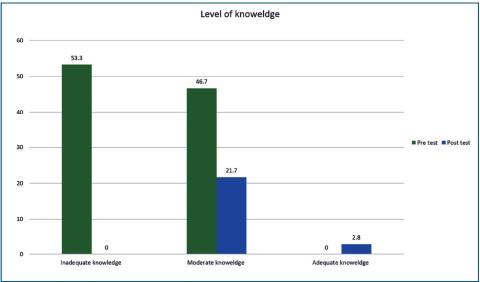
The total fertility rate (TFR) in Gujarat is 1.9 children per woman. High fertility is mainly attributed to the high unmet need for family planningrefers to the gap between women’s reproductive intentions and their actual use of family planning methods. It occurs when women who want to delay or avoid pregnancy are not using any form of contraception. It also includes information on men’s attitude towards women using a contraceptive method. This study aimed to assess Effectiveness of Planned Teaching Programme regarding raising women’s knowledge and awareness about Long-acting reversible contraceptives. The Pre experimental one group pre-test and post-test research design was conducted among rural women to evaluate the effectiveness of raising women’s knowledge and awareness about Long-actingreversible contraceptives. The researcher selected 60 samples based on non probity sampling technique. The results shown that the level of knowledge was improved after implementation of planned teaching, which indicates the planned teaching was effective. The researcher concluded that, the teaching aids will be helpful in improving the level of knowledge among rural women. The researcher recommended that, the community based education programme and personal behavior change education is required to save the women life and reduce the maternal morbidity and mortality in India. By prioritizing women’s education and empowerment, we can promote reproductive autonomy, improve health outcomes, and support women’s overall well-being.
References
- 1. PRB: World Population Data Sheet. Washington, DC; 2013:1–20.
- 2. Stover J., Ross J.: How increased contraceptive Use has reduced maternal mortality. Matern Child Health J 2010, 14(5):687–695.
- 3. UN: Contraceptive Commodities for Women’s Health, in Key Data and Findings. New York: 1–29.
- 4. UNFPA: United Nations High Level Meeting on Reproductive Health Commodity Security New York: United Nations; 2011: 1–40.
- 5. Espey E., Ogburn T.: Long-acting reversible contraceptives: intrauterine devices and the contraceptive implant. ObstetGynecol 2011, 117(3): 705–719.
- 6. Roberts A., Noyes J.: Contraception and women over 40 years of age: mixed-method systematic review. J AdvNurs 2009, 65(6): 1155–1170.
- 7. Dougherty A., Kayongo A., Deans A., Mundaka J, Nassali F., Sewanyana J, et al. (2018). Knowledge and use of family planning among men in rural Uganda. BMC Public Health 18: 1294.
- 8. Tsui A., McDonald-Mosley R., Burke A (2010). Family planning and the burden of unintended pregnancies. Epidemiol Rev 32: 152–174.
- 9. United Nation Population Fund (UNFPA). (2012). Costs and benefits of investing in contraceptive services in the developing world. UNFPA. Available at: https://www.unfpa. org/resources/costs-and-benefits-investingcontraceptive-services-developing-world. [Accessed on May 2019].
- 10. WHO (2010) The ABC’s of family planning. Available at: https://www.who.int/ pmnch/ media/news/2010/20100322_d_shaw_oped/ en/. [Accessed on 24 April 2019].
- 11. WHO (2019). 2019 family planning data sheet highlights family planning method around the world. Available at: https://www. prb.org/2019-familyplanning-data-sheethighlights-family-planning-method-usearound-theworld/. [Accessed on 25 July 2019].
- 12. World Economic Forum (2017). The global gender gap report. Available at: http:// www3. weforum.org/docs/WEF_GGGR_2017.pdf. [Accessed on April 2019].
- 13. Finer, L.B.; Jerman, J.; Kavanaugh, M.L. Changes in use of long-acting contraceptive methods in the United States, 2007–2009. Fert. Steril. 2012, 98, 893–897.
- 14. Bulto, G.A.; Zewdie, T.A.; Beyen, T.K. Demand for long acting and permanent contraceptive methods and associated factors among married women of reproductive age group in DebreMarkos Town, North West Ethiopia. BMC Women‘s Health 2014, 14.
- 15. Luchowski, A.T.; Anderson, B.L.; Power, M.L.; Raglan, G.B.; Espey, E.; Schulkin, J. Obstetrician-Gynecologists and contraception: Long-acting reversible contraception practices and education. Contraception 2014, 89, 578–583.
Data Sharing Statement
There are no additional data available. All raw data and code are available upon request.
Funding
This research received no funding.
Author Contributions
All authors contributed significantly to the work and approve its publication.
Ethics Declaration
This article does not involve any human or animal subjects, and therefore does not require ethics approval.
Acknowledgements
We would like to express our gratitude to the patients, their families, and all those who have contributed to this study.
Conflicts of Interest
No conflicts of interest.
About this article

Cite this article
Devi US, Abisha MV. Raising Women’s Knowledge and Awareness about Long-acting Reversible Contraceptives. Community Pub Health Nurs. 2025;10(3):135-138.
Licence:
Attribution-Non-commercial 4.0 International (CC BY-NC 4.0)This license enables reusers to distribute, remix, adapt, and build upon the material in any medium or format for noncommercial purposes only, and only so long as attribution is given to the creator.
| Received | Accepted | Published |
|---|---|---|
| May 12, 2025 | July 10, 2025 | December 30, 2025 |
DOI: https://doi.org/10.21088/cphn.2455.8621.10325.2
Keywords
KnowledgeReversible contraceptivesRural womenSearch for Similar Articles
Similar Articles
- A Study to assess the Impact of Structured Teaching Programme on Knowledge of Pl...
- Effectiveness of Nurse Led Intervention on Knowledge and Practice of Food Borne...
- Effectiveness of a Structured Teaching Programme on Knowledge, Attitude, and Pra...
- A Study to assess the Effectiveness of Video Assisted Teaching on Knowledge Rega...
- Effectiveness of Planned Teaching Programme on Knowledge and Skill Regarding BLS...
Article Level Metrics
Last UpdatedTuesday 29 September 2026, 13:45:56 (IST)
7593
Accesses
22
1522
00
Citations
NA
NA
NA
Download citation
Article Keywords
Keyword Highlighting
Highlight selected keywords in the article text.
Timeline
| Received | May 12, 2025 |
| Accepted | July 10, 2025 |
| Published | December 30, 2025 |
licence
Attribution-Non-commercial 4.0 International (CC BY-NC 4.0)
This license enables reusers to distribute, remix, adapt, and build upon the material in any medium or format for noncommercial purposes only, and only so long as attribution is given to the creator.