Full Text (PDF)
Community and Public Health Nursing 11(2):p 73-76, May-August 2026. | DOI: https://doi.org/10.21088/cphn.2455.8621.11226.3
Original Article
Effectiveness of Planned Teaching Programme on Knowledge and Skill Regarding BLS among B.Sc (N) I & II year Students at Selected Nursing College in Chennai
Gowri. R, Priya. C, Deepa S.P, Ciby Jose, Abirami P
Author Information
Licence:
Attribution-Non-commercial 4.0 International (CC BY-NC 4.0)This license
enables reusers to distribute, remix, adapt, and build upon the material in any
medium or format for noncommercial purposes only, and only so long as
attribution is given to the creator.
Community and Public Health Nursing 11(2):p 73-76, May-August 2026. | DOI: https://doi.org/10.21088/cphn.2455.8621.11226.3
How Cite This Article:
Gowri. R, Priya. C, Deepa. S.P et al. Effectiveness of planned teaching programme on knowledge and skill regarding BLS among B.SC (N) I & II year students at selected Nursing College in Chennai. Community Pub Health Nurs. 2026; 11(2): 73-76.Timeline
Received : December 19, 2025
Accepted : January 21, 2026
Published : August 30, 2026
Abstract
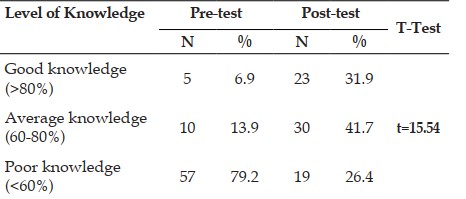
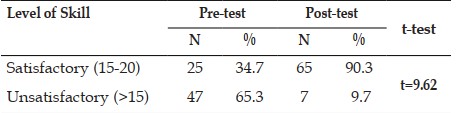
Background: Being at the heart of the health care delivery is an enormous challenge for nurses, but it is also a golden opportunity to save the life of the patient. A high level of knowledge and skill of CPR is expected for all nurses to save the life of the victims who had cardiac arrest.According to the American heart association estimated that in the world among the incidence of death due to cardiac arrest varies between 0.2 to 0.4 percent per year. WHO estimates that 60% of the world’s cardiac patients will be Indian by 2015 Cardiovascular disease related to deaths in India occur below the age group of below 70 compared with just 20% in the west. Aims and Objectives: 1. To assess the knowledge and skill regarding BLS among B.Sc(N) I & II year students. 2. To evaluate the effectiveness of planned teaching programme on knowledge and skill regarding BLS among B.Sc(N) students. 3. To find out the association between knowledge and skill among B.Sc (N) I & II year students with their selected demographic variables. Methodology: A quantitative research approach with a pre-experimental onegroup pre-test and post-test design was adopted. The study was conducted in venkateswara nursing college, Thalambur, Chennai, among 72 students among B.Sc(N) I&II year selected through non probability convenient sampling. Results: Significant improvement was observed in post-test scores (p < 0.05), indicating the effectiveness of the teaching module. Post-test knowledge levels showed a statistically significant difference in level of knowledge and skill on BLS. Conclusion: The findings suggest that a planned teaching programme significantly improves knowledge and skill among B.Sc (N) I&II year students. Implementing similar for other field of students,police man, fire workers.
References
- 1. American Heart Association Guidelines for Cpr & Emergency Cardiovascular Care Circulation. 2005; 112:Iv1-203.
- 2. Anil Kumar Parashar. Effective Planned Teaching Programme on Knowledge & Practice of Basic Life Support among Students in Mangalore. The Nursing Journal of India. February 2010-Feb, Vol. Ci No. 2.
- 3. Bakshah f (2010) Assessing the Need and Effect of Updating the Knowledge about CardioPulmonary Resuscitation in Experts, Journal of Clinical and Diagnostic Research. 4(3) 2511-14.
- 4. Benjamin s. Abella, He, Quality of Cardiopulmonary Resuscitation During in Hospital Cardiac Arrest. The Journal of American Medical Association. 2005 Jan 19; Vol.3: 293-98.
- 5. Bmy Cheung (2003) Knowledge of Cardiopulmonary Resuscitation among The Public in Hong Kong: Telephone Questionnaire Survey. Hong Kong Med j. 9(5). 323-28.
- 6. Dr. H. Shankar, “Effectiveness of CPR in Hospital Cardiac Arrest”, 2008. Volume 17, Number 5, Madurai Meenakshi Mission Medical Journal. Dr. Shantha Chandrasekaran and Team, Awareness of Basic Life Support in Vinuyaka Mission Medical College, Salem, 2010 March, Volume 54(2), Page No: 121-126, Indian Journal of Anaesthesia. Eisenberg Ms, Mengert t. j, Cardiac Resuscitation, n. Eng j Med 2002; 344:1034-13.
- 7. Hamilton r. (2005) Nurses’ Knowledge and Skill Retention Following Cardiopulmonary Resuscitation Training: A Review of the Literature. Journal of Advanced Nursing. 51(3) 288-97.
- 8. Kuhnigl H, Sefrin. P, Paulus T (1994) Skills and Self-Assessment in Cardiopulmonary Resuscitation of the Hospital Nursing Staff. European Journal of Emergency Medicine. 1(4) 193-8.
- 9. Lan H Kerridge, Sallie-Anne Pearson, Isobel E Rolfe And Michael Lowe, Decision Making i,n CPR: Attitudes of Hospital Patients And Healthcare Professional. The Medical Journal Of Australia. 1998; 169: 128-131.
- 10. Losert H. Quality of Cardiopulmonary Resuscitation Among Highly Trained Staff In An Emergency Department. Archives International Medicine. 2006 Nov 27; 166(21): 2375-80.
Data Sharing Statement
There are no additional data available. All raw data and code are available upon request.
Funding
This research received no funding.
Author Contributions
All authors contributed significantly to the work and approve its publication.
Ethics Declaration
This article does not involve any human or animal subjects, and therefore does not require ethics approval.
Acknowledgements
We would like to express our gratitude to the patients, their families, and all those who have contributed to this study.
Conflicts of Interest
No conflicts of interest in this work.
About this article

Cite this article
Gowri. R, Priya. C, Deepa. S.P et al. Effectiveness of planned teaching programme on knowledge and skill regarding BLS among B.SC (N) I & II year students at selected Nursing College in Chennai. Community Pub Health Nurs. 2026; 11(2): 73-76.
Licence:
Attribution-Non-commercial 4.0 International (CC BY-NC 4.0)This license
enables reusers to distribute, remix, adapt, and build upon the material in any
medium or format for noncommercial purposes only, and only so long as
attribution is given to the creator.
| Received | Accepted | Published |
|---|---|---|
| December 19, 2025 | January 21, 2026 | August 30, 2026 |
DOI: https://doi.org/10.21088/cphn.2455.8621.11226.3
Keywords
Basic Life SupportKnowledgeSkillB.Sc (N) StudentsEffectivenessStructured Teaching ProgrammeSearch for Similar Articles
Similar Articles
- Assess the Effectiveness of Strutctured Teaching Program on Knowledge Regarding...
- Assess the Effectiveness of Structured Teaching Program on Knowledge Regarding S...
- Health Monitoring in Community under NRHM
- A Descriptive Study to Assess the Knowledge of Adolescents Regarding Tobacco Smo...
- The Prevalence of Zinc Deficiency in Diabetic Subjects
Article Level Metrics
Last UpdatedFriday 23 October 2026, 02:50:27 (IST)
8098
Accesses
26
1691
00
Citations
NA
NA
NA
Download citation
Article Keywords
Keyword Highlighting
Highlight selected keywords in the article text.
Timeline
| Received | December 19, 2025 |
| Accepted | January 21, 2026 |
| Published | August 30, 2026 |
licence
Attribution-Non-commercial 4.0 International (CC BY-NC 4.0)
This license
enables reusers to distribute, remix, adapt, and build upon the material in any
medium or format for noncommercial purposes only, and only so long as
attribution is given to the creator.