Full Text (PDF)
Journal of Forensic Chemistry and Toxicology 9(2):p 93-100, July-December 2023. | DOI: http://dx.doi.org/10.21088/jfct.2454.9363.9223.3
Case Report
Postmortem Computed Tomography: A Supplant Technique to Autopsy for Firearm Injuries in the Head
Abhishek Yadav, Karthi Vignesh Raj K, Sudhir K Gupta, Zahid Ali CH, Gokul G., Manivel S
Author Information
Licence:
Attribution-Non-commercial 4.0 International (CC BY-NC 4.0)This license enables reusers to distribute, remix, adapt, and build upon the material in any medium or format for noncommercial purposes only, and only so long as attribution is given to the creator
Journal of Forensic Chemistry and Toxicology 9(2):p 93-100, July-December 2023. | DOI: http://dx.doi.org/10.21088/jfct.2454.9363.9223.3
How Cite This Article:
Raj KKV, Yadav A, Gupta SK, et al. Postmortem computed tomography (PMCT): a supplant technique to autopsy for firearm injuries in the head. J Forensic Chem Toxicol. 2023;9(2):93–100.Timeline
Received : July 10, 2023
Accepted : August 30, 2023
Published : December 12, 2023
Abstract
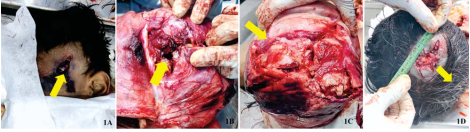
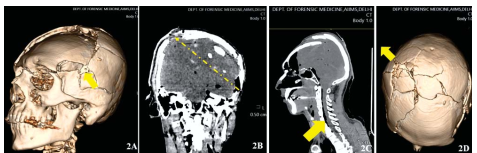
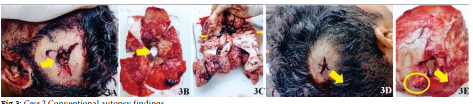
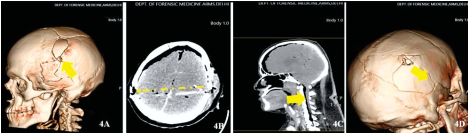
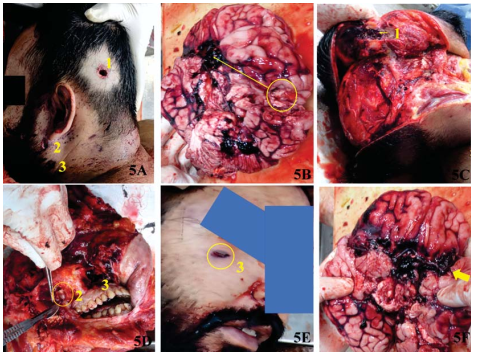
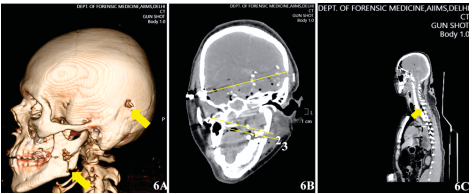
Background: Autopsy is more time consuming if the bullet/bullets are lodged at the difficult to access sites of the head especially maxillofacial regions. The procedure of suturing the deceased becomes even more difficult after the retrieval of bullets post dissection of facial tissues. The altered aesthetics psychologically and emotionally disturbs the already bereaved next of kin. The authors explored the utility of PMCT and propose a methodology of targeted dissection/minimally invasive approach to retrieve the bullet. The authors discussed the feasibility to conclude the cause of death in cases of single/multiple firearm injuries tothe head using PMCT alone. Methods: The authors evaluated three cases of firearm deaths at a distance lesser than close range to the head. The deceased was subjected to PMCT scanning using a 16 slice Multi-Slice CT spiral scanner and findings were analyzed using the Vitrea software v.6.9.1 with the slice thickness ranging from 0.5mm to 5mm. A routine conventional autopsy was conducted postscanning. Two of the three cases were suicide and succumbed to a single firearm injury while the third case was a homicide due to multiple firearm injuries. Conclusion: PMCT alone can beutilized and relied upon in deaths due to a single shot to the head and suggest a combined methodology of PMCT evaluation and minimally invasive approach in cases of multiple firearm injuries for better correlation of wound track. Lastly, PMCT helped in a targeted approach to reach the in situ bullets more precisely than any other radiological technique which upholds the humanitarian forensic aspect.
References
- 1. Kneubuehl BP (Ed), Coupland RM, Rothschild MA, Thali MJ. Wound Ballistics: Basics and Applications. In: Kneubuehl BP, ed. General wound ballistics. 3rd ed. Heidelberg: Springer; 2011:p 87.
- 2. Nolte KB, Taylor DG, Richmond JY. Biosafety considerations for autopsy. Am J Forensic Med Pathol. 2002;23(2):107–22.
- 3. DiMaio VJM. Gunshot wounds: practical aspects of firearms, ballistics, and forensic techniques, 3rded. Boca Raton, New York: CRC Press; 2016.
- 4. Dey A Sharma N, Yadav A, Prasad K, Gupta SK. Digital Virtual Autopsy: Need of the Hour in India. RFP IndJ Hosp Admin. 2019;3(1):21-4.
- 5. Yadav A, Gupta SK, Abilash S, Chandran V. NonInvasive/ Minimal Invasive Autopsy in Medicolegal Cases: A Need of the Hour and Future. Ind Police J. 2021;68(1):120-127.
- 6. Jalalzadeh H, Giannakopoulos GF, Berger FH, Fronczek J, Goot VDFRW, Reijnders UJ, et al. Post-mortem imaging compared with autopsy in trauma victims-systematic review. Forensic Sci Int. 2015;257:29–48.
- 7. Scholing M, Saltzherr TP, Fung Kon Jin PH, Ponsen KJ, Reitsma JB, Lameris JS, et al. The value of postmortem computed tomography as an alternative for autopsy in trauma victims: a systematic review. Eur Radiol. 2009;19(10):2333–41.
- 8. Ampanozi G, Halbheer D, Ebert LC, Thali MJ, Held U. Postmortem imaging findings and cause of death determination compared with autopsy: a systematic review of diagnostic test accuracy and meta-analysis. Int J Legal Med. 2020;134(1):321–37.
- 9. Raj KKV, Yadav A, Manivel S, Khan A, Gupta SK. Corpus Alienum captured in Postmortem Computed Tomography, death due to an accidental ingestion of “Momos (Dumpling)”. Forensic Imaging. 2022;29:200503.
- 10. Raj KKV, Yadav A, Gokul G, Ranjan A, Gupta SK. Post-mortem CT: A Useful Tool to Confirm a Case of Suspected Sudden Cardiac Death. Cureus. 2022;14(8):e28021.
- 11. Tartaglione T, Filograna L, Roiati S, Guglielmi G, Colosimo C, Bonomo L. Importance of 3D-CT imaging in single-bullet cranioencephalic gun shot wounds. Radiol Med. 2012;117(3):461–70.
- 12. Makhlouf F, Scolan V, Ferretti G, Stahl C, Paysant F. Gunshot fatalities: correlation between postmortem multi-slice computed tomography and autopsy findings: a 30-months retrospective study. Leg Med. 2013;15(3):145–8
- 13. Andenmatten MA, Thali MJ, Kneubuehl BP, Oesterhelweg L, Ross S, Spend love D, et al. Gunshot injuries detected by post-mortem Multislice computed tomography (MSCT): a feasibility study. Leg Med. 2008;10(6):287–92.
- 14. Elkhateeb SA, Mohammed EB, Meleka HA, Ismail AA. Postmortem computed tomography and autopsy for detection of lesions andcauses of death in gun shot injury cases:a comparative study. Egyp J Forensic Sci. 2018; 8(1):1-9.
Data Sharing Statement
There are no additional data available.
Funding
This research received no funding.
Author Contributions
All authors contributed significantly to the work and approve its publication.
Ethics Declaration
This article does not involve any human or animal subjects, and therefore does not require ethics approval
Acknowledgements
Information Not Provided
Conflicts of Interest
No conflicts of interest in this work.
About this article

Cite this article
Raj KKV, Yadav A, Gupta SK, et al. Postmortem computed tomography (PMCT): a supplant technique to autopsy for firearm injuries in the head. J Forensic Chem Toxicol. 2023;9(2):93–100.
Licence:
Attribution-Non-commercial 4.0 International (CC BY-NC 4.0)This license enables reusers to distribute, remix, adapt, and build upon the material in any medium or format for noncommercial purposes only, and only so long as attribution is given to the creator
| Received | Accepted | Published |
|---|---|---|
| July 10, 2023 | August 30, 2023 | December 12, 2023 |
DOI: http://dx.doi.org/10.21088/jfct.2454.9363.9223.3
Keywords
BulletsWound BallisticsPMCTAutopsyMinimal Invasive AutopsyHead InjurySearch for Similar Articles
Similar Articles
- Lethal Poisoning Cases: The Poisoning Cases of India: A Review Study
- Deciphering the Secrets of Magic Pen Inks: A Review
- From Effluents to Exposure: Wastewater-Based Epidemiology in Occupational and En...
- Sub Standard and Falsified Drugs Toxicity: An Alarming Concern of Today
- Detection and Identification of Kerosene in Turpentine Oil: A Review
Article Level Metrics
Last UpdatedSunday 16 August 2026, 09:00:41 (IST)
1119
Accesses
9
106
00
Citations
NA
NA
NA
Download citation
Article Keywords
Keyword Highlighting
Highlight selected keywords in the article text.
Timeline
| Received | July 10, 2023 |
| Accepted | August 30, 2023 |
| Published | December 12, 2023 |
licence
Attribution-Non-commercial 4.0 International (CC BY-NC 4.0)
This license enables reusers to distribute, remix, adapt, and build upon the material in any medium or format for noncommercial purposes only, and only so long as attribution is given to the creator