Full Text (PDF)
Indian Journal of Obstetrics and Gynecology 13(1):p 17-21, Jan-March 2025. | DOI: https://doi.org/10.21088/ijog.2321.1636.13125.3
Case Report
Post Partum Eclampsia Complicated with Posterior Reversible Encephalopathy Syndrome: A Case Study
Author Information
Licence:
Attribution-Non-commercial 4.0 International (CC BY-NC 4.0)This license enables reusers to distribute, remix, adapt, and build upon the material in any medium or format for noncommercial purposes only, and only so long as attribution is given to the creator
Indian Journal of Obstetrics and Gynecology 13(1):p 17-21, Jan-March 2025. | DOI: https://doi.org/10.21088/ijog.2321.1636.13125.3
How Cite This Article:
Shivani, Sunny. Post Partum Eclampsia complicated with Posterior Reversible Encephalopathy Syndrome: A case study. Indian J Obstet Gynecol. 2025;13(1):17-21.Timeline
Received : January 25, 2025
Accepted : March 21, 2025
Published : March 30, 2025
Abstract
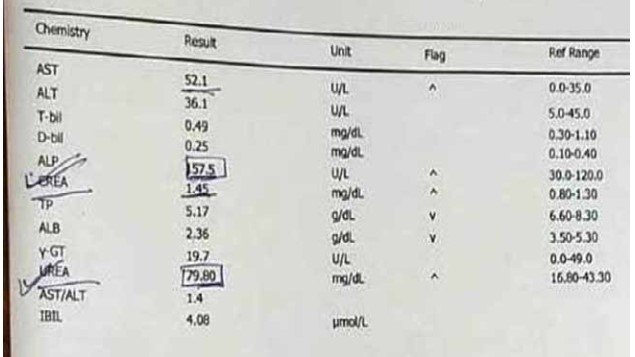
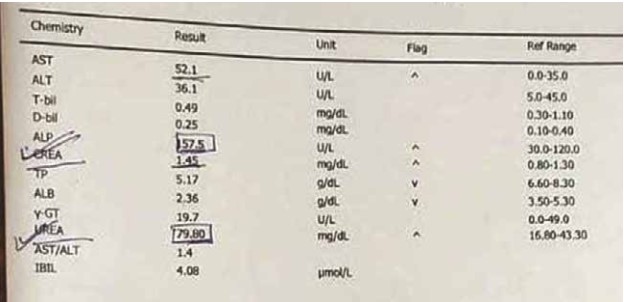
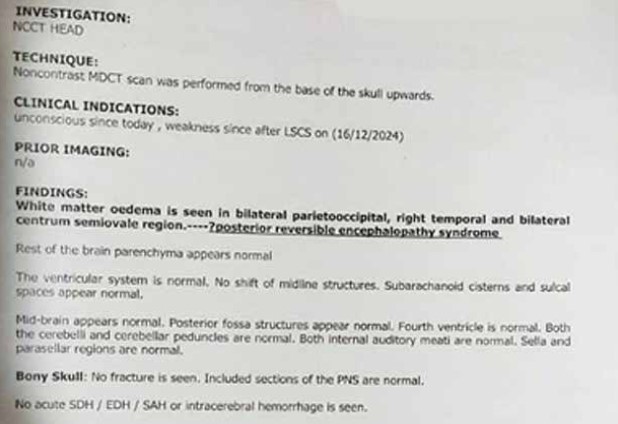
Background: Posterior reversible encephalopathy syndrome (PRES) is a rare but serious clinical neuroradiological entity characterized by headache, visual disturbances, vomiting, seizures, altered mental status and unconsciousness with characteristic imaging findings including sub-cortical vasogenic edema at the bilateral parietal and occipital lobes. Objective 1. To identify potential risk factors, signs and symptoms that can lead to PRES syndrome. 2. To promptly diagnose this condition with the help of imaging modalities so that timely treatment can be started. 3. This condition is to be kept in mind as a differential diagnosis in comatose patient of pregnancy with uncontrolled hypertension or history of convulsions (severe preeclampsia and eclampsia). 4. Explain importance of knowledge and communication among interprofessional team to enhance patient care and management with patient of PRES. Method: In this case study, we describe a case of 21 year old PRES patient with post partum eclampsia. The diagnosis of PRES was reached after report of CT brain. Conclusion: Inspite of treatment, the patient could not survive.Early diagnosis and aggressive treatment should be kept in mind for such patients.
References
- 1. Fugate JE, Rabinstein AA. Posterior reversible encephalopathy syndrome: clinical and radiological manifestations, pathophysiology, and outstanding questions. Lancet Neurol. 2015;14(9):914–925. doi: 10.1016/S1474-4422(15)00111-8. [DOI] [PubMed] [Google Scholar].
- 2. https://pmc.ncbi.nlm.nih.gov/articles/ PMC5533845/#CR1
- 3. Fischer M, Schmutzhard E. Posterior reversible encephalopathy syndrome. J Neurol. 2017 Aug;264 (8):1608-1616. [PMC free article] [Pub Med] [Reference list].
- 4. Fugate JE, Claassen DO, Cloft HJ, Kallmes DF, Kozak OS, Rabinstein AA. Posterior reversible encephalopathy syndrome: associated clinical and radiologic findings. Mayo Clin Proc. 2010 May;85(5):427-32. [PMC free article] [PubMed] [Reference list].
- 5. Akins PT, Axelrod Y, Silverthorn JW, Guppy K, Banerjee A, Hawk MW. Management and outcomes of malignant posterior reversible encephalopathy syndrome. Clin Neurol Neurosurg. (2014) 125:52–7. doi: 10.1016/j. clineuro.2014.06.034.
- 6. Bartynski WS. Posterior reversible encephalopathy syndrome, part 1: fundamental imaging and clinical features. AM J Nueroradiol 2008; 29(6):1036–42. [DOI] [PMC free article] [PubMed].
- 7. Chen Z, Zhang G, Lerner A, Wang AH, Gao B, Liu J. Risk factors for poor outcome in posterior reversible encephalopathy syndrome: systematic review and meta-analysis. Quant Imaging Med Surg 2018; 8(4):421–32. [DOI] [PMC free article] [PubMed].
- 8. Hutcheon JA, Lisonkova S, Joseph KS. Epidemiology of pre-eclampsia and the other hypertensive disorders of pregnancy. Best Pract Res Clin Obstetrics & Gynaecology 2011;25:391-403. [PubMed].
- 9. Sibai BM1, Stella CL. Diagnosis and management of atypical preeclampsiaeclampsia. Am J Obstet Gynecol.
- 10. Staykov D, Schwab S. Posterior reversible encephalopathy syndrome. J Intensive Care Med 2012;27:11-24. [PubMed].
- 11. McKinney AM, Short J, Truwit CL, McKinney ZJ, Kozak OS, SantaCruz KS, Teksam M. Posterior reversible encephalopathy syndrome: incidence of atypical regions of involvement and imaging findings. AJR Am J Roentgenol 2007;189:904- [PubMed].
- 12. Lamy C, Oppenheim C, Méder JF, Mas JL. Neuroimaging in posterior reversible encephalopathy syndrome. J Neuroimaging 2004;14:89-96. [PubMed].
- 13. Hinchey J, Chaves C, Appignani B, Breen J, Pao L, Wang A, Pessin MS, Lamy C, Mas JL, Caplan LR. A reversible posterior leukoencephalopathy syndrome. N Engl J Med 1996;334:494-500. [PubMed].
Data Sharing Statement
There are no additional data available. All raw data and code are available upon request.
Funding
This research received no funding.
Author Contributions
All authors contributed significantly to the work and approve its publication.
Ethics Declaration
This article does not involve any human or animal subjects, and therefore does not require ethics approval.
Acknowledgements
We would like to express our gratitude to the patients, their families, and all those who have contributed to this study.
Conflicts of Interest
No conflicts of interest in this work.
About this article

Cite this article
Shivani, Sunny. Post Partum Eclampsia complicated with Posterior Reversible Encephalopathy Syndrome: A case study. Indian J Obstet Gynecol. 2025;13(1):17-21.
Licence:
Attribution-Non-commercial 4.0 International (CC BY-NC 4.0)This license enables reusers to distribute, remix, adapt, and build upon the material in any medium or format for noncommercial purposes only, and only so long as attribution is given to the creator
| Received | Accepted | Published |
|---|---|---|
| January 25, 2025 | March 21, 2025 | March 30, 2025 |
DOI: https://doi.org/10.21088/ijog.2321.1636.13125.3
Keywords
PRES (posterior reversible encephalopathy syndrome)eclampsiaMental statusUnconsciousnessSearch for Similar Articles
Similar Articles
- Fibromyoma: A Clinical Dilemma
- Optimizing Obstetric Care: A Review of Indications and Outcomes for First-Time C...
- A Rare Case of Geriatric Endometrial Adenocarcinoma Presenting with Nonpuerperal...
- Relationship between Hypothyroidism and Gestational Diabetes Mellitus: A Prospec...
- Influence of Maternal Anthropometry and Hemoglobin on Neonatal Anthropometry
Article Level Metrics
Last UpdatedTuesday 08 September 2026, 16:19:32 (IST)
3505
Accesses
4
580
00
Citations
NA
NA
NA
Download citation
Article Keywords
Keyword Highlighting
Highlight selected keywords in the article text.
Timeline
| Received | January 25, 2025 |
| Accepted | March 21, 2025 |
| Published | March 30, 2025 |
licence
Attribution-Non-commercial 4.0 International (CC BY-NC 4.0)
This license enables reusers to distribute, remix, adapt, and build upon the material in any medium or format for noncommercial purposes only, and only so long as attribution is given to the creator