Full Text (PDF)
New Indian Journal of Surgery 16(3):p 123-126, July-September 2025. | DOI: 10.21088/nijs.0976.4747.16325.4
Case Report
Polyhexanide-Betaine Wound Gel in Skin Graft Donor Site Healing
Ravi Kumar Chittoria, Sriram V S, Amrutha J S
Author Information
Licence:
Attribution-Non-commercial 4.0 International (CC BY-NC 4.0)This license enables reusers to distribute, remix, adapt, and build upon the material in any medium or format for noncommercial purposes only, and only so long as attribution is given to the creator.
New Indian Journal of Surgery 16(3):p 123-126, July-September 2025. | DOI: 10.21088/nijs.0976.4747.16325.4
How Cite This Article:
S VS, Chittoria RK, Amrutha JS. Polyhexanide-Betaine Wound Gel in Skin Graft Donor Site Healing. New Indian J Surg. 2025;16(3):123-126.Timeline
Received : June 13, 2025
Accepted : July 13, 2025
Published : September 27, 2025
Abstract
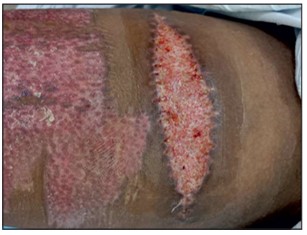
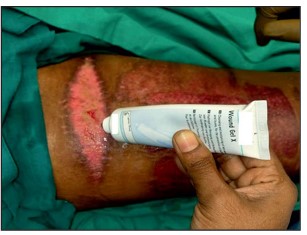
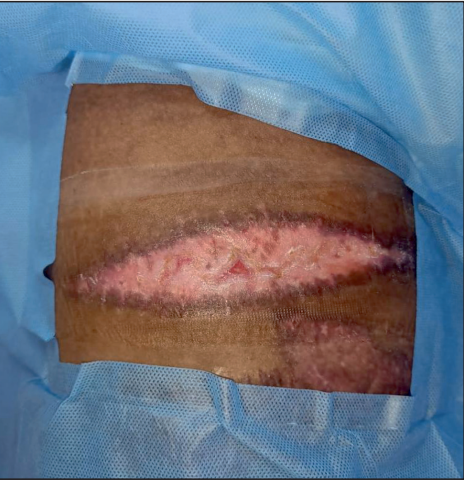
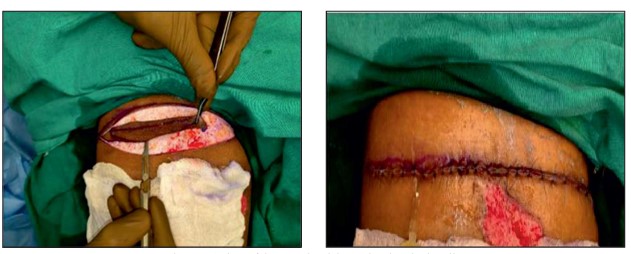
Donor site management is pivotal in overall grafting outcomes, emphasising rapid epithelialisation, minimal discomfort, and infection prevention. Polyhexanide and betaine preparations have shown promise in chronic wounds due to their antimicrobial and biofilm-disruptive properties. We report the case of a 24-yearold male who sustained 15% TBSA thermal burns and underwent full-thickness strip grafting following which the donor site wound dehisced. The graft donor site on the right lateral thigh was dressed with Polyhexanide (PHMB)-Betaine gel. The wound was dressed regularly, followed by periodic assessment. The wound demonstrated early re-epithelialization with minimal exudate, no signs of infection, and acceptable patient-reported pain scores. Complete healing was achieved by Post-operative day 14. This case highlights the potential utility of PHMB-betaine gel in donor site management, offering an effective balance of antimicrobial protection and tissue compatibility. Larger controlled studies are warranted to validate these findings further.
References
- 1. Yong E, Zhu X, Weng J, Ng MJM, Khoo YM, Lo ZJ. Role of therapeutic treatment with antiseptic solutions in the care of diabetic foot ulcers. J Wound Care. 2025;34:S4–13.
- 2. Babalska ZŁ, Korbecka-Paczkowska M, Karpiński TM. Wound Antiseptics and European Guidelines for Antiseptic Application in Wound Treatment. Pharm Basel Switz. 2021;14:1253.
- 3. Kaehn K. Polihexanide: a safe and highly effective biocide. Skin Pharmacol Physiol. 2010;23 Suppl:7–16.
- 4. Ikeda T, Ledwith A, Bamford CH, Hann RA. Interaction of a polymeric biguanide biocide with phospholipid membranes. Biochim Biophys Acta. 1984;769:57–66.
- 5. Dissemond J, Assadian O, Gerber V, Kingsley A, Kramer A, Leaper DJ, et al. Classification of wounds at risk and their antimicrobial treatment with polihexanide: a practiceoriented expert recommendation. Skin Pharmacol Physiol. 2011;24:245–55.
- 6. Salisbury AM, Mullin M, Chen R, Percival SL. Antibiofilm Efficacy of Polihexanide, Octenidine and Sodium Hypochlorite/ Hypochlorous Acid Based Wound Irrigation Solutions against Staphylococcus aureus, Pseudomonas aeruginosa and a Multispecies Biofilm. Adv Exp Med Biol. 2022;1369:53–67.
- 7. Andriessen AE, Eberlein T. Assessment of a wound cleansing solution in the treatment of problem wounds. Wounds Compend Clin Res Pract. 2008;20:171–5.
- 8. Ciprandi G, Ramsay S, Budkevich L, Strack A, van Capellen P, Marathovouniotis N. A retrospective systematic data review on the use of a polihexanide-containing product on burns in children. J Tissue Viability. 2018;27:244–8.
- 9. Oropallo A, Snyder RJ, Karpf A, Valencia D, Curtin CR, Cetnarowski W. Quality of life improvement in patients with hard-to-heal leg wounds treated with Prontosan wound irrigation solution and wound gel. J Wound Care. 2021;30:854–65.
Data Sharing Statement
There are no additional data available.
Funding
This research received no funding.
Author Contributions
All authors contributed significantly to the work and approve its publication.
Ethics Declaration
This article does not involve any human or animal subjects, and therefore does not require ethics approval.
Acknowledgements
Information not provide.
Conflicts of Interest
The authors report no conflicts of interest in this work.
About this article

Cite this article
S VS, Chittoria RK, Amrutha JS. Polyhexanide-Betaine Wound Gel in Skin Graft Donor Site Healing. New Indian J Surg. 2025;16(3):123-126.
Licence:
Attribution-Non-commercial 4.0 International (CC BY-NC 4.0)This license enables reusers to distribute, remix, adapt, and build upon the material in any medium or format for noncommercial purposes only, and only so long as attribution is given to the creator.
| Received | Accepted | Published |
|---|---|---|
| June 13, 2025 | July 13, 2025 | September 27, 2025 |
DOI: 10.21088/nijs.0976.4747.16325.4
Keywords
Donor Site HealingPolyhexanide-Betaine GelSkin GraftBurn Wound ManagementSearch for Similar Articles
Similar Articles
- Role of Autologous Platelet-Rich Plasma Spray in an Adult with Electrical Burns
- Laparoscopic Management of Large Right Adrenal Teratoma Adherent to Inferior Ven...
- Application of Haemoglobin Spray in Wound Healing in Scald Burns
- Robotic Inguinal Hernia Repair: A Review of Meta-Analyses Comparing Operative Ou...
- A Comparative Study Between Laser Hemorrhoidoplasty and Open Hemorrhoidectomy
Article Level Metrics
Last UpdatedWednesday 29 July 2026, 23:13:28 (IST)
3363
Accesses
21
295
00
Citations
NA
NA
NA
Download citation
Article Keywords
Keyword Highlighting
Highlight selected keywords in the article text.
Timeline
| Received | June 13, 2025 |
| Accepted | July 13, 2025 |
| Published | September 27, 2025 |
licence
Attribution-Non-commercial 4.0 International (CC BY-NC 4.0)
This license enables reusers to distribute, remix, adapt, and build upon the material in any medium or format for noncommercial purposes only, and only so long as attribution is given to the creator.