Full Text (PDF)
Indian Journal of Obstetrics and Gynecology 11(2):p 69-72, April-June 2023. | DOI: https://doi.org/10.21088/ijog.2321.1636.11223.3
Original Article
Perinatal Outcome in Twin Pregnancy According to Chorionicity
Lakshman H Rathod, Kiran Oswal
Author Information
Licence:
Attribution-Non-commercial 4.0 International (CC BY-NC 4.0)This license enables reusers to distribute, remix, adapt, and build upon the material in any medium or format for noncommercial purposes only, and only so long as attribution is given to the creator.
Indian Journal of Obstetrics and Gynecology 11(2):p 69-72, April-June 2023. | DOI: https://doi.org/10.21088/ijog.2321.1636.11223.3
How Cite This Article:
Kiran Oswal, Lakshman H Rathod/A perinatal Outcome in Twin Pregnancy According to Chorionicity/Indian J Obstet Gynecol. 2023;11(2):69–72.Timeline
Received : December 27, 2022
Accepted : January 29, 2023
Published : June 30, 2023
Abstract
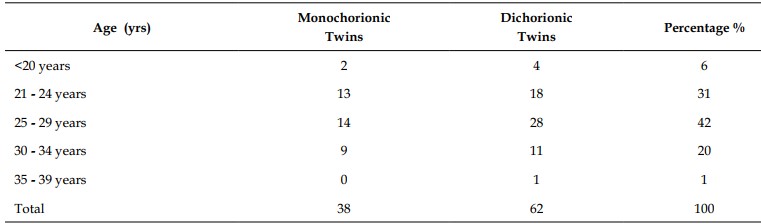
Background: Multiple pregnancy is defined as pregnancy with 2 or more fetuses. It is termed as twins for 2 fetuses, triplets for 3 fetuses, Quadruplets for 4 fetuses, Quintuplets for 5 fetuses, Sextuplets for 6 fetuses and Septuplets for 7 fetuses and so on. The incidence of multiple pregnancies varies significantly. In several overview studies (since the early 1970) it was found that natural twinning rates were less than 8 twin births per 1000 births in East Asia and Oceania, 9-16 per 1000 births in Europe, USA and India and 17 and more per 1000 births in African countries. Methods: This prospective observational study was conducted by the department of OBG at Sri muthukumaran medical college hospital and research institute, Shikkarayapuram, Chennai from December 2019 to May 2020. Results: Primigravidas constituted for 43% of pregnancies and multigravidas constituted for 57% of pregnancies. The maximum cases 42 (42%) were in the age of 25-29 yrs followed by 31(31%) in the age group 21-24 years. The mean age of the patients was 26.87 (SD 9.67) years. The discordant growth constituted for 12% of pregnancies in both monochorionic and dichorionic twins where as it was absent in 88% of cases.
References
- 1. Bulmer MG. The biology of twinning in man. Oxford: Oxford University Press; 1970.
- 2. Little J, Thompson B. Descriptive epidemiology. In: McGillivray I, Campbell DM, Thompson BJ, editors. Twinning and twins. New York: Wiley; 1988. p. 37–66.
- 3. Blickstein I, Keith LG. Multiple pregnancy, epidemiology, gestation and perinatal outcome. 2nd ed. London: Taylor and Francis; 2005.
- 4. Nylander PPS. Frequency of multiple births. In: Mc Gillivray I, Nylander PPS, Corney G, editors. Human multiple reproduction. London: Saunders; 1975. p. 87–97.
- 5. Nylander PPS. The phenomenon of twinning. In: Barron SL, Thompson AM, editors. Obstetrical epidemiology. London: Academic Press; 1983. p. 143–65.
- 6. Smits J, Monden C. Twinning across the developing world. PLoS One. 2011;6(9):e25239.
- 7. Su RN, Zhu WW, Wei YM, Wang C, Feng H, Lin L, et al. Maternal and neonatal outcomes in multiple pregnancies: A multicentre study in the Beijing population. Chronic Dis Transl Med. 2015;1(4):197–202.
- 8. Aslam S, Rashid Y. A comparative study between mono chorionic and dichorionic twins to assess the perinatal outcome. P J M H S. 2010;4(4):484–8.
- 9. Pant P, Patil Y, Patil SK. A retrospective study of maternal and fetal outcomes of twin pregnancy. Biomed Pharmacol J. 2022;15(1).
- 10. Dominigues et al. Chorionicity in twin pregnancies: impact upon perinatal results. Acta Obstet Ginecol Port. 2007;1(4):163–6.
- 11. Bellizzi S, Sobel H, Betran AP, Temmerman M. Early neonatal mortality in twin pregnancy: findings from 60 low- and middle-income countries. J Glob Health. 2018;8:010404.
Data Sharing Statement
There are no additional data available. All raw data and code are available upon request.
Funding
This research received no funding.
Author Contributions
All authors contributed significantly to the work and approve its publication.
Ethics Declaration
This article does not involve any human or animal subjects, and therefore does not require ethics approval.
Acknowledgements
We would like to express our gratitude to the patients, their families, and all those who have contributed to this study.
Conflicts of Interest
No conflicts of interest in this work.
About this article

Cite this article
Kiran Oswal, Lakshman H Rathod/A perinatal Outcome in Twin Pregnancy According to Chorionicity/Indian J Obstet Gynecol. 2023;11(2):69–72.
Licence:
Attribution-Non-commercial 4.0 International (CC BY-NC 4.0)This license enables reusers to distribute, remix, adapt, and build upon the material in any medium or format for noncommercial purposes only, and only so long as attribution is given to the creator.
| Received | Accepted | Published |
|---|---|---|
| December 27, 2022 | January 29, 2023 | June 30, 2023 |
DOI: https://doi.org/10.21088/ijog.2321.1636.11223.3
Keywords
Multiple pregnancyMonochorionictwinsDichorionic twinsMonochorionic twinsSearch for Similar Articles
Similar Articles
- Fibromyoma: A Clinical Dilemma
- Optimizing Obstetric Care: A Review of Indications and Outcomes for First-Time C...
- A Rare Case of Geriatric Endometrial Adenocarcinoma Presenting with Nonpuerperal...
- Relationship between Hypothyroidism and Gestational Diabetes Mellitus: A Prospec...
- Influence of Maternal Anthropometry and Hemoglobin on Neonatal Anthropometry
Article Level Metrics
Last UpdatedTuesday 08 September 2026, 16:22:33 (IST)
3505
Accesses
15
580
00
Citations
NA
NA
NA
Download citation
Article Keywords
Keyword Highlighting
Highlight selected keywords in the article text.
Timeline
| Received | December 27, 2022 |
| Accepted | January 29, 2023 |
| Published | June 30, 2023 |
licence
Attribution-Non-commercial 4.0 International (CC BY-NC 4.0)
This license enables reusers to distribute, remix, adapt, and build upon the material in any medium or format for noncommercial purposes only, and only so long as attribution is given to the creator.