Full Text (PDF)
Physiotherapy and Occupational Therapy Journal 19(4):p 278-286, Oct - Dec. 2026. | DOI: 10.21088/potj.0974.5777.19426.2
Original Article
Pain Self-Efficacy as a Predictor of Disability and Kinesiophobia in Adults with Chronic Low Back Pain: A Cross-Sectional Study.
Bid Dibyendunarayan Dhrubaprasad, Bhayani Vishva Jayantibhai, Savaliya Tanvi Hiteshbhai, Bhaliya Monika Kiritbhai, Pansuriya Vishva Jayantibhai
Author Information
Licence:
Attribution-Non-commercial 4.0 International (CC BY-NC 4.0)This license enables reusers to distribute, remix, adapt, and build upon the material in any medium or format for noncommercial purposes only, and only so long as attribution is given to the creator.
Physiotherapy and Occupational Therapy Journal 19(4):p 278-286, Oct - Dec. 2026. | DOI: 10.21088/potj.0974.5777.19426.2
How Cite This Article:
Bid Dibyendunarayan Dhrubaprasad, Bhayani Vishva Jayantibhai, Savaliya Tanvi Hiteshbhai, et al. Pain SelfEfficacy as a Predictor of Disability and Kinesiophobia in Adults with Chronic Low Back Pain: A Cross-Sectional Study. Therapy Jr. 2026; 19(4): 278-286.Timeline
Received : August 14, 2026
Accepted : September 19, 2026
Published : December 30, 2026
Abstract
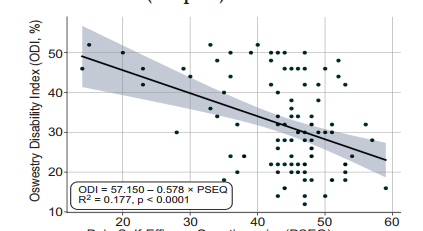
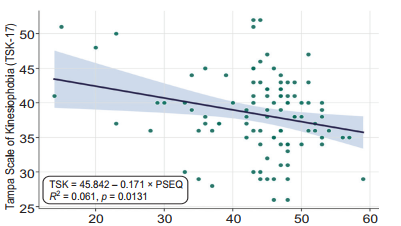
Background: Chronic low back pain (CLBP) is the leading cause of disability among working-age adults worldwide. Psychological factors, such as pain selfefficacy, rooted in Bandura's Social Cognitive Theory, increasingly shape outcomes alongside pain intensity and pathology. Objective: This study examined pain self-efficacy as a predictor of disability and kinesiophobia in adults with CLBP undergoing physiotherapy in Surat, Gujarat, India. Methods: A cross-sectional, correlational design recruited 100 adults aged 18-60 years with nonspecific CLBP lasting over 12 weeks and moderate-to-severe pain intensity. Gujarati-validated versions of the Pain Self-Efficacy Questionnaire (PSEQ), Oswestry Disability Index (ODI), and Tampa Scale of Kinesiophobia (TSK-17) were used to measure self-efficacy, disability, and kinesiophobia, respectively. Pearson's correlation and simple linear regression were used to test the relationships between self-efficacy and each outcome. Results: Self-efficacy correlated negatively with disability (r=-0.42, p<0.0001) and kinesiophobia (r=-0.25, p=0.013). In contrast, disability and kinesiophobia showed no significant correlation in this sample (r = 0.16, p=0.117). Self-efficacy significantly predicted disability, explaining 17.7% of its variance in a simple regression model (β=-0.578, p<0.0001). It predicted kinesiophobia more weakly, explaining 6.1% of the variance (β = -0.171, p=0.013).
References
- 1. Strelow B, O’Laughlin D, Anderson T, Cyriac J, Buzzard J, Klindworth A. Menopause Decoded: What’s Happening and How to Manage It. Journal of Primary Care & Community Health. 2024:2150(1):319
- 2. Davis SR, Pinkerton J, Santoro N, Simoncini T. Menopause—Biology, consequences, supportive care, and therapeutic options. Cell. 2023;186(19):4038-58
- 3. Prasad JB, Tyagi NK, Verma P. Age at menopause in India: A systematic review. Diabetes & Metabolic Syndrome: Clinical Research & Reviews. 2021;15(1):373-7.5.
- 4. D’souza CJ, Haripriya S, Krishna HS. The association between physical activity and menopause-related quality of life. International Journal of Therapy And Rehabilitation. 2021;28(5):1-1.
- 5. Guerrero-González C, Cueto-Ureña C, CantónHabas V, Ramírez Expósito MJ, Martínez Martos JM. Healthy aging in menopause: prevention of cognitive decline, depression and dementia through physical exercise. Physiologia. 2024;4(1):115-38.
- 6. Chen X, Wei K, Peng S, Liu N, He L, Wu B, Shi M, Lin Y. Association between physical activity and cognitive function in post-menopausal women with high parity: the chain mediating effects of nutritional status and depression. BMC Women’s Health. 2025;25(1):27.
- 7. Chia YC, Low EN, The JK, Chew J, Thanaraju A, Lim WG, Vafa S, Jenkins MJ. Association between physical activity and cognitive function in a multiethnic Asian older adult population. Scientific Reports. 2025;15(1):7249.
- 8. Chhabra R, Desai M, Kumar A. Determination of Agility in Elderly using Assistive Device by 8 Foot Up and Go Test. Journal of the Indian Academy of Geriatrics. 2018;14(1):26- 30.
- 9. Barati M, Akbari-Heidari H, Samadi-Yaghin E, Jenabi E, Jormand H, Kamyari N. The factors associated with the quality of life among postmenopausal women. BMC women’s health. 2021;21(1):208.
- 10. Tsekoura M, Dimitriadis Z, Gridelas A, Sakellaropoulou A, Kolokithas G. The Relationship between Physical Activity and Quality of Life in Postmenopausal Women: A Cross-Sectional Study. In Healthcare 2024; 12(19):1963. MDPI
- 11. Pathak N, Shivaswamy MS. Prevalence of menopausal symptoms among postmenopausal women of urban Belagavi, Karnataka. Indian Journal of Health Sciences and Biomedical Research KLEU. 2018;11(1):77-80
- 12. Pokorski M, Alberski M. Physical activity and cognitive function in postmenopausal women. Management & Education/Upravlenie i Obrazovanie. 2023;19(6).
- 13. Wang J, Hong JT, Xiang Y, Zhang C. Do the dual-task “8-foot up and go” tests provide additional predictive value for early detection of cognitive decline in communitydwelling older women?. Aging Clinical and Experimental Research. 2022;34(10):2431-9.
- 14. Rodrigues F, Monteiro AM, Forte P, Morouço P. Effects of muscle strength, agility, and fear of falling on risk of falling in older adults. International journal of environmental research and public health. 2023;20(6):4945.
- 15. Felipe J, Viezel J, Reis AD, da Costa Barros EA, De Paulo TR, Neves LM, Júnior IF. Relationship of different intensities of physical activity and quality of life in postmenopausal women. Health and quality of life outcomes. 2020;18(1):123.276 POTJ / Volume 19 Number 4 / October - December 2026 Physiotherapy and Occupational Therapy Journal
- 16. De Sousa WG, Margato LR, Pelet DC, de Paula RF, de Souza Lino AD, Orsatti FL, Souza MV. Association between physical and cognitive function in post menopause: a cross sectional study. Revista Brasileira de Atividade Física & Saúde. 2022;27:1-8.
- 17. Anderson D, Seib C, Rasmussen L. Can physical activity prevent physical and cognitive decline in postmenopausal women?: A systematic review of the literature. Maturitas. 2014;79(1):14-33. 13
- 18. Donat Tuna H, Ozcan Edeer A, Malkoc M, Aksakoglu G. Effect of age and physical activity level on functional fitness in older adults. European review of aging and physical activity. 2009;6:99-106.
- 19. Hallage T, Krause MP, Haile L, Miculis CP, Nagle EF, Reis RS, Da Silva SG. The effects of 12 weeks of step aerobics training on functional fitness of elderly women. The Journal of Strength & Conditioning Research. 2010;24(8):2261-6.
- 20. Galán-Arroyo C, Pereira-Payo D, HernándezMocholí MA, MerellanoNavarro E, Pérez Gómez J, Rojo-Ramos J, Adsuar JC. Association between agility, health-related quality of life, depression, and anthropometric variables in physically active older adult women with depression. InHealthcare 2022;10(1):100. MDPI
- 21. Latorre-Rojas EJ, Prat-Subirana JA, PeirauTerés X, Mas-Alòs S, BeltránGarrido JV, PlanasAnzano A. Determination of functional fitness age in women aged 50 and older. Journal of sport and health science. 2019;8(3):267-72
- 22. Guna, I.W.A.W.; Andayani, N.L.N.A.; Artini, I.G.A.A.; Putra, I.P.Y.P. The Relationship between Physical Activity Levels and Quality of Life in Menopausal Women. Fisiomu 2024;5:162–168.
- 23. Felipe, J.; Viezel, J.; Reis, A.D.; da Costa Barros, E.A.; Paulo, T.; Neves, L.M.; Freitas Junior, I.F. Relationship of different intensities of physical activity and quality of life in postmenopausal women. Health Qual. Life Outcomes 2020;18:123.
- 24. Daley, A.; MacArthur, C.; Mutrie, N.; Stokes-Lampard, H. Exercise for vasomotor menopausal symptoms. Cochrane Database Syst.Rev. 2007;4:CD006108.
- 25. Ferreira Freitas R, Santos Brant Rocha J, Ives Santos L, de Carvalho Braule Pinto AL, Rodrigues Moreira MH, Piana Santos Lima de Oliveira F, Marques MS, Souza Guerra Júnior GE, de Oliveira Silva Guerra KD, Araújo Drummond AM, Villas Boas Spelta JV. Validity and precision of the International Physical Activity Questionnaire for climacteric women using computational intelligence techniques. PLoS One. 2021;16(1):e0245240.
- 26. Papathanasiou, G.; Georgoudis, G.; Papandreou, M.; Spyropoulos, P.; Georgakopoulos, D.; Kalfakakou, V.; Evangelou, A Reliability measures of the short International Physical Activity Questionnaire (IPAQ) in Greek young adults. Hell. J. Cardiol.2009;50:283–294.
- 27. Papathanasiou, G.; Georgoudis, G.; Georgakopoulos, D.; Katsouras, C.; Kalfakakou, V.; Evangelou, A. Criterion-related validity of the short International Physical Activity Questionnaire against exercise capacity in young adults. Eur. J. Cardiovasc. Prev. Rehabil.2010;17:380–386.
- 28. Freitas S, Simoes MR, Marôco J, Alves L, Santana I. Construct validity of the montreal cognitive assessment (MoCA). Journal of the International Neuropsychological Society. 2012;(2):242-50
- 29. Bruijnen CJ, Dijkstra BA, Walvoort SJ, Budy MJ, Beurmanjer H, De Jong CA, Kessels RP. Psychometric properties of the Montreal Cognitive Assessment (MoCA) in healthy participants aged 18–70. International journal of psychiatry in clinical practice. 2020;24(3):293-300.
- 30. Haldar A, Singh S, Kar SK, Singh R, Yadav S. Study of cognitive functions and heart rate variability in reproductive-age group and post-menopausal women. Indian Journal of Psychiatry. 2026;68(2):132-6.
- 31. Reneker JC. Validity of the 8-foot up and go, timed up and go, and activities specific balance confidence scale in older adults with and without cognitive impairment. Journal of Rehabilitation Research and Development. 2016;53(4):511.
- 32. Beura S, Patnaik L, Sahu M. Translation, reliability, and validity test of Odia version of menopause-specific quality of life questionnaire among postmenopausal women for menopausal symptoms. Journal of mid-life health. 2022;13(2):121-6.
- 33. Jenabi E, Shobeiri F, Hazavehei SM, Roshanaei G. Assessment of questionnaire measuring quality of life in menopausal women: a systematic review. Oman medical journal. 2015;30(3):151.
- 34. Dalal PK, Agarwal M. Postmenopausal syndrome. Indian journal of psychiatry. 2015;57(2):222-32.277 POTJ / Volume 19 Number 4 / October - December 2026 Samuel Sanjay Eapen, Khandige Ganesh Kumar, Rosa V T. Correlation of Physical Activity with Cognitive Function, Agility and Quality of Life among Post-menopausal women: A Pilot Study
- 35. Stelmach M. Physical activity assessment tools in monitoring physical activity: the Global Physical Activity Questionnaire (GPAQ), the International Physical Activity Questionnaire (IPAQ) or accelerometers–choosing the best tools. Health Problems of Civilization. 2018;12(1):57-63.
- 36. Maduro PA, Carvalho LP, Maduro LA, Rodrigues AB, Rocha AS, Matos LR, Nascimento MD, Bavaresco Gambassi B, Schwingel PA. Accuracy of the mini-mental state examination and montreal cognitive assessment in detecting cognitive impairment in older adults: A comparative study adjusted for educational level. NeuroSci. 2025;6(3):86.
- 37. Yahia A, Yangui N, Mallek A, Ghroubi S, Elleuch MH. Kinesiophobia, functional disability and physical deconditioning evaluation in chronic low back pain. Annals of Physical and Rehabilitation Medicine. 2017;60:e19-e20.
- 38. Leeuw M, Goossens ME, Linton SJ, Crombez G, Boersma K, Vlaeyen JW. The fear-avoidance model of musculoskeletal pain: current state of scientific evidence. J Behav Med. 2007;30(1):77- 94.
- 39. Alaca N, Kaba H, Atalay A. Associations between the severity of disability level and fear of movement and pain beliefs in patients with chronic low back pain. Journal of back and musculoskeletal rehabilitation. 2020;33(5):785- 91.
- 40. Waddell G. 1987 Volvo award in clinical sciences. A new clinical model for the treatment of low-back pain. Spine. 1987;12(7):632-44.
- 41. Main CJ, George SZ. Psychologically informed practice for management of low back pain: future directions in practice and research. Physical therapy. 2011;91(5):820-4.
- 42. Nicholas MK, George SZ. Psychologically informed interventions for low back pain: an update for physical therapists. Physical therapy. 2011;91(5):765-76.
Data Sharing Statement
There are no additional data available. All raw data and code are available upon request.
Funding
This research received no funding.
Author Contributions
All authors contributed significantly to the work and approve its publication.
Ethics Declaration
This article does not involve any human or animal subjects, and therefore does not require ethics approval.
Acknowledgements
We would like to express our gratitude to the patients, their families, and all those who have contributed to this study.
Conflicts of Interest
No conflicts of interest in this work.
About this article

Cite this article
Bid Dibyendunarayan Dhrubaprasad, Bhayani Vishva Jayantibhai, Savaliya Tanvi Hiteshbhai, et al. Pain SelfEfficacy as a Predictor of Disability and Kinesiophobia in Adults with Chronic Low Back Pain: A Cross-Sectional Study. Therapy Jr. 2026; 19(4): 278-286.
Licence:
Attribution-Non-commercial 4.0 International (CC BY-NC 4.0)This license enables reusers to distribute, remix, adapt, and build upon the material in any medium or format for noncommercial purposes only, and only so long as attribution is given to the creator.
| Received | Accepted | Published |
|---|---|---|
| August 14, 2026 | September 19, 2026 | December 30, 2026 |
DOI: 10.21088/potj.0974.5777.19426.2
Keywords
Chronic Low Back PainSelf-EfficacyDisability •KinesiophobiaFear-Avoidance • PPhysiotherapySearch for Similar Articles
Similar Articles
- Correlation Between Hamstring Muscle Strength, Dynamic Balance and Knee Hyperex...
- Correlation Between Physical Activity, Social Isolation and Cognitive Function...
- Effect of Different Doses of Task-Specific Training on Upper Limb Motor Recover...
- Correlation of Physical Activity with Cognitive Function, Agility and Quality o...
- Leadership in Physiotherapy: A Narrative Review
Article Level Metrics
Last UpdatedTuesday 03 November 2026, 23:05:28 (IST)
4675
Accesses
5
744
00
Citations
NA
NA
NA
Download citation
Article Keywords
Keyword Highlighting
Highlight selected keywords in the article text.
Timeline
| Received | August 14, 2026 |
| Accepted | September 19, 2026 |
| Published | December 30, 2026 |
licence
Attribution-Non-commercial 4.0 International (CC BY-NC 4.0)
This license enables reusers to distribute, remix, adapt, and build upon the material in any medium or format for noncommercial purposes only, and only so long as attribution is given to the creator.