Full Text (PDF)
Physiotherapy and Occupational Therapy Journal 19(4):p 287-292, Oct - Dec. 2026. | DOI: 10.21088/potj.0974.5777.19426.3
Original Article
Effect of Different Doses of Task-Specific Training on Upper Limb Motor Recovery in Individuals with Subacute Stroke: A Pilot Experimental Study
Author Information
Licence:
Attribution-Non-commercial 4.0 International (CC BY-NC 4.0)This license enables reusers to distribute, remix, adapt, and build upon the material in any medium or format for noncommercial purposes only, and only so long as attribution is given to the creator.
Physiotherapy and Occupational Therapy Journal 19(4):p 287-292, Oct - Dec. 2026. | DOI: 10.21088/potj.0974.5777.19426.3
How Cite This Article:
Manoj Kumar, Shraddha Diwan. Effect of Different Doses of Task-Specific Training on Upper Limb Motor Recovery in Individuals with Subacute Stroke: A Pilot Experimental Study. Therapy Jr. 2026; 19(4): 287-292Timeline
Received : July 14, 2026
Accepted : August 17, 2026
Published : December 30, 2026
Abstract
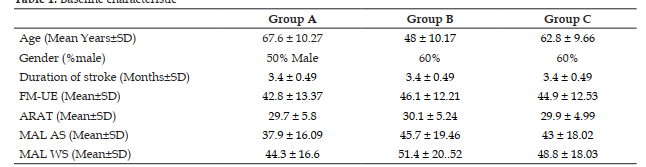
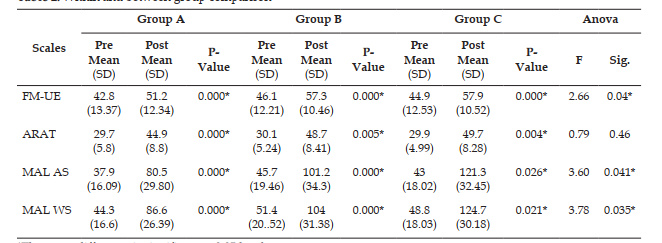
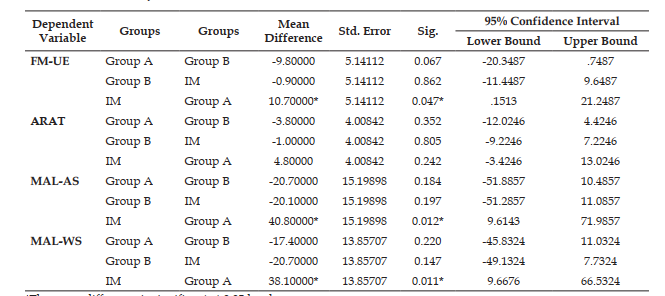
Background: Task-specific training (TST) is an established rehabilitation approach for improving upper limb function after stroke. However, the optimal dose of repetitive task practice required to maximize recovery remains unclear. Aim: To determine the effect of different doses of task-specific training on upper limb motor recovery in individuals with subacute stroke. Methods: This pilot experimental study included 30 individuals with subacute stroke, allocated into three groups (n=10 each). Group A performed 3,200 repetitions (100 repetitions/session), Group B performed 6,400 repetitions (200 repetitions/ session), and Group C performed individualized maximum repetitions (up to 300 repetitions/session) of functional tasks including eating, drinking, and combing hair. Training was provided four days per week for eight weeks. Outcomes were assessed using the Fugl-Meyer Assessment–Upper Extremity (FM-UE), Action Research Arm Test (ARAT), and Motor Activity Log (MAL). Paired t-tests, oneway ANOVA, and post hoc analyses were used for statistical analysis. Results: All groups demonstrated significant improvements in FM-UE, ARAT, and MAL scores (p<0.05). Between-group analysis showed significant differences in FM-UE (p=0.047), MAL Amount of Use (p=0.041), and MAL Quality of Movement (p=0.035), while ARAT showed no significant difference (p=0.46). Post hoc analysis revealed significantly greater improvements in the individualized maximum repetition group compared with the 3,200-repetition group for FM-UE and MAL outcomes. Conclusion: Higher doses of task-specific training improved upper limb motor recovery following subacute stroke. Individualized maximum repetition training (approximately ≥300 repetitions/session) produced superior improvements in motor impairment and functional arm use, supporting the potential benefit of high-dose rehabilitation. Larger randomized controlled trials are recommended to confirm these findings.
References
- 1. Gund GMBM, Jagtap MPN, Ingale MVB, Patil RY. Stroke: A Brain Attack. IOSR J Pharm. 2013;3(8):1-23.
- 2. Kamalakannan S, Gudlavalleti ASV, Murthy Gudlavalleti VS, Goenka S, Kuper H. Incidence & prevalence of stroke in India: A systematic review. Indian J Med Res. 2017;146(2):175. doi:10.4103/IJMR.IJMR_516_15
- 3. Lang CE, Lohse KR, Birkenmeier RL. Dose and timing in neurorehabilitation: prescribing motor therapy after stroke. Curr Opin Neurol. 2015;28(6):549-555. doi:10.1097/ WCO.0000000000000256
- 4. Lang CE, Strube MJ, Bland MD, et al. Dose response of task-specific upper limb training in people at least 6 months poststroke: A phase II, single-blind, randomized, controlled trial. Ann Neurol. 2016;80(3):342-354. doi:10.1002/ ANA.24734
- 5. Guo YR, Zhou Y, Liu TS. Current Situation of the Fugl-Meyer Scale for Evaluation of Upper Extremity Motor Function in Stroke Patients: A Short Review Mini Review. doi:10.34297/ AJBSR.2023.18.002520
- 6. Hsieh CL, Hsueh IP, Chiang FM, Lin PH. Inter-rater reliability and validity of the action research arm test in stroke patients. Age Ageing. 1998;27(2):107-114. doi:10.1093/ AGEING/27.2.107
- 7. Van Der Lee JH, Beckerman H, Knol DL, De Vet HCW, Bouter LM. Clinimetric properties of the motor activity log for the assessment of arm use in hemiparetic patients. Stroke. 2004;35(6):1410-1414. doi:10.1161/01.STR.000 0126900.24964.7E;CTYPE:STRING:JOURNAL
- 8. Han C, Wang Q, Meng PP, Qi MZ. Effects of intensity of arm training on hemiplegic upper extremity motor recovery in stroke patients: a randomized controlled trial. Clin Rehabil. 2013;27(1):75-81. doi:10.1177/0269215512447223
Data Sharing Statement
There are no additional data available. All raw data and code are available upon request.
Funding
This research received no funding.
Author Contributions
All authors contributed significantly to the work and approve its publication.
Ethics Declaration
This article does not involve any human or animal subjects, and therefore does not require ethics approval.
Acknowledgements
We would like to express our gratitude to the patients, their families, and all those who have contributed to this study.
Conflicts of Interest
No conflicts of interest in this work.
About this article

Cite this article
Manoj Kumar, Shraddha Diwan. Effect of Different Doses of Task-Specific Training on Upper Limb Motor Recovery in Individuals with Subacute Stroke: A Pilot Experimental Study. Therapy Jr. 2026; 19(4): 287-292
Licence:
Attribution-Non-commercial 4.0 International (CC BY-NC 4.0)This license enables reusers to distribute, remix, adapt, and build upon the material in any medium or format for noncommercial purposes only, and only so long as attribution is given to the creator.
| Received | Accepted | Published |
|---|---|---|
| July 14, 2026 | August 17, 2026 | December 30, 2026 |
DOI: 10.21088/potj.0974.5777.19426.3
Keywords
Subacute StrokeTask-Specific TrainingUpper Limb RehabilitationRepetitive Task Practice •NeurorehabilitationPilot Experimental StudySearch for Similar Articles
Similar Articles
- Correlation Between Hamstring Muscle Strength, Dynamic Balance and Knee Hyperex...
- Correlation Between Physical Activity, Social Isolation and Cognitive Function...
- Pain Self-Efficacy as a Predictor of Disability and Kinesiophobia in Adults with...
- Correlation of Physical Activity with Cognitive Function, Agility and Quality o...
- Leadership in Physiotherapy: A Narrative Review
Article Level Metrics
Last UpdatedTuesday 03 November 2026, 23:03:38 (IST)
4675
Accesses
3
744
00
Citations
NA
NA
NA
Download citation
Article Keywords
Keyword Highlighting
Highlight selected keywords in the article text.
Timeline
| Received | July 14, 2026 |
| Accepted | August 17, 2026 |
| Published | December 30, 2026 |
licence
Attribution-Non-commercial 4.0 International (CC BY-NC 4.0)
This license enables reusers to distribute, remix, adapt, and build upon the material in any medium or format for noncommercial purposes only, and only so long as attribution is given to the creator.