Full Text (PDF)
Journal of Orthopedic Education 10(3):p 77-83, September - December 2024. | DOI: https://doi.org/10.21088/joe.2454a.7956.10324.1
Original Article
Open Tibial Fracture: The Treatment of Soft-tissue Defects of the Lower Leg after a Trauma
Author Information
Licence:
Attribution-Non-commercial 4.0 International (CC BY-NC 4.0)This license enables reusers to distribute, remix, adapt, and build upon the material in any medium or format for noncommercial purposes only, and only so long as attribution is given to the creator.
Journal of Orthopedic Education 10(3):p 77-83, September - December 2024. | DOI: https://doi.org/10.21088/joe.2454a.7956.10324.1
How Cite This Article:
Abhishek Sharma, Open Tibial Fracture: The Treatment of Soft-tissue Defects of the Lower Leg after a Trauma. Jr. Orth. Edu. 2024;10(3):077–083Timeline
Received : October 01, 2024
Accepted : November 13, 2024
Published : December 25, 2024
Abstract
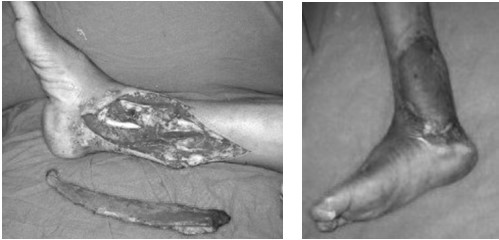
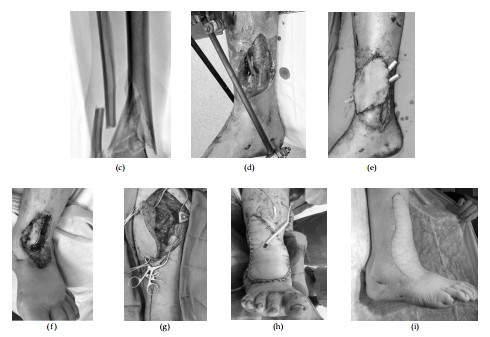
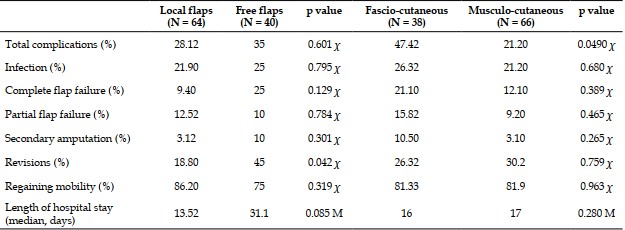
The large soft tissue defect in the lower leg and its treatment remain a challenge. The most suitably available type of tissue, the surgery timing, and the decision between free flap or local for the coverage still remain the subject of debate. One hundred and four patients were managed with a free flap or local cover for a lower leg soft-tissue defect. We compared the outcomes after treatment with free flaps versus local and musculocutaneous flaps versus fasciocutaneous flaps. In this study, we also compared the results of our patients according to the timing of the surgery: patients managed within 3 days after the trauma versus patients managed after 3 days. Thirty-four patients (32.69%) were presented with chronic osteomyelitis and treated accordingly. Seventy patients (67.30%) with posttraumatic soft-tissue defects have been treated because of insufficient fracture coverage. The statistically significant difference in complications was not observed in free and local flaps in our study. Postoperatively. In our study group, patients managed with a musculocutaneous flap were associated with less postoperative complications than fasciocutaneous. In the number of revisions after treatment with a free flap, a significant increase could be demonstrated in the results after early or late flap coverage. There was no significant difference observed. Equal outcomes were observed in patients treated with free flaps or local flaps except local flaps, which required a lesser number of revisions postoperatively. Regarding postoperative complications, Musculocutaneous flaps are preferable over fasciocutaneous flaps. The operation timing is not to be proved a discriminating factor.
References
- 1. Patzakis MJ, Wilkins J, Moore TM. Use of antibiotics in open tibial fractures. Clin Orthop. 1983; 178:31. PubMed Google Scholar
- 2. Dickson K, Katzman S, Delgado E, et al. Delayed unions and nonunions of open tibial fractures. Correlation with arteriography results. Clin Orthop. 1994; 302:191. PubMed Google Scholar
- 3. Aldea PA, Shaw WW. The evolution of the surgical management of severe lower extremity trauma. Clin Plast Surg. 1986; 13:549. PubMed Google Scholar
- 4. Parrett BM, Matros E, Pribaz JJ, et al. Lower extremity trauma: trends in the management of softtissue reconstruction of open tibia-fibula fractures. PlastReconstr Surg. 2006; 117:1315. doi: 10.1097/01. prs.0000204959.18136.36. PubMed CrossRef Google Scholar
- 5. Reddy V, Stevenson TR. MOC-PS(SM) CME article: lower extremity reconstruction. PlastReconstr Surg. 2008; 121:1. doi: 10.1097/01.prs.0000305928.98611.87. PubMed CrossRef Google Scholar
- 6. Karanas YL, Nigriny J, Chang J. The timing of microsurgical reconstruction in lower extremity trauma. Mircosurgery. 2008; 28:632. doi: 10.1002/ micr.20551. PubMed CrossRef Google Scholar
- 7. DeFranzo AJ, Argenta LC, Marks MW, et al. The use of vacuum-assisted closure therapy for the treatment of lower-extremity wounds with exposed bone. PlastReconstr Surg. 2001; 108:1184. doi: 10.1097/00006534-200110000-00013. PubMed CrossRef Google Scholar
- 8. Herscovici D, Jr., Sanders RW, Scaduto JM, et al. Vacuum-assisted wound closure (VAC therapy) for the management of patients with high-energy soft tissue injuries. J Orthop Trauma. 2003; 17:983. doi: 10.1097/00005131-200311000-00004. PubMed CrossRef Google Scholar
- 9. Gustilo RB, Anderson JT. Prevention of infection in the treatment of one thousand and twenty-five open fractures of long bones: retrospective and prospective analyses. J Bone Joint Surg Am. 1976; 58:453. PubMed Google Scholar
- 10. Heinz TR, Cowper PA, Levin LS. Microsurgery costs and outcome. PlastReconstr Surg. 1999; 104:89. doi: 10.1097/00006534-199907000-00012. PubMed CrossRef Google Scholar
- 11. Benacquista T, Kasabian AK, Karp NS. The fate of lower extremities with failed free flaps. PlastReconstr Surg. 1996; 98:834. doi: 10.1097/00006534- 199610000-00013. PubMed CrossRef Google Scholar
- 12. Yazar S, Lin CH, Lin YT. Outcome comparison between free muscle and free fasciocutaneous flaps for reconstruction of distal third and ankle traumatic open tibial fractures. PlastRestr Surg. 2006; 117:2471. doi: 10.1097/01.prs.0000224304.56885.c2. PubMed CrossRef Google Scholar
- 13. Yaremchuk MJ. Acute management of severe softtissue damage accompanying open fractures of the lower extremity. Clin Plast Surg. 1986; 13:621. PubMed Google Scholar
- 14. Russell GG, Henderson R, Arnett G. Primary or delayed closure for open tibial fractures. J Bone Joint Surg Br. 1990; 72:125. PubMed Google Scholar
- 15. Godina M. Early microsurgical reconstruction of complex trauma of the extremities. PlastReconstr Surg. 1986; 78:285. PubMed Google Scholar
- 16. Cierny G, Byrd HS, Jones RE. Primary versus delayed soft tissue coverage for severe open tibial fractures: a comparison of results. Clin Orthop. 1983; 178:54. PubMed Google Scholar
- 17. Fischer MD, Gustilo RB, Varecka TF. The timing of flap coverage, bone grafting, and intramedullary nailing in patients who have a fracture of the tibial shaft with extensive soft-tissue injury. J Bone Joint Surg Am. 1991; 73:1316. PubMed Google Scholar
- 18. M. Franken, Hupkens, P., et al. The treatment of soft-tissue defects of the lower leg after a traumatic open tibial fracture. Eur J Plast Surg. 2010; 33(3): 129–133, PMID: 20502513
Data Sharing Statement
There are no additional data available. All raw data and code are available upon request.
Funding
This research received no funding.
Author Contributions
All authors contributed significantly to the work and approve its publication.
Ethics Declaration
This article does not involve any human or animal subjects, and therefore does not require ethics approval.
Acknowledgements
We would like to express our gratitude to the patients, their families, and all those who have contributed to this study.
Conflicts of Interest
No conflicts of interest in this work.
About this article

Cite this article
Abhishek Sharma, Open Tibial Fracture: The Treatment of Soft-tissue Defects of the Lower Leg after a Trauma. Jr. Orth. Edu. 2024;10(3):077–083
Licence:
Attribution-Non-commercial 4.0 International (CC BY-NC 4.0)This license enables reusers to distribute, remix, adapt, and build upon the material in any medium or format for noncommercial purposes only, and only so long as attribution is given to the creator.
| Received | Accepted | Published |
|---|---|---|
| October 01, 2024 | November 13, 2024 | December 25, 2024 |
DOI: https://doi.org/10.21088/joe.2454a.7956.10324.1
Keywords
Tibial fractureLegSoft-tissue defectsFasciocutaneous flapmusculocutaneous flapSearch for Similar Articles
Similar Articles
- Joint Forces: Orthopedics and General Medicine in Tackling Musculoskeletal Manif...
- Application of Nanotechnology and Stem Cell Therapy in Musculoskeletal Disorders...
- Novel Surgical and Antibiotic Strategy for Treating Septic Arthritis after Total...
- Terrible Triad of Elbow
- The Present Day Orthopaedic Education for Residents in India: A Perspective from...
Article Level Metrics
Last UpdatedFriday 21 August 2026, 23:06:51 (IST)
1964
Accesses
5
237
00
Citations
NA
NA
NA
Download citation
Article Keywords
Keyword Highlighting
Highlight selected keywords in the article text.
Timeline
| Received | October 01, 2024 |
| Accepted | November 13, 2024 |
| Published | December 25, 2024 |
licence
Attribution-Non-commercial 4.0 International (CC BY-NC 4.0)
This license enables reusers to distribute, remix, adapt, and build upon the material in any medium or format for noncommercial purposes only, and only so long as attribution is given to the creator.