Full Text (PDF)
Ophthalmology and Allied Sciences 10(1):p 13-19, January - April 2024. | DOI: http://dx.doi.org/10.21088/oas.2454.7816.10124.2
Original Article
Ocular Muscle Balance Disorders and Associated Refractive status in School Children and Young Adults
Vaibhav Kanduri, , Anupama Raju Taklikar1 , Vaibhav Kanduri2 , Aisha Nikhat3 , Meghana N.4
Author Information
Licence:
Ophthalmology and Allied Sciences 10(1):p 13-19, January - April 2024. | DOI: http://dx.doi.org/10.21088/oas.2454.7816.10124.2
How Cite This Article:
Anupama Raju Taklikar, Vaibhav Kanduri, Aisha Nikhat, et al. Ocular Muscle Balance Disorders and Associated Refractive status in School Children and Young Adults. Ophthalmol Allied Sci. 2024;10(1): 13–19.
Timeline
Received : N/A
Accepted : N/A
Published : N/A
Abstract
Introduction: The Human race is supreme in hierarchy of animal kingdom by the acquisition of Binocular Single Vision 1 (BSV). It is important to have normal ocular muscle balance to have normal BSV. Any muscle balance disorder may lead to squint or amblyopia. Ocular muscle balance disorders shows an association with refractive error. Most of this research has focused on myopia. But hyperopia and astigmatism are also being examined in our study.
Methodology: A Prospective study conducted over period of 1 year 300 subjects were included 150 were selected from OPD and rest 150 by screening 1875 students of various schools in Raichur District who had vision less than 6\6 or with 6\6 vision and as the no pic symptoms. Visual Acuity was measured. Fund us examination, Squint evaluation and Type of squint was noted. AC/A ratio was calculated. Binocular Vision was assessed. Those who needed treatment were treated by spectacles ororthoptic exercises. Correlation was made between ocular muscle imbalance and refraction.
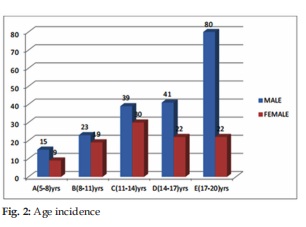
Results: The prevalence of refractive errors was 8% with mallet of emaleratio 1.9:1. Highest were between 17-20 yrs. Heterophori as were the most common Type of ocular muscle balance disorders (80%) followed by heterotropias (20%). Exophoria was highest (52.8%) followed by esophoria (46.6%). Strong association was noted between myopia and exophoria 43 out of 60 (p=0.042). Cases of mixed astigmatism were observed having esophoria for near and exophoria for far. Significant association was noted between hypermetropia and convergent squint (67 out of 81).
Conclusion: Myopia is mainly associated with divergent squint, Hypermetropia with convergent squint. Mixed astigmatism associated with exophoria for far, esophoria fornear.
References
No records found.
About this article

Cite this article
Anupama Raju Taklikar, Vaibhav Kanduri, Aisha Nikhat, et al. Ocular Muscle Balance Disorders and Associated Refractive status in School Children and Young Adults. Ophthalmol Allied Sci. 2024;10(1): 13–19.
Licence:
| Received | Accepted | Published |
|---|---|---|
| N/A | N/A | N/A |
DOI: http://dx.doi.org/10.21088/oas.2454.7816.10124.2
Keywords
Refractive errors; Heterophoria; Heterotropia.Search for Similar Articles
Similar Articles
- Familial Foveal Hypoplasia and Review of Literature
- Conjunctivitis Nursing Care: A Comprehensive Review of Evidence-Based Practice
- The Critical Role of Peri-operative Infection Control Nurses in the Mitigation...
- Management of Corneal Perforation in a Tertiary Care Hospital: An Observational...
- Conjunctivitis Nursing Care: A Comprehensive Review of Evidence Based Practice
Article Level Metrics
Last UpdatedSunday 27 September 2026, 13:34:30 (IST)
1191
Accesses
25
82
00
Citations
NA
NA
NA
Download citation
Article Keywords
Keyword Highlighting
Highlight selected keywords in the article text.
Timeline
| Received | N/A |
| Accepted | N/A |
| Published | N/A |