Full Text (PDF)
Indian Journal of Cancer Education and Research 10(1):p 9-14, January - June 2022. | DOI: https://doi.org/10.21088/ijcer.2321.9815.10122.1
Original Article
Nimotuzumab with Concomitant Chemoradiation as an Organ Preservation Treatment in Advanced Muscle Invasive Bladder Cancer
Shyam Ji Rawat null, Shyam Ji Rawat1 null, Rajesh Jain2 null, Ramez Ahmed3 null
Author Information
Licence:
Attribution-Non-commercial 4.0 International (CC BY-NC 4.0)This license enables reusers to
distribute, remix, adapt, and build upon the material in any medium or format
for noncommercial purposes only, and only so long as attribution is given to
the creator.
Indian Journal of Cancer Education and Research 10(1):p 9-14, January - June 2022. | DOI: https://doi.org/10.21088/ijcer.2321.9815.10122.1
How Cite This Article:
Shyam Ji Rawat, Rajesh Jain, Ramez Ahmed/Nimotuzumab with Concomitant Chemoradiation as an Organ Preservation Treatment in Advanced Muscle Invasive Bladder Cancer/Indian J Canc Educ Res 2022;10(1):9-14.
Timeline
Received : October 26, 2021
Accepted : November 19, 2021
Published : June 10, 2021
Abstract
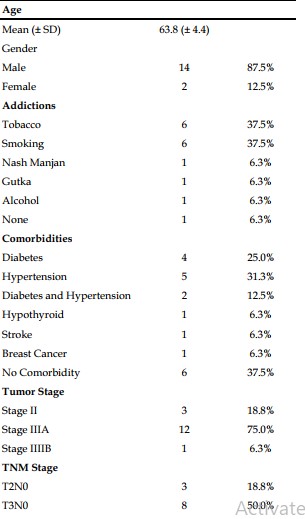
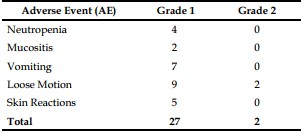
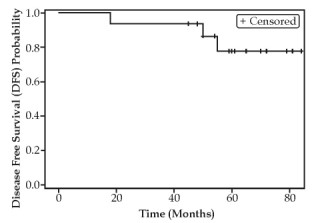
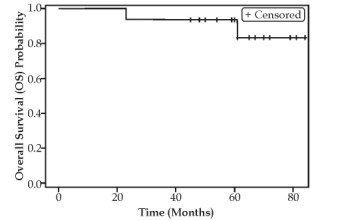
Introduction: Radical Cystectomy (RC) and lymph node dissection is standard of care in MIBC. Bladder preservation techniques like trimodal therapy (TMT) has shown similar outcomes to RC with a complete response (CR) rate of 64-74%, 5 year overall survival (OS) rate of 50-70% along with 40-60% of bladder preservation. As bladder cancers show EGFR overexpression, anti-EGFR can be a potential treatment option in improving outcomes. Method: We retrospectively evaluated Nimotuzumab with concomitant chemoradiation (CRT) in Muscle invasive advanced bladder cancer (MIBC). Effectiveness and safety outcomes were analysed in these patients. Results: Sixteen patients with a transitional cell carcinoma and mean age of 63.8 (±4.4) were included Majority of the patients were male (87.5%) and 87.5% patients had tobacco addictions. All patients had an Objective Response Rate (ORR) (15 complete response and 1 partial response). With a median follow up duration of 61 months, median OS and Disease Free Survival (DFS) was not reached. DFS & OS rate of 1, 3, 5 and 7 year was 100% & 100%, 93.8% & 93.8%, 81.3% & 93.8% and 81.3% & 87.5%, respectively. Two patients had metastasis and one patient had recurrence. Two deaths were reported. Only two RC were performed subjecting an organ preservation rate of 87.5%. There were no grade 3/4 AEs recorded. Conclusion: Nimotuzumab with concomitant CRT improves outcomes with manageable toxicity and can play a potential role as bladder preservation treatment option.
References
- 1. World Health Organization International Agency for Research on Cancer (IARC). Global Cancer Observatory (GCO) (2020) [Accessed 30 June 2021] Available from: https://gco.iarc.fr/
- 2. Prakash G, Pal M, Odaiyappan K, Shinde R, Mishra J, Jalde D, et al. Bladder cancer demographics and outcome data from 2013 at a tertiary cancer hospital in India. Indian J Cancer. 2019;56:54-8
- 3. Gupta P, Jain M, Kapoor R, Muruganandham K, Srivastava A, Mandhani A. Impact of age and gender on the clinicopathological characteristics of bladder cancer. Indian J Urol. 2009; 25: 207-10.
- 4. Rayn KN, Hale GR, Grave GP, Agarwal PK. New therapies in nonmuscle invasive bladder cancer treatment. Indian J Urol. 2018; 34: 11-9.
- 5. Pinto IG. Systemic therapy in bladder cancer. Indian J Urol. 2017; 33: 118-26.
- 6. González Del Alba A, De Velasco G, Lainez N, Maroto P, Morales-Barrera R, Muñoz-Langa J, et al. SEOM clinical guideline for treatment of muscle-invasive and metastatic urothelial bladder cancer (2018). Clin Transl Oncol. 2019; 21(1): 64-74.
- 7. Neal DE, Sharples L, Smith K, Fennelly J, Hall RR, Harris AL. The epidermal growth factor receptor and the prognosis of bladder cancer. Cancer. 1990; 65(7): 1619-25.
- 8. Chaux A, Cohen JS, Schultz L, Albadine R, Jadallah S, Murphy KM, et al. High epidermal growth factor receptor immunohistochemical expression in urothelial carcinoma of the bladder is not associated with EGFR mutations in exons
- 9. Mooso BA, Vinall RL, Mudryj M, Yap SA, deVere White RW, Ghosh PM. The role of EGFR family inhibitors in muscle invasive bladder cancer: a review of clinical data and molecular evidence. J Urol. 2015; 193(1): 19-29.
- 10. Abbosh PH, McConkey DJ, Plimack ER. Targeting Signaling Transduction Pathways in Bladder Cancer. Curr Oncol Rep. 2015; 17(12): 58.
- 11. van Kessel KE, Zuiverloon TC, Alberts AR, Boormans JL, Zwarthoff EC. Targeted therapies in bladder cancer: an overview of in vivo research. Nat Rev Urol. 2015; 12(12): 681-94.
- 12. Patil VM, Noronha V, Joshi A, Agarwal J, GhoshLaskar S, Budrukkar A, et al. A randomized phase 3 trial comparing Nimotuzumab plus cisplatin chemoradiotherapy versus cisplatin chemoradiotherapy alone in locally advanced head and neck cancer. Cancer. 2019; 125(18): 3184- 97.
- 13. Rosario DJ, Becker M, Anderson JB. The changing pattern of mortality and morbidity from radical cystectomy. BJU Int. 2000; 85(4): 427-30.
- 14. Caffo O, Fellin G, Graffer U, Luciani L. Assessment of quality of life after cystectomy or conservative therapy for patients with infiltrating bladder carcinoma. A survey by a self-administered questionnaire. Cancer. 1996; 78(5): 1089-97.
- 15. Kimura T, Ishikawa H, Kojima T, Kandori S, Kawahara T, Sekino Y, et al. Bladder preservation therapy for muscle invasive bladder cancer: the past, present and future. Jpn J Clin Oncol. 2020; 50(10): 1097-107.
- 16. Arcangeli G, Strigari L, Arcangeli S. Radical cystectomy versus organ-sparing trimodality treatment in muscle-invasive bladder cancer: A systematic review of clinical trials. Crit Rev Oncol Hematol. 2015; 95(3): 387-96.
- 17. Tanaka H, Kijima T, Fujii Y. Bladder preservation therapy in muscle-invasive bladder cancer: Current evidence and future perspectives. AME Med J. 2020; 5: 16.
- 18. Bellmunt J, Hussain M, Dinney CP. Novel approaches with targeted therapies in bladder cancer. Therapy of bladder cancer by blockade of the epidermal growth factor receptor family. Crit Rev Oncol Hematol. 2003; 46(suppl): S85-S104.
- 19. Lipponen P, Eskelinen M. Expression of epidermal growth factor receptor in bladder cancer as related to established prognostic factors, oncoprotein (c-erbB-2, p53) expression and longterm prognosis. Br J Cancer. 1994; 69: 1120-5.
- 20. Philips GK, Halabi S, Sanford BL, Bajorin D, Small EJ. A phase II trial of cisplatin (C), gemcitabine (G) and gefitinib for advanced urothelial tract carcinoma: results of Cancer and Leukemia Group B (CALGB) 90102. Ann Oncol. 2009; 20(6): 1074-9.
- 21. Pruthi RS, Nielsen M, Heathcote S, Wallen EM, Rathmell WK, Godley P, et al. A phase II trial of neoadjuvant erlotinib in patients with muscleinvasive bladder cancer undergoing radical cystectomy: clinical and pathological results. BJU Int. 2010; 106(3): 349-54.
- 22. Wülfing C, Machiels JP, Richel DJ, Grimm MO, Treiber U, De Groot MR, et al. A single-arm, multicenter, open-label phase 2 study of lapatinib as the second-line treatment of patients with locally advanced or metastatic transitional cell carcinoma. Cancer. 2009; 115: 2881–90.
- 23. Tang S, Dorff TB, Tsao-Wei D, Massopust K, Ketchens C, Goldkorn JH, et al. Single arm phase II study of docetaxel and lapatinib in metastatic urothelial cancer: USC trial 4B-10-4. J Clin Oncol. 2016; 34(2): 424.
- 24. Powles T, Huddart RA, Elliott T, Sarker SJ, Ackerman C, Jones R, et al. Phase III, DoubleBlind, Randomized Trial That Compared Maintenance Lapatinib Versus Placebo After First-Line Chemotherapy in Patients With Human Epidermal Growth Factor Receptor 1/2-Positive Metastatic Bladder Cancer. J Clin Oncol.2017; 35: 48–55.
- 25. Cerbone L, Sternberg CN, Sengeløv L, Agerbaek M, Van Herpen C, Marreaud S, et al. Results from a Phase I Study of Lapatinib with Gemcitabine and Cisplatin in Advanced or Metastatic Bladder
- 26. Wong YN, Litwin S, Vaughn D, Cohen S, Plimack ER, Lee J, et al. Phase II trial of cetuximab with or without paclitaxel in patients with advanced urothelial tract carcinoma. J Clin Oncol. 2012;
- 27. Hussain SA, Buckley L, Kaur B, Hendron C, Zarkar A, Ford D, et al. Phase I/II trial of cetuximab with 5-fluorouracil and mitomycin C concurrent with radiotherapy in patients with muscle invasive bladder cancer. J Clin Oncol. 2017; 35(15): 4527.
- 28. James ND, Pirrie S, Liu W, Ford D, Zarkar A, Southgate E, et al. A phase I/II feasibility study of cetuximab with 5FU and mitomycin C or cisplatin with concurrent radiotherapy in muscle invasive bladder cancer. J Clin Oncol. 2020; 38(6): 491.
- 29. Fransen van de Putte EE, Pos F, Doodeman B, van Rhijn BWG, van der Laan E, Nederlof P, et al. Concurrent Radiotherapy and Panitumumab after Lymph Node Dissection and Induction Chemotherapy for Invasive Bladder Cancer. J Urol. 2019; 201(3): 478-85.
Data Sharing Statement
There are no additional data available. All raw data and code are available upon request.
Funding
This research received no funding.
Author Contributions
All authors contributed significantly to the work and approve its publication.
Ethics Declaration
This article does not involve any human or animal subjects, and therefore does not require ethics approval.
Acknowledgements
We would like to express our gratitude to the patients, their families, and all those who have contributed to this study.
Conflicts of Interest
No conflicts of interest in this work.
About this article

Cite this article
Shyam Ji Rawat, Rajesh Jain, Ramez Ahmed/Nimotuzumab with Concomitant Chemoradiation as an Organ Preservation Treatment in Advanced Muscle Invasive Bladder Cancer/Indian J Canc Educ Res 2022;10(1):9-14.
Licence:
Attribution-Non-commercial 4.0 International (CC BY-NC 4.0)This license enables reusers to
distribute, remix, adapt, and build upon the material in any medium or format
for noncommercial purposes only, and only so long as attribution is given to
the creator.
| Received | Accepted | Published |
|---|---|---|
| October 26, 2021 | November 19, 2021 | June 10, 2021 |
DOI: https://doi.org/10.21088/ijcer.2321.9815.10122.1
Keywords
Anti-EGFRBladder CancerChemoradiationMIBCNimotuzumabOrgan Preservation.Search for Similar Articles
Similar Articles
- Unusual Presentation of Solitary Metastasis to the Right Metacarpal Bone in Rena...
- Technical Feasibility and Planning Challenges of Delivering Total Body Irradiat...
- Excellent Response Rates with Bortezomib - Cyclophosphamide – Dexamethasone (VCD...
- Optimizing Postoperative Radiation Therapy in Ewing’s Sarcoma with Lung Metasta...
- Current Therapeutic Strategies Targeting Tyrosine Kinase Receptor in Colon Canc...
Article Level Metrics
Last UpdatedWednesday 30 September 2026, 08:35:20 (IST)
1909
Accesses
9
289
00
Citations
NA
NA
NA
Download citation
Article Keywords
Keyword Highlighting
Highlight selected keywords in the article text.
Timeline
| Received | October 26, 2021 |
| Accepted | November 19, 2021 |
| Published | June 10, 2021 |
licence
Attribution-Non-commercial 4.0 International (CC BY-NC 4.0)
This license enables reusers to
distribute, remix, adapt, and build upon the material in any medium or format
for noncommercial purposes only, and only so long as attribution is given to
the creator.