Full Text (PDF)
Indian Journal of Cancer Education and Research 10(1):p 17-25, January - June 2022. | DOI: https://doi.org/10.21088/ijcer.2321.9815.10122.2
Original Article
Dosimetric Comparison of 3DCRT Planning and Forward IMRT Field in Field Techniques in Early Stage Left Breast Cancer
Chinnamuthu Mahendran null, Chinnamuthu Mahendran1 null, Ganapathi Murugan2 null, Anmol Verma3 null, Saurabh Karnawat4 null, Virendra Bhandari5 null
Author Information
Licence:
Attribution-Non-commercial 4.0 International (CC BY-NC 4.0)This license enables reusers to distribute, remix, adapt, and build upon the material in any medium or format for noncommercial purposes only, and only so long as attribution is given to the creator.
Indian Journal of Cancer Education and Research 10(1):p 17-25, January - June 2022. | DOI: https://doi.org/10.21088/ijcer.2321.9815.10122.2
How Cite This Article:
Chinnamuthu Mahendran, Ganapathi Murugan, Anmol Verma, et. al./Dosimetric Comparison of 3DCRT Planning and Forward IMRT Field in Field Techniques in Early Stage Left Breast Cancer/Indian J Canc Educ Res 2022;10(1):17-25.
Timeline
Received : November 20, 2021
Accepted : December 03, 2021
Published : June 10, 2022
Abstract
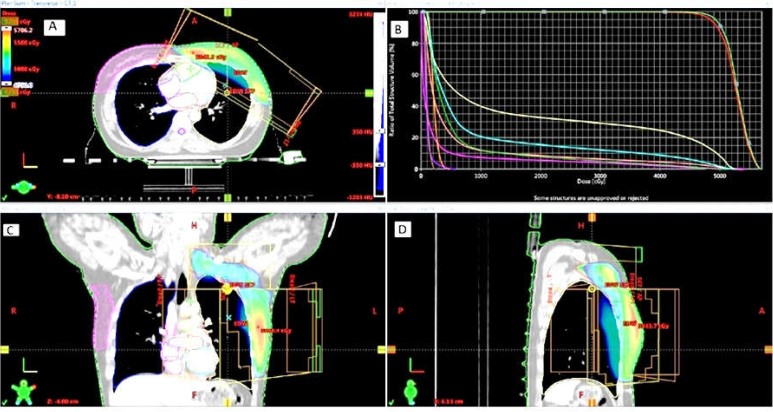
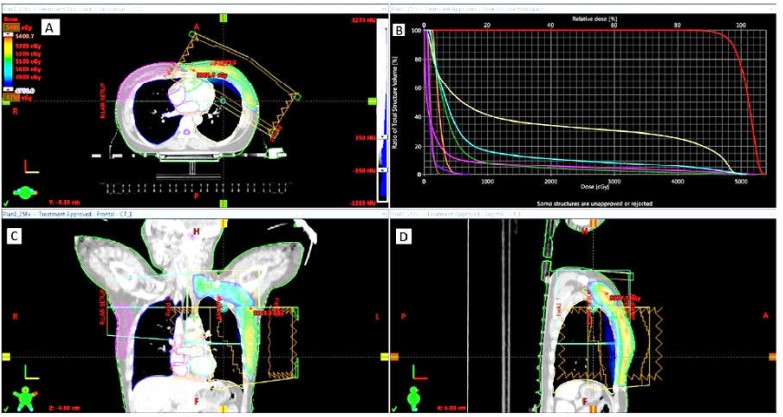
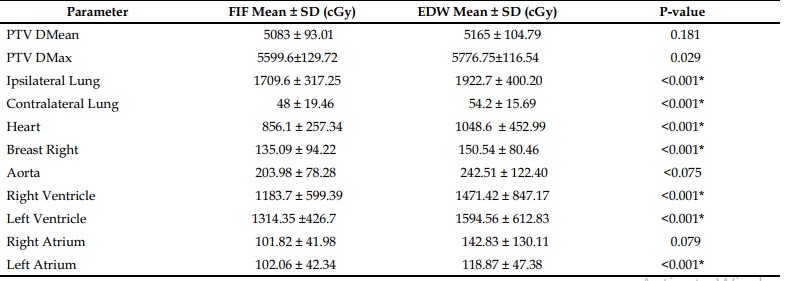
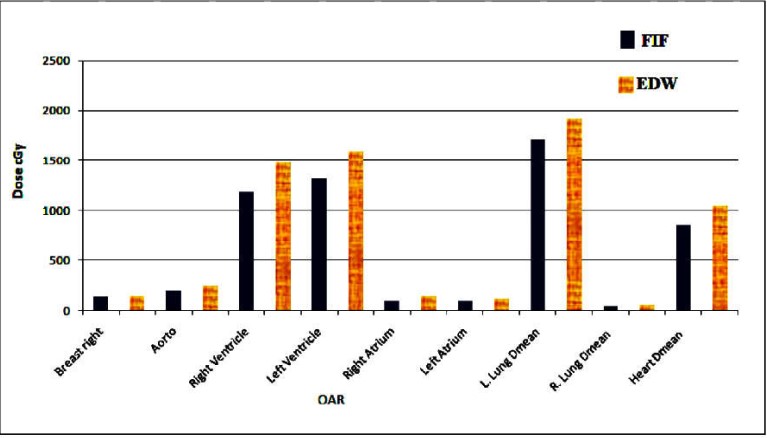
Background: The objective of the study is to compare Forwarded IMRT FiF plan with Enhance Dynamic Wedge (EDW) tangential field radiotherapy in terms of dosimetric benefits for OARs early stage left side breast cancer radiotherapy. Materials and Methods: Twenty patients of consecutive left side breast cancer who underwent breast conserving surgery were included and without surgery patients were also included in the study. Two different methods of treatment plans were created for the entire left side breast cancer patients. Forwarded IMRT Field in Field plans (FiF) plan and Enhance Dynamic Wedge (EDW) planning’s are compared for doses in the planning target volume (PTV), the organs at risk (OARs) volume including ipsilateral lung, heart, left ascending coronary artery (LAD) and the contralateral breast, the dose homogeneity index (DHI), conformity index (CI) and the monitor units (MUs) counts required for the treatment. Results: The homogeneity conformity of the dose to planning target volume (PTV) and the dose delivered to the heart, contralateral breast, and left ascending coronary artery (LAD) were compared with two techniques in all the 20 patients. Both the radiotherapy techniques achieved comparable radiation dose delivery to PTV-95% of the prescribed dose covering > 95% of the breast PTV as well as the mean doses of the heart, ipsilateral lung, contralateral lung, aorta, left atrium, right atrium, left ventricle, right ventricle, contralateral breast. Forwarded IMRT FiF technique achieving better uniform dose distribution and conformity with lower doses to OARs and less MUs. Conclusion: The Forwarded IMRT FiF technique achieving better dose distribution in the PTV and spare the OARs. The lesser MUs required for treatment of the Forwarded IMRT FiF technique seems to be more advantageous compared to the Enhance Dynamic Wedge plan during whole left side breast irradiation
References
- 1. Habermann EB., et al. “Are mastectomy rates really increasing in the United States”. Journal of Clinical Oncology 28.21 (2010): 3437-3441.
- 2. Clarke M, Collins R, Darby S, Davies C, Elphinstone P, Evans E et al. (2005) “Effects of radiotherapy and of differences in the extent of surgery for early breast cancer on local recurrence and 15-year survival: an overview of the randomized trials”. Lancet, 366: 2087– 2106.
- 3. Cuzick J, Stewart H, Rutqvist L, Houghton J, Edwards R, Redmond C, et al. (1994) Causespecific mortality in long-term survivors of breast cancer who participated in trials of radiotherapy. J Clin Oncol, 12:447–53.
- 4. Muren LP, Maurstad G, Halfslund R, Anker G, Dahl O (2002) “Cardiac and pulmonary doses and complication probabilities in standard and conformal tangential irradiation in conservative management of breast cancer.” Radiotherapy
- 5. Kutcher GJ, Smith AR, Fowble BL, Owen JB, Hanlon A, Wallace M et al. (1996) Treatment planning for breast cancer: a patterns of care study. Int J Radiat Oncol Biol Phys, 36:731-737.
- 6. Ercan T, Igdem S, Alco G, Zengin F, Atilla S, Dincer M and Okkan S (2010) “Dosimetric comparison of field in field intensity-modulated radiotherapy technique with conformal radiotherapy techniques in breast cancer”. Jpn J Radiol, 28:283–289.
- 7. Warlick WB, O’Rear JH, Earley L, Moeller JH, Gaffney DK, Leavitt DD (1997) “Dose to the contralateral breast: a comparison of two techniques using the enhanced dynamic wedge versus a standard wedge”. Med Dosim, 22:185–91.
- 8. Sasaoka M and Futami T (2011) Dosimetric evaluation of whole breast radiotherapy using field-in-field technique in early-stage breast cancer. Int J Clin Oncol, 16:250-256.
- 9. Fong A, Bromley R, Beat M, Vien D, Dineley J, Morgan G. “Dosimetric comparison of intensity modulated radiotherapy techniques and standard wedged tangents for whole breast radiotherapy”. J Med Imaging Radiat Oncol. 2009; 53:92–9.
- 10. Al-Rahbi ZS., et al. “Dosimetric comparison of intensity modulated radiotherapy isocentric field plans and field in field (FiFIMRT) forward plans in the treatment of breast cancer”. Journal of Medical Physics 38.1 (2013): 22-29.
- 11. McGale P., et al. “Incidence of heart disease in 35000 women treated with radiotherapy for breast cancer in Denmark and Sweden”. Radiotherapy and Oncology 100.2 (2011): 167-175.
- 12. Mansouri S., et al. “Dosimetric Evaluation of 3-D Conformal and Intensity modulated Radiotherapy for Breast Cancer after Conservative Surgery.” Asian Pacific Journal of Cancer Prevention 15.11 (2014): 4727-4732.
- 13. Rudat V., et al. “Tangential beam IMRT versus tangential beam 3D-CRT of the chest wall in postmastectomy breast cancer patients: A dosimetric comparison”. Radiation Oncology 6 (2011): 26.
- 14. Prabhakar R., et al. “Breast dose heterogeneity in CT-based radiotherapy treatment planning”. Journal of Medical Physics. 33.2 (2008): 43-48.
- 15. Baycan D., et al. “Field-in-field IMRT versus 3DCRT of the breast. Cardiac vessels, ipsilateral lung, and contralateral breast absorbed doses in patients with left-sided lumpectomy: a dosimetric comparison”. Japanese Journal of Radiology 30.10 (2012): 819-823.
- 16. Moody AM., et al. “The influence of breast size on late radiation effects and association with radiotherapy dose inhomogeneity”. Radiotherapy and Oncology 33.2 (1994): 106-112.
- 17. Neal AJ., et al. “Correlation of breast heterogeneity with breast size using 3D CT planning and dosevolume histograms”. Radiotherapy and Oncology 34.3 (1995): 210-218.
- 18. Stovall M., et al. “Dose to the Contralateral Breast from Radiotherapy and Risk of Second Primary Breast Cancer in the Wecare Study”. International Journal of Radiation Oncology, Biology, Physics 72.4 (2008): 1021-1030.
- 19. Roychoudhuri R., et al. “Radiation induced malignancies following radiotherapy for breast cancer”. British Journal of Cancer 91.5 (2004): 868- 872.
- 20. Goldman UB., et al. “Reduction of radiation pneumonitis by V20-constraints in breast cancer”. Radiation Oncology 5 (2010): 99.
- 21. Rancati T., et al. “Early clinical and radiological pulmonary complications following breast cancer
- 22. Gursel, B., Meydan, D., Ozbek, N. et al. Dosimetric comparison of three different external beam whole breast irradiation techniques. Adv Therapy 28, 1114–1125 (2011).
- 23. Prabhakar R, Julka PK, Rath GK (2008) “Can field-in-field technique replace wedge filter in radiotherapy treatment planning: a comparative analysis in various treatment sites”. Australas Phys Eng Sci Med, 31: 317-324.
- 24. Prabhakar R, Julka PK, Malik M, Ganesh T, Joshi RC, Sridhar PS, Rath GK, Pant GS, Thulkar S (2007) “Comparison of contralateral breast dose for various tangential field techniques in clinical radiotherapy”. Technol Cancer Res Treat, 6: 135-8.
- 25. Zackrisson B, Arevarn M, Karlsson M (2000) Optimized MLCbeam arrangement for tangential breast irradiation. Radiotherapy Oncol, 54:209–21.
- 26. Richmond ND, Turner RN, Dawes PJDK et al. (2003) “Evaluation of the dosimetric consequences of adding a single asymmetric or MLC shaped field to a tangential breast radiotherapy technique”. Radiat Oncol, 67: 165– 170.
- 27. Lee JW, Hong S, Choi KS et al. (2008) Performance evaluation of field-in-field technique for tangential breast irradiation. Jpn J Clin Oncol, 38:158–163.
- 28. Bhatnagar AK, Brandner E, Sonnik D et al. (2006) “Intensity modulated radiation therapy (IMRT) reduced the dose to the contralateral breast when compared to the conventional tangential fields for primary breast irradiation. Breast Cancer Res Treat”, 96:41–46.
- 29. Woo TC, Pignol JP, and Rakovitch E et al. (2006) Body irradiation exposure in breast cancer
- 30. Marks LB, Yorke ED, and Jackson A et al. (2010) Use of normal tissue complication probability models in the clinic. Int J Radiat Oncol Biol Phys, 76: supplement 10-19.
- 31. Storey MR, Munden R, Strom EA, Mc Neese MD, Buchholz TA (2001) Coronary artery dosimetry in
Data Sharing Statement
There are no additional data available. All raw data and code are available upon request.
Funding
This research received no funding.
Author Contributions
All authors contributed significantly to the work and approve its publication.
Ethics Declaration
This article does not involve any human or animal subjects, and therefore does not require ethics approval.
Acknowledgements
We would like to express our gratitude to the patients, their families, and all those who have contributed to this study.
Conflicts of Interest
No conflicts of interest in this work.
About this article

Cite this article
Chinnamuthu Mahendran, Ganapathi Murugan, Anmol Verma, et. al./Dosimetric Comparison of 3DCRT Planning and Forward IMRT Field in Field Techniques in Early Stage Left Breast Cancer/Indian J Canc Educ Res 2022;10(1):17-25.
Licence:
Attribution-Non-commercial 4.0 International (CC BY-NC 4.0)This license enables reusers to distribute, remix, adapt, and build upon the material in any medium or format for noncommercial purposes only, and only so long as attribution is given to the creator.
| Received | Accepted | Published |
|---|---|---|
| November 20, 2021 | December 03, 2021 | June 10, 2022 |
DOI: https://doi.org/10.21088/ijcer.2321.9815.10122.2
Keywords
Breast cancerEnhanced dynamic wedgeDose volume histograms;Intensity modulated radiotherapyField in field techniqueAn organ at riskMonitor units.Search for Similar Articles
Similar Articles
- Unusual Presentation of Solitary Metastasis to the Right Metacarpal Bone in Rena...
- Technical Feasibility and Planning Challenges of Delivering Total Body Irradiat...
- Excellent Response Rates with Bortezomib - Cyclophosphamide – Dexamethasone (VCD...
- Optimizing Postoperative Radiation Therapy in Ewing’s Sarcoma with Lung Metasta...
- Current Therapeutic Strategies Targeting Tyrosine Kinase Receptor in Colon Canc...
Article Level Metrics
Last UpdatedWednesday 30 September 2026, 08:35:08 (IST)
1909
Accesses
11
289
00
Citations
NA
NA
NA
Download citation
Article Keywords
Keyword Highlighting
Highlight selected keywords in the article text.
Timeline
| Received | November 20, 2021 |
| Accepted | December 03, 2021 |
| Published | June 10, 2022 |
licence
Attribution-Non-commercial 4.0 International (CC BY-NC 4.0)
This license enables reusers to distribute, remix, adapt, and build upon the material in any medium or format for noncommercial purposes only, and only so long as attribution is given to the creator.