Full Text (PDF)
Indian Journal of Anesthesia and Analgesia 12(1):p 39-43, Jan- March 2025. | DOI: https://doi.org/10.21088/ijaa.2349.8471.12125.7
Case Report
Neuroanesthetic Concerns during Removal of Giant Intracranial Hydatid Cyst: A Case Report
Kunal Sharma, Shyam Chandran, Vartika Chauhan, Akshay Behera
Author Information
Licence:
Attribution-Non-commercial 4.0 International (CC BY-NC 4.0)This license enables reusers to distribute, remix, adapt, and build upon the material in any medium or format for noncommercial purposes only, and only so long as attribution is given to the creator.
Indian Journal of Anesthesia and Analgesia 12(1):p 39-43, Jan- March 2025. | DOI: https://doi.org/10.21088/ijaa.2349.8471.12125.7
How Cite This Article:
Sharma KK, Chandran S, Chauhan V, et al. Neuroanesthetic concerns during removal of giant intracranial hydatid cyst: a case report. Ind J Anesth Analg. 2025;12(1):39-43.Timeline
Received : November 20, 2024
Accepted : December 28, 2024
Published : March 15, 2025
Abstract
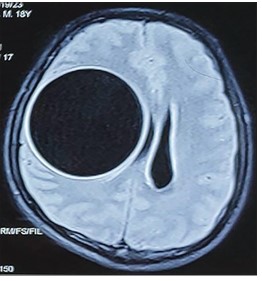
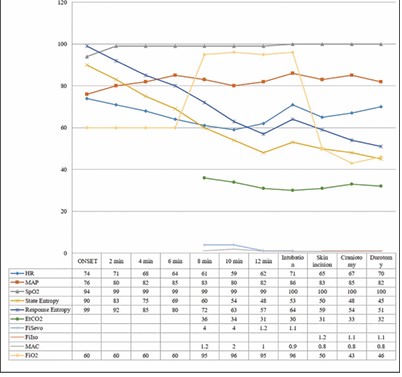
Introduction: Intracranial hydatid cysts are rare supra-tentorial lesions in the neurosurgical population of India. Methodology: In this report, we presented a case of a 18 year old male patient with midline shift, posted for excision of hydatid cyst in brain. The use of dexmeditomidine alongwith sevoflurane for anesthetic induction helped in achieving optimal intra-operative brain relaxation and a good surgical outcome for this patient. Results: Neuroanesthetic monitoring for this patient encompassed the state entropy monitoring, cerebral blood flow velocity monitoring, non-invasive intra-cranial pressure monitoring and analgesia monitoring in conjunction to the standard ASA monitoring. Conclusion: The authors advocate similar management for achieving optimal standard of care while operating giant cystic lesions in supra-tentorial compartment.
References
- 1. Khaldi M., Mohamed S., Kallel J., Khouja N. Brain hydatidosis: report on 117 cases. Childs Nerv Syst. 2000; 16(10–11): 765–769.
- 2. Pedrosa I., Saíz A., Arrazola J., Ferreirós J., Pedrosa C. Hydatid disease: radiologic and pathologic features and complications. Radiographics. 2000; 20: 795–817.
- 3. Tanki H., Singh H., Raswan U., Bhat A., Kirmani A., Ramzan A. Pediatric Intracranial Hydatid Cyst: A Case Series with Literature Review. Pediatr Neurosurg. 2018; 53: 299-304.
- 4. Chauhan B., Sharma K., Barwal K., Kaundal P. Cerebrovascular changes during laproscopic vesico-vaginal repair. Ain-Shams J Anesthesiol. 2024; 16(1): 1-4.
- 5. Chauhan B., Raina P., Dogra R., Pathania J. Serial perioperative optic nerve sheath measurements for early diagnosis of the transurethral resection of prostate syndrome: an open label pilot study. Ain-Shams J Anesthesiol. 2023; 15(18).
- 6. Polat G., Ogul H., Sengul G. Hydatidosis Following Giant Cerebral Hydatid Cyst Operation. World Neurosurg. 2018; 118: 14-15.
- 7. Schwarz A., Nossaman B., Carollo D., Ramadhyani U. Dexmedetomidine for Neurosurgical procedures. Curr Anesthesiol Rep. 2013; 3: 205–209.
- 8. Can M., Gul S., Bektas S., Hanci V., Acikgoz S. Effects of dexmedetomidine or methylprednisolone on inflammatory responses in spinal cord injury. Acta Anaesth Scand. 2009; 53: 1068-1072.
- 9. He H., Zhou Y., Zhou Y., Zhuang J., He X., Wang S., Lin W. Dexmedetomidine mitigates microglia-mediated neuroinflammation through upregulation of programmed cell death protein 1 in a rat spinal cord injury model. J Neurotrauma. 2018; 35: 2591-2603.
- 10. Sharma K., Chauhan B. Integrated Dexmeditomidine-sevoflurane algorithm for anesthetic induction- A viable asset for neurosurgery. Surg Neurol Int. 2024; 15: 466.
- 11. 11. Viby-Mogensen J., Engbaek J., Eriksson L., Gramstad L., Jensen E., Jensen F., KoscielniakNielsen Z., Skovgaard L., Ostergaard D. Good clinical research practice (GCRP) in pharmacodynamic studies of neuromuscular blocking agents. Acta Anaesthesiol Scand 1996; 40: 59 74.
- 12. Gao J., Sun Z., Xiao Z., Du Q., Niu X., Wang G., Chang Y., Sun Y., Sun W., Lin A., Bresnahan J., Maze M., Beattie M., Pan J. Dexmedetomidine modulates neuroinflammation and improves outcome via alpha2-adrenergic receptor signaling after rat spinal cord injury. British Journal of Anaesthesia. 2019; 123(6): 827-838.
- 13. Ramsay M., Luterman D. Dexmedetomidine as a Total Intravenous Anesthetic Agent. Anesthesiology 2004; 101: 787–790.
- 14. Mu B., Xu W., Li H., Suo Z., Wang X., Zheng Y., Tian Y., Zhang B., Yu J., Tian N., Lin N., Zhao D., Zheng Z., Zheng H., Ni C. Determination of the effective dose of dexmedetomidine to achieve loss of consciousness during anesthesia induction. Front. Med. 2023; 10: 1158085.
- 15. Sharma KK, Sharma S, Takkar V, Devi M, Krishnaswami S. Neurocognition after Electroencephalography Guided Anesthetic Induction with Dexmeditomidine in Neurosurgical Patients: A Case Series, J. Neuroscience and Neurological Surgery. 2025;17(3):1-6.
Data Sharing Statement
There are no additional data available.
Funding
The authors report no involvement in the research by the sponsor that could have influenced the outcome of this work.
Author Contributions
All authors contributed significantly to the work and approve its publication.
Ethics Declaration
This article does not involve any human or animal subjects, and therefore does not require ethics approval.
Acknowledgements
Information not provided.
Conflicts of Interest
The authors report no conflicts of interest in this work.
About this article

Cite this article
Sharma KK, Chandran S, Chauhan V, et al. Neuroanesthetic concerns during removal of giant intracranial hydatid cyst: a case report. Ind J Anesth Analg. 2025;12(1):39-43.
Licence:
Attribution-Non-commercial 4.0 International (CC BY-NC 4.0)This license enables reusers to distribute, remix, adapt, and build upon the material in any medium or format for noncommercial purposes only, and only so long as attribution is given to the creator.
| Received | Accepted | Published |
|---|---|---|
| November 20, 2024 | December 28, 2024 | March 15, 2025 |
DOI: https://doi.org/10.21088/ijaa.2349.8471.12125.7
Keywords
NeuroanesthesiaHydatid cystNeurosurgeryTCCDDexmeditomidineSearch for Similar Articles
Similar Articles
- Awake Fibreoptic Intubation for Airway Management in Massive Thyroid Enlargement...
- A Case of Thoracotomy with One Lung Ventilation for Carcinoma Oesophagus
- A Case of Empyema for Thoracotomy and Decortication-Anaesthesia Management
- Full Mouth Rehabilitation in a 3-Year-Old Female Child with Repaired Tetralogy o...
- Do Gel Manicures Affect SpO2 Readings ? A Clinical Investigation
Article Level Metrics
Last UpdatedTuesday 14 July 2026, 11:11:35 (IST)
5693
Accesses
35
679
00
Citations
NA
NA
NA
Download citation
Article Keywords
Keyword Highlighting
Highlight selected keywords in the article text.
Timeline
| Received | November 20, 2024 |
| Accepted | December 28, 2024 |
| Published | March 15, 2025 |
licence
Attribution-Non-commercial 4.0 International (CC BY-NC 4.0)
This license enables reusers to distribute, remix, adapt, and build upon the material in any medium or format for noncommercial purposes only, and only so long as attribution is given to the creator.