Full Text (PDF)
Indian Journal of Anesthesia and Analgesia 12(1):p 44-47, Jan- March 2025. | DOI: https://doi.org/10.21088/ijaa.2349.8471.12125.8
Case Report
Continuous Supraclavicular Brachial Plexus Block for a Case with Severe Aortic Stenosis: Case Report
Namratha K.R., Suresh Kumar N., Ankitha S
Author Information
Licence:
Attribution-Non-commercial 4.0 International (CC BY-NC 4.0)This license enables reusers to distribute, remix, adapt, and build upon the material in any medium or format for noncommercial purposes only, and only so long as attribution is given to the creator.
Indian Journal of Anesthesia and Analgesia 12(1):p 44-47, Jan- March 2025. | DOI: https://doi.org/10.21088/ijaa.2349.8471.12125.8
How Cite This Article:
Namratha KR, Suresh Kumar N, Ankitha S. Continuous supraclavicular brachial plexus block for a case with severe aortic stenosis: case report. Ind J Anesth Analg. 2025;12(1):44-47.Timeline
Received : October 14, 2024
Accepted : November 13, 2024
Published : March 15, 2025
Abstract
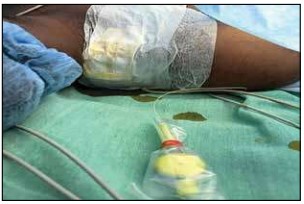
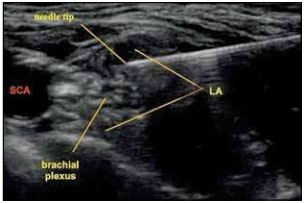
Regional anaesthesia is often used as a technique of choice for managing both intraoperative surgical procedure and postoperative analgesia in patients with upper extremity injuries. For providing extended pain relief continuous peripheral nerve block (CPNB) is an appropriate anaesthetic technique. The use of CPNB allows rapid establishment of analgesia sufficient for surgical interventions and provides excellent pain control while decreasing the need for opioids and other pain medications after operation.1 We report a successful use of ultrasound-guided supraclavicular CPNB in a case of accidental cut injury to right forearm for intraop surgical procedure and postop analgesia. This case demonstrates the utility of ultrasound-guided CPNB in anaesthetic management of traumatic injuries in which general anesthesia can be precarious due to severe cardiac pathology. We report a case of 30-year-old male with accidental cut injury to middle 1/3rd of right forearm who underwent wound exploration and artery/nerve/tendon repair. During pre-anaesthetic evaluation, he was found to have ‘pulsus parvus et tardes’ and an ejection systolic murmur in aortic and pulmonary areas. Clinically, however, the patient appeared stable with MET score of >4 and gave no history fatigue, shortness of breath or chest discomfort. He was not previously evaluated for any cardiac disorders. The 2D echo done, revealed severe aortic stenosis. Cardiologist was consulted regarding the same, who opined that the patient carries high risk for perioperative adverse cardiac events. Pre-operative VAS as described by the patient was5. Before performing the anaesthetic procedure, patient was sedated with injection Midazolam 2mg and injection Fentanyl 30mcg. Under strict aseptic precautions, skin infiltrated with Inj Lignocaine 2%. Under ultrasound guidance using the in-plane technique, the tip of an 18G tuohy’s needle was positioned at the brachial plexus and a catheter was sited. After negative aspiration, 20ml of Inj Bupivacaine 0.5% was injected. Adequate motor and sensory block was achieved after 15 minutes with VAS, now reduced to, 0. Intra-op, after 4hrs of initial local anaesthetic dose patient complained of pain, top-up of Inj Bupivacaine 0.5%, 5cc was administered. A 5-lead ECG was used for continuous cardiac monitoring for optimal identification of adverse cardiac events. NIBP was used to monitor intraop BP, and since, significant fluid/blood loss was not anticipated in this case, an arterial line wasn’t sited. The surgical procedure was 5 hours long. Vitals were stable throughout. The catheter was removed in the immediately after completion of the procedure before shifting the patient to PACU (post anaesthesia care unit). The patient was monitored in PACU and discharged with an Aldrete score of 9 and VAS of 1. Post-op analgesic effect lasted for 5 hours, after which rescue analgesia (Inj Diclofenac 75mg, slow IV) was administered.
References
- 1. Plunkett A.R., Brown D.S., Rogers J.M., Buckenmaier C.C. 3rd. Supraclavicular continuous peripheral nerve block in a wounded soldier: when ultrasound is the only option. Br J Anaesth. 2006 Nov. 97(5): 715-7.
- 2. Winnie A.P., Collins V.J. The Subclavian Perivascular Technique of Brachial Plexus Anesthesia. Anesthesiology. 1964 May-Jun; 25: 353-63.
- 3. Nishimura R.A., Otto C.M., Bonow R.O., Carabello B.A., Erwin J.P. 3rd, Guyton R.A., O’Gara P.T., Ruiz C.E., Skubas N.J., Sorajja P., Sundt T.M. 3rd, Thomas J.D.; ACC/AHA Task Force Members. 2014 AHA/ACC Guideline for the Management of Patients With Valvular Heart Disease: Executive summary: A report of the American College of Cardiology/ American Heart Association Task Force on Practice Guidelines. Circulation. 2014 Jun 10; 129(23): 2440-92.
- 4. Burt C.C., Littwin S.M., Adebayo J., Mallavaram N.A., Thys D.M. Regional Anesthesia & Cardiovascular Disease. In: Hadzic A. eds. Hadzic’s Textbook of Regional Anesthesia and Acute Pain Management, 2e. McGraw-Hill Education; 2017.
- 5. Aguirre J., Del Moral A., Cobo I., Borgeat A, Blumenthal S. The role of continuous peripheral nerve blocks. Anesthesiol Res Pract. 2012; 2012: 560879.
- 6. Tai Y.H., Chang C.C., Yeh C.C., Cherng Y.G., Chen T.L., Liao C.C. Adverse outcomes after noncardiac surgery in patients with aortic stenosis. Sci Rep. 2021 Sep 30; 11(1): 19517.
Data Sharing Statement
There are no additional data available.
Funding
This research received no funding.
Author Contributions
All authors contributed significantly to the work and approve its publication.
Ethics Declaration
This article does not involve any human or animal subjects, and therefore does not require ethics approval.
Acknowledgements
Information not provided.
Conflicts of Interest
The authors report no conflicts of interest in this work.
About this article

Cite this article
Namratha KR, Suresh Kumar N, Ankitha S. Continuous supraclavicular brachial plexus block for a case with severe aortic stenosis: case report. Ind J Anesth Analg. 2025;12(1):44-47.
Licence:
Attribution-Non-commercial 4.0 International (CC BY-NC 4.0)This license enables reusers to distribute, remix, adapt, and build upon the material in any medium or format for noncommercial purposes only, and only so long as attribution is given to the creator.
| Received | Accepted | Published |
|---|---|---|
| October 14, 2024 | November 13, 2024 | March 15, 2025 |
DOI: https://doi.org/10.21088/ijaa.2349.8471.12125.8
Keywords
Continuous Peripheral Nerve BlockAortic StenosisPost-op analgesicSearch for Similar Articles
Similar Articles
- Awake Fibreoptic Intubation for Airway Management in Massive Thyroid Enlargement...
- A Case of Thoracotomy with One Lung Ventilation for Carcinoma Oesophagus
- A Case of Empyema for Thoracotomy and Decortication-Anaesthesia Management
- Full Mouth Rehabilitation in a 3-Year-Old Female Child with Repaired Tetralogy o...
- Do Gel Manicures Affect SpO2 Readings ? A Clinical Investigation
Article Level Metrics
Last UpdatedTuesday 14 July 2026, 09:00:53 (IST)
5690
Accesses
21
679
00
Citations
NA
NA
NA
Download citation
Article Keywords
Keyword Highlighting
Highlight selected keywords in the article text.
Timeline
| Received | October 14, 2024 |
| Accepted | November 13, 2024 |
| Published | March 15, 2025 |
licence
Attribution-Non-commercial 4.0 International (CC BY-NC 4.0)
This license enables reusers to distribute, remix, adapt, and build upon the material in any medium or format for noncommercial purposes only, and only so long as attribution is given to the creator.