Full Text (PDF)
Journal of Pharmaceutical and Medicinal Chemistry 10(1):p 17-23, Jan-June 2024. | DOI: https://doi.org/10.21088/jpmc.2395.6615.10124.2
Review Article
Method Development and Validation for Simultaneous Estimation of Trace Level Ions in Purified Water by Ion Chromatography
Anirudh Mehta, Nilesh Patel K, Ravi Joshi M, Amit Vegad, Naicker Prashant S
Author Information
Licence:
Attribution-Non-commercial 4.0 International (CC BY-NC 4.0)This license enables reusers to distribute, remix, adapt, and build upon the material in any medium or format for noncommercial purposes only, and only so long as attribution is given to the creator.
Journal of Pharmaceutical and Medicinal Chemistry 10(1):p 17-23, Jan-June 2024. | DOI: https://doi.org/10.21088/jpmc.2395.6615.10124.2
How Cite This Article:
Anirudh Mehta, Nilesh Patel K., Ravi Joshi et al. Method Development and Validation for Simultaneous Estimation of Trace Level Ions in Purified Water by Ion Chromatography. J Pharmaceut Med Chem. 2024;10(1):17-23.Timeline
Received : April 25, 2024
Accepted : May 30, 2024
Published : June 28, 2024
Abstract
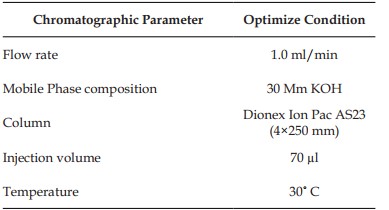
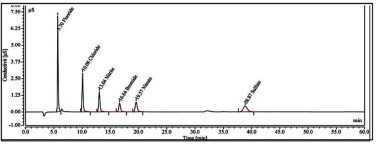
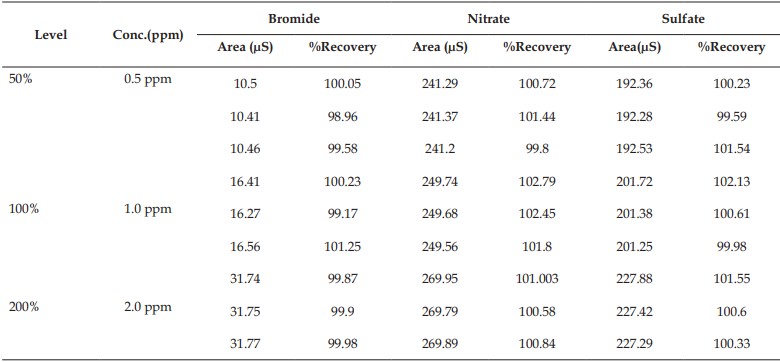
Background: A simple, accurate, precise and reproducible Ion Chromatography simultaneous estimation method development and validation for estimation of trace level ions in purified water. Method: A specific and sensitive isocratic IC method was developed and validated for analysis of trace level ions in purified water using thermo scientific AS23 (4×250 mm) with flow rate 1.0 ml/min and Temperature 30 °C. The isocratic mode was used for elution and the mobile phase was 30 mM KOH. Result: The samples were analyzed using 70 µl injection volume. The developed method was validated as per ICH Q2R1 for linearity, specificity, accuracy, precision, limit of detection, limit of quantification and robustness. The linearity of the proposed method was investigated in the range of 0.1-2.0 ppm for Fluoride, Chloride, Nitrite, Bromide, Nitrate, and Sulfate (R2 = 0.9991,0.9974,0.9997,0.9982,0.9979,0.9968). The % accuracy was found to be in the range of Fluoride, Chloride, Nitrite, Bromide, Nitrate and Sulfate was found to be in range of 98.05 –99.79%, 98.17 – 101.04%, 99.62 – 101.06%, 98.96 – 102.04%, 99.80 – 101.04%, 99.59 – 102.31%. The RSD for precision and robustness was found less than 2. Conclusion: A rapid and sensitive isocratic elution mode analytical method was developed and validated for the simultaneous analysis for Purified water. Fluoride, Chloride, Nitrite, Bromide, Nitrate and Sulfate been validated in accordance with ICH Q2 (R1) requirements.
References
- 1. International Conference on Harmonization ICH of Technical Requirements for the Registration of Pharmaceuticals for Human Use, “Guidance for Industry Q3A Impurities in New Drug Substances”, ICH –Q3A, Geneva, 2008.
- 2. Kumar M and Puri A, “A review of permissible limits of drinking water.”Indian Journal of Occupational and Environmental Medicine. 2012,41- 43.
- 3. WHO, “Guidelines for drinking-water quality”, November 2022, https://www.who.int/ publications/i/item/9789240045064
- 4. Snyder LR, Kirkland JJ and Glajch JL. Practical HPLC method development;2nd Edn; John Wiley & Sons, INC, 1997, pp21-56.
- 5. Yogesh K, Sayed MD and Mustaq A., “HPLC: Principle and Maintenance with application.” J. International Journal of Trend in Scientific Research and Development, 2018, 2 (5),1618-1626.
- 6. Sethi PD, HPLC-Quantitative analysis of pharmaceutical formulations; 3rd Edn; CBS publishers & distributors, 1997, pp59-63.
- 7. Chatwal GP. and Anand Sk. In Instrumental methods of chemical analysis; 5th Edn; Himalaya Publishing House, New Delhi,2002, pp2.165.
- 8. Skoog DA. And West DM., Principle of instrumental analysis; 2nd Edn; saunders college, united states of America, 1980, pp667.
- 9. Bansal V, Malviya R, Pal OP and Sharma PK, “High performance liquid chromatography: a short review.” J. Global Pharma Technol. 2010,2(5),22- 26.
- 10. Heftman, E. (Ed.), Chromatography: a laboratory handbook of chromatographicand electrophoretic techniques; Van Noostrand Rheinhold Co, New York, 1975.
- 11. Auriga Research, “Potential Application of Ion Chromatography” November 2022, https:// aurigaresearch.com/ion-chromatography/
- 12. G. Lavanya, M. Sunil, M.M. Eswarudu, M. Chinna Eswaraiah, K. Harisudha and B. Naga Spandana., “Analytical method validation: an updated review.” Int.J. Pharm. Sci. Res, 2013,4(4),1280-1286.
- 13. Shankar SR. Textbook of Pharmaceutical Analysis; 3rd Edn; Rx Publications,2006, pp13-1, 13-2.
- 14. Validation of analysis procedure: Text and Methodology Q2 (R1); ICHHarmonized Tripartite Guideline. 2005, 4-13.
- 15. WHO, “Water for Pharmaceutical Use”, November 2022, https://www.pharmaguideline. com/2010/12/who-water-for-pharmaceutical- use. html
- 16. BIS, “Drinking Water”, November 2022 https:// www.bis.gov.in/wp-content/uploads/2020/10/ PM-IS-10500.pdf
- 17. V Ivanova, A Surleva and B Koleva, “Validation of Ion Chromatographic Method for Determination of Standard Inorganic Anions in Treated and Untreated Drinking Water”,Materials Science and Engineering.2018.
- 18. Damian Connolly and Brett Paul, “Rapid determination of nitrate and nitrite in drinking water samples using ion-interaction liquid chromatography.” AnalyticaChimica Acta.2001. 53–62.
- 19. Corpinot M, Estelle R, Beatrice Frocrain, Devaux M, Stephane M, “Drinking Water Testing by Ion Chromatography using Ultrapure Water.”
- 20. Dragana K, Ivana D, Antonije O and Ljubinka R, “Development of ion chromatography methods for the determination of trace anions in ultra-pure water from power plant.” Journal of the Serbian Chemical Society 2005.997.
- 21. Musa M, Ahmed IM and Ismat A, “Determination of Bromate at Trace LevelinSudanese Bottled Drinking Water Using Ion Chromatography”, E-Journal of Chemistry.2010.S285.
- 22. Kazuaki I, Ryosuke N and Takuya F, “Determination of nitrite, nitrate, bromide,and iodide in seawater by ion chromatography with UV detection using dilauryldimethylammonium-coated monolithic ODS columns and sodium chloride as an eluent.” Anal Bioanal Chem ,2012.2514-2515.
- 23. Rajmund M and Aleksandra L, “Trace level determination of inorganic anions and cations in water.” Archives of Environmental Protection. 2007.23–29.
- 24. Fuad Al, “Method development and validation of simultaneous determination of seventeen metals in water by ICP/MS.” Journal of Advances in Chemistry.2013.
Data Sharing Statement
There are no additional data available. All raw data and code are available upon request.
Funding
This research received no funding.
Author Contributions
All authors contributed significantly to the work and approve its publication.
Ethics Declaration
This article does not involve any human or animal subjects, and therefore does not require ethics approval.
Acknowledgements
We would like to express our gratitude to the patients, their families, and all those who have contributed to this study.
Conflicts of Interest
No conflicts of interest in this work.
About this article

Cite this article
Anirudh Mehta, Nilesh Patel K., Ravi Joshi et al. Method Development and Validation for Simultaneous Estimation of Trace Level Ions in Purified Water by Ion Chromatography. J Pharmaceut Med Chem. 2024;10(1):17-23.
Licence:
Attribution-Non-commercial 4.0 International (CC BY-NC 4.0)This license enables reusers to distribute, remix, adapt, and build upon the material in any medium or format for noncommercial purposes only, and only so long as attribution is given to the creator.
| Received | Accepted | Published |
|---|---|---|
| April 25, 2024 | May 30, 2024 | June 28, 2024 |
DOI: https://doi.org/10.21088/jpmc.2395.6615.10124.2
Keywords
Purified waterAnalytical Method validationTrace level AnionsIon ChromatographySearch for Similar Articles
Similar Articles
- Pharmaceutical Care in Primary Healthcare: A Study of Nurses
- Artificial Intelligence in Pharmaceutical Research and Development: From Target...
- Developing a Structured Teaching Program for Precision Medicine in Nursing Pract...
- Comprehensive Scientific Review on the Natural Process of Aging, Anti-Aging Mech...
- Formulation and Evaluation of Curcumin Lozenges to Treat Throat Infections
Article Level Metrics
Last UpdatedMonday 26 October 2026, 22:20:31 (IST)
1383
Accesses
12
118
00
Citations
NA
NA
NA
Download citation
Article Keywords
Keyword Highlighting
Highlight selected keywords in the article text.
Timeline
| Received | April 25, 2024 |
| Accepted | May 30, 2024 |
| Published | June 28, 2024 |
licence
Attribution-Non-commercial 4.0 International (CC BY-NC 4.0)
This license enables reusers to distribute, remix, adapt, and build upon the material in any medium or format for noncommercial purposes only, and only so long as attribution is given to the creator.