Full Text (PDF)
Journal of Dermatology 9(1):p 13-18, January–June 2024. | DOI: NA
Original Article
Management of Perineal Scald Burn in a Tertiary Care Hospital: Our Experience
Ravi Kumar Chittoria, Walunj Sachin Dnyaneshwar, Barath Kumar Singh P
Author Information
Licence:
Attribution-Non-commercial 4.0 International (CC BY-NC 4.0)This license enables reusers to distribute, remix, adapt, and build upon the material in any medium or format for noncommercial purposes only, and only so long as attribution is given to the creator
Journal of Dermatology 9(1):p 13-18, January–June 2024. | DOI: NA
How Cite This Article:
Dnyaneshwar WS, Chittoria RK, Singh PBK. Management of Perineal Scald Burn in a Tertiary care hospital: Our experience. RFP Jr of Drea. 2024;9(1):13-18.Timeline
Received : September 21, 2023
Accepted : November 01, 2023
Published : June 30, 2024
Abstract
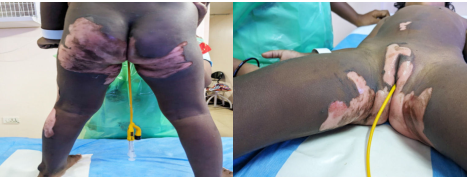
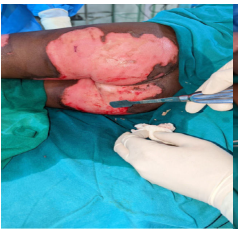
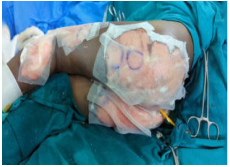
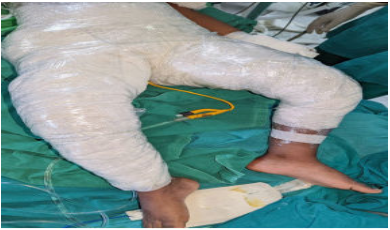
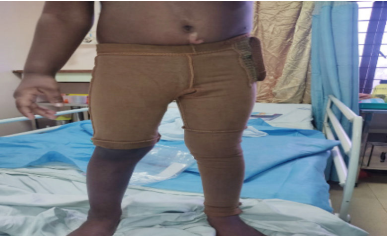
Burns to the perineum and buttocks are difficult to heal for a number of reasons, including the constant threat of contamination and shear stress. Pathogens can easily penetrate the wound bed and induce systemic infection. Patients' recovery is further delayed by lengthy healing times, which increases their pain and psychological stress as a result of the injury. Though they are rare, significant burns to the lower trunk and lower limbs can also involve the external urethra, penis, labial tissues, anal opening, and distal rectal mucosa. In this case report, we discuss the management of perineal burn wounds in our center.
References
- 1. L.D. Carrillo-Córdova, R. Carrillo-Esper, J.R. Carrillo-CórdovaBurns to the genitalia and perineum: General considerations and urologic managementRev Mex Urol, 77 (1) (2017), pp. 36-49
- 2. Sajad W, Hamid R. Outcome of split-thickness skin grafting and multiple z-plasties in postburn contractures of groin and perineum: a 15-year experience. Plast Surg Int. 2014; 2014:358526. 10.1155/2014/358526. Epub 2014 May 21.
- 3. N.J. Abel, Z. Klaassen, E.H. Mansour, M.A Marano, S.J. Petrone, A.P. Houng, et al.
- 4. Clinical outcome analysis of male and female genital burn injuries: a 15-year experience at a Level-1Burn Center. Int J Urol, 19 (2012), pp. 351-358
- 5. Akbarzadeh S, McKenzie MB, Rahman MM, Cleland H. Allogeneic platelet-rich plasma: is it safe and effective for wound repair? European Surgical Research. 2021 May 18;62(1):1-9.
- 6. Lu W, Lu K, Peng Y, Chen P, Bian W, Yu W. The efÀcacy of low-level laser therapy for the healing of second-degree burn wounds on lower limbs of glucocorticoid-dependent patients. Lasers in Medical Science. 2023 Aug 15;38(1):186.
- 7. Shpichka A, Butnaru D, Bezrukov EA, Sukhanov RB, Atala A, Burdukovskii V, Zhang Y, Timashev P. Skin tissue regeneration for burn injury. Stem cell research & therapy. 2019 Dec; 10:1-6.
- 8. Dumville JC, Munson C, Christie J. Negative pressure wound therapy for partial thickness burns. Cochrane Database of Systematic Reviews. 2014(12).
- 9. Mustoe TA. Evolution of silicone therapy and mechanism of action in scar management. Aesthetic plastic surgery. 2008 Jan;32: 82-92.
- 10. Moenadjat Y, Setiabudy R, Astrawinata DA, Gumay S. The safety and efÀcacy of feracrylum as compared to silver sulfadiazine in the management of deep partial thickness burn: A clinical study report. Medical Journal of Indonesia. 2008 Nov 1;17(4):259-71.
Data Sharing Statement
There are no additional data available
Funding
This research received no funding
Author Contributions
All authors contributed significantly to the work and approve its publication
Ethics Declaration
This article does not involve any human or animal subjects, and therefore does not require ethics approval
Acknowledgements
Information Not Provided
Conflicts of Interest
No conflicts of interest in this work
About this article

Cite this article
Dnyaneshwar WS, Chittoria RK, Singh PBK. Management of Perineal Scald Burn in a Tertiary care hospital: Our experience. RFP Jr of Drea. 2024;9(1):13-18.
Licence:
Attribution-Non-commercial 4.0 International (CC BY-NC 4.0)This license enables reusers to distribute, remix, adapt, and build upon the material in any medium or format for noncommercial purposes only, and only so long as attribution is given to the creator
| Received | Accepted | Published |
|---|---|---|
| September 21, 2023 | November 01, 2023 | June 30, 2024 |
DOI: NA
Keywords
Management; Scald; Burns; Perineum.ScaldBurnsPerineumManagementSearch for Similar Articles
Similar Articles
- Role of Topical Cholecalciferol Granules in the Recovery and Management of Therm...
- Chitosan Liquid Wound Dressing in the Use of Deep Scald Burns
- Role of Biocellulose Occlusive Dressing in Partial Thickness Burn Wound Manageme...
- Artificial Intelligence in the Digital Transformation of Dermatology: Current E...
- Artificial Intelligence in Dermatology in India: A PRISMA-Compliant Systematic...
Article Level Metrics
Last UpdatedSaturday 05 September 2026, 18:22:49 (IST)
1128
Accesses
24
109
00
Citations
NA
NA
NA
Download citation
Article Keywords
Keyword Highlighting
Highlight selected keywords in the article text.
Timeline
| Received | September 21, 2023 |
| Accepted | November 01, 2023 |
| Published | June 30, 2024 |
licence
Attribution-Non-commercial 4.0 International (CC BY-NC 4.0)
This license enables reusers to distribute, remix, adapt, and build upon the material in any medium or format for noncommercial purposes only, and only so long as attribution is given to the creator