Full Text (PDF)
Journal of Dermatology 9(1):p 07-11, January–June 2024. | DOI: NA
Original Article
Role of Topical Feracrylum in Management of Second Degree Scald Burns
Ravi Kumar Chittoria, Nivetha , Bharath Prakash
Author Information
Licence:
Attribution-Non-commercial 4.0 International (CC BY-NC 4.0)This license enables reusers to distribute, remix, adapt, and build upon the material in any medium or format for noncommercial purposes only, and only so long as attribution is given to the creator
Journal of Dermatology 9(1):p 07-11, January–June 2024. | DOI: NA
How Cite This Article:
Nivetha, Chittoria RK, Prakash B. Role of Topical Feracrylum in Management of Second Degree Scald Burns. RFP Jr of Drea. 2024;9(1):7-11Timeline
Received : August 14, 2023
Accepted : October 04, 2023
Published : June 30, 2024
Abstract
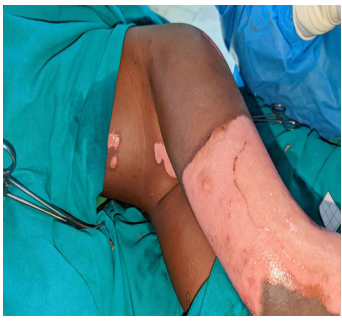
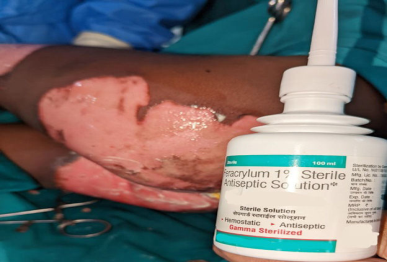
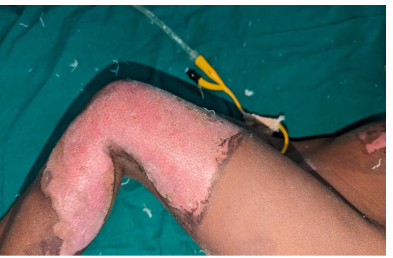
Partial and deep partial-thickness burn wounds present a difficult diagnosis and prognosis.Management of burn wound inflicted by the different physical and chemical agents require different regimes which are poles apart from the regimes used for any of the other traumatic wounds. In extensive burn, because of increased capillary permeability, there is extensive loss of plasma leading to shock while whole blood loss is the cause of shock in other acute wounds.Even though the burn wounds are sterile in the beginning in comparison to most of other wounds, yet, the death in extensive burns is mainly because of wound infection and septicemia, because of the immunocompromised status of the burn patients. Current techniques of burn wound care have significantly reduced the incidence of invasive burn wound infection, altered the organisms causing the infections that do occur, increased the interval between injury and the onset of infection, reduced the mortality associated with infection, decreased the overall incidence of infection in burn patients, and increased burn patient survival. Feracrylum, a water-soluble combination of partial ferrous salts (II and III) of polyacrylic acid, is one of the chemical hemostatic agents and an antibacterial agent. Its molecular weight ranges from 500,000 to 800,000 Daltons, which prevents systemic absorption and prevents any negative effects on the liver, kidney, adrenals, cardiovascular, or hemostatic systems. Feracrylum has antibacterial properties, which lowers the risk of wound infection.
References
- 1. Mehta M, Tudor GJ. StatPearls [Internet]. StatPearls Publishing; Treasure Island (FL): Jul 11, 2022. Parkland Formula.
- 2. Sahin C, Kaplan P, Ozturk S, Alpar S, Karagoz H. Treatment of partial-thickness burns with a tulle-gras dressing and a hydrophilic polyurethane membrane: a comparative study. J Wound Care. 2019 Jan 02;28(1):24-28.
- 3. Eyvaz K, Kement M, Balin S, Acar H, Kündeş F, Karaoz A, Civil O, Eser M, Kaptanoglu L, Vural S, Bildik N. Clinical evaluation of negativepressure wound therapy in the management of electrical burns. Ulus Travma Acil Cerrahi Derg. 2018 Sep;24(5):456-461.
- 4. Wu YT, Chen KH, Ban SL, Tung KY, Chen LR. Evaluation of leap motion control for hand rehabilitation in burn patients: An experience in the dust explosion disaster in Formosa Fun Coast. Burns. 2019 Feb;45(1):157-164.
- 5. Moenadjat Y, Setiabudy R, Astrawinata AWD, Gumay S. The Safety and EfÀcacy of Feracrylum as Compared to Silver Sulfadiazine in the Management of Deep Partial Thickness Burn: A Clinical Study Report. Med J Indones, 2008; 17: 259-71.
- 6. Bhagwat AM, Save S, Burli S, Karki SG. A Study to Evaluate the Antimicrobial Activity of Feracrylum and its Comparison with Povidone Iodine. Indian J Pathol Microbial, 2001; 44: 431-433.
- 7. Lahoti KB, Aggarwal G, Diwaker A, Sharma SS, Laddha A. Hemostasis during Hypospadias Surgery via Topical Application of FeracrylumCitrate: A Randomized Prospective Study. J Indian Assoc Pediatr Surg, 2010; 15: 87-89.
- 8. Chauhan MK, Feracrylum KM. An Effective and safe Topical Haemostatic agent. World J Pharm Res. 2017;6(10):319–325. doi: 10.20959/ wjpr201710-9372.
- 9. Laddha AK, Mulla M, Sharma SS, Lahoti BK, Mathur R. A prospective comparison of topical feracrylum citrate versus adrenaline as haemostatic agent in hypospadias surgery in children. Afr J Paediatr Surg. 2014;11(3):215. doi: 10.4103/0189-6725.143191.
- 10. Sathyaki DC, Roy MS, Mohan M, Raghu N, Sheriff RM. Feracrylum versus topical adrenaline for hemostasis in tonsillectomy. Int J Sci Stud. 2017;4(10):34–36. doi: 10.17354/ijss/2017/07.
- 11. Prabhu NT, Munshi AK. Clinical, radiographic and histological observations of the redicular pulp following “feracrylum” pulpotomy. J Clin Pediatr Dent. 1997; 21:151-6.
Data Sharing Statement
There are no additional data available
Funding
This research received no funding
Author Contributions
All authors contributed significantly to the work and approve its publication
Ethics Declaration
This article does not involve any human or animal subjects, and therefore does not require ethics approval
Acknowledgements
Information Not Provided
Conflicts of Interest
No conflicts of interest in this work
About this article

Cite this article
Nivetha, Chittoria RK, Prakash B. Role of Topical Feracrylum in Management of Second Degree Scald Burns. RFP Jr of Drea. 2024;9(1):7-11
Licence:
Attribution-Non-commercial 4.0 International (CC BY-NC 4.0)This license enables reusers to distribute, remix, adapt, and build upon the material in any medium or format for noncommercial purposes only, and only so long as attribution is given to the creator
| Received | Accepted | Published |
|---|---|---|
| August 14, 2023 | October 04, 2023 | June 30, 2024 |
DOI: NA
Keywords
Topicalferacrylummanagementsecond degree scald burns.Topicalferacrylummanagementsecond degree scald burns.Search for Similar Articles
Similar Articles
- Role of Topical Cholecalciferol Granules in the Recovery and Management of Therm...
- Chitosan Liquid Wound Dressing in the Use of Deep Scald Burns
- Role of Biocellulose Occlusive Dressing in Partial Thickness Burn Wound Manageme...
- Artificial Intelligence in the Digital Transformation of Dermatology: Current E...
- Artificial Intelligence in Dermatology in India: A PRISMA-Compliant Systematic...
Article Level Metrics
Last UpdatedSaturday 05 September 2026, 18:22:34 (IST)
1128
Accesses
30
109
00
Citations
NA
NA
NA
Download citation
Article Keywords
Keyword Highlighting
Highlight selected keywords in the article text.
Timeline
| Received | August 14, 2023 |
| Accepted | October 04, 2023 |
| Published | June 30, 2024 |
licence
Attribution-Non-commercial 4.0 International (CC BY-NC 4.0)
This license enables reusers to distribute, remix, adapt, and build upon the material in any medium or format for noncommercial purposes only, and only so long as attribution is given to the creator