Full Text (PDF)
Indian Journal of Obstetrics and Gynecology 13(3):p 99-108, July - Sept. 2025. | DOI: 10.21088/ijog.2321.1636.13325.2
Original Article
Lower Dose of Ulipristal Therapy: Comparison of 2.5 versus 5 mg for Efficacy and Safety in Medical Management of Uterine Fibroids
Nutan Agarwal,, Saroj Rajan, Vatsla Dadhwal, Aparna K Sharma, Vidushi Kulshrestha
Author Information
Licence:
Attribution-Non-commercial 4.0 International (CC BY-NC 4.0)This license enables reusers to distribute, remix, adapt, and build upon the material in any medium or format for noncommercial purposes only, and only so long as attribution is given to the creator.
Indian Journal of Obstetrics and Gynecology 13(3):p 99-108, July - Sept. 2025. | DOI: 10.21088/ijog.2321.1636.13325.2
How Cite This Article:
Agarwal N, Rajan S, Dadhwal V, et al. Lower dose of ulipristal therapy: comparison of 2.5 versus 5 mg for efficacy and safety in medical management of uterine fibroids. Indian J Obstet Gynecol. 2025;13(3):99-108.Timeline
Received : July 28, 2025
Accepted : October 08, 2025
Published : September 30, 2025
Abstract
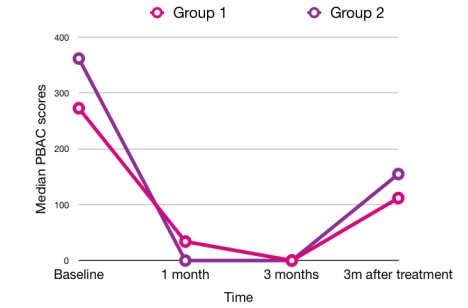
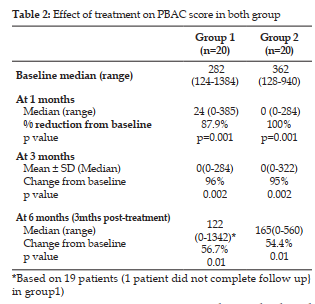
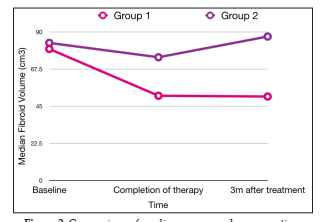
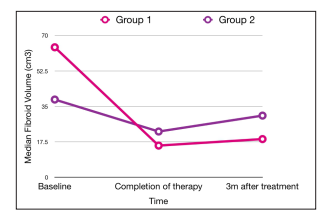
Objective: To compare the efficacy of 2.5mg versus 5mg ulipristal acetate in reducing symptoms (menstrual blood loss and pelvic pain) and volume of uterine fibroids. Design: Randomized controlled trial, conducted at All India Institute of Medical Sciences, New Delhi. Recruitment was terminated after 40 patients in June 2018, after MHRA advisory. Methods: Women with symptomatic uterine fibroids, with PBAC score >100 with or without pelvic pain and at least one fibroid >3cm diameter, were recruited and randomized into two groups: group 1 (n=20) received 2.5mg ulipristal acetate and group 2 (n=20) received 5mg ulipristal acetate once daily for 13 weeks. Assessment of PBAC scores and fibroid volume by ultrasound were done at baseline, after 3 months of therapy and then 3 months after discontinuation of therapy i.e. at 6 month follow-up. Liver functions were evaluated at 3 and 6 months follow-up. Results: Significant reductions in PBAC scores occurred in both groups. Median (interquartile range) of PBAC scores reduced from 282 (124–1384) to 34 (0-385), in the 2.5mg group and 362 (128–940) to 0 (0- 284) in the 5mg group showing .87.5% and 100% reduction respectively. Further reduction after 3 months on treatment was as 0 ((0- 185) and 0 (0-322), p=0.001 in group1 and 2 respectively(p=0.001), 3 months after stopping treatment, score increased to 122(0-1312) & 165(0-560) however reduction from baseline in both groups 56.7 & 54.4% respectively. Amenorrhoea occurred in 6(30%) and 13(65%), 15(75%) & 16(80%) after1mth, 3mths on therapy and 4(20%) & 1(5%) 3months after treatment in 2.5 and 5mg group respectively. Normal periods achieved in 8(40%), 3(15%) at 1 month, 2(10%) & 1(5%) at 3mths and 4(20%) & 6(30%) cases in gp1 & 2 respectively. VAS remained significantly reduced in both groups even after stopping drug Median fibroid volumes reduced significantly in the 2.5mg group [(79.63cm3 (27.35- 148.04) to 51.3cm3 (2.52-82.86), 35.58%, p=0.002] but less in the 5mg group baseline 83.31cm3 (33.99- 309.8)] to 74.61cm3 (18.-283.64), 10.44%, p=0.526] Monitoring of liver functions showed increased SGOT and SGPT up to 222 and 399 in group 2 at 3 months follow-up which became normal in 3 months’ time. Monitoring of liver functions tests in both groups did not reveal any abnormalities. Neither dose of ulipristal suppressed estradiol. Conclusions: Treatment with 2.5mg Ulipristal acetate for 3 months is a feasible option in terms of symptoms control when compared to 5 mg dose. Rebound phenomenon is more with higher dose. With concerns of side effects with 5 mg dose, chief aauthor suggests to give 2.5 mg dose as it can be safer option. Further larger well powered studies may be conducted with lower doses of ulipristal for fibroid management.
References
- 1. Day Baird D, Dunson DB, Hill MC, Cousins D, Schectman JM. High cumulative incidence of uterine leiomyoma in black and whitewomen: Ultrasound evidence. American Journal of Obstetrics and Gynecology. 2003 Jan;188(1):100–7.
- 2. Merill R. Hysterectomy Surveillance in the United States, 1997 through 2005. Med Sci Monit, 2008; 14(1): CR24-31.
- 3. Courtoy GE, Henriet P, Marbaix E, de Codt M, Luyckx M, Donnez J, et al. Matrix Metalloproteinase Activity Correlates With Uterine Myoma Volume Reduction After Ulipristal Acetate Treatment. The Journal of Clinical Endocrinology & Metabolism. 2018 Apr 1;103(4):1566–73.
- 4. Donnez J, Bouchard P, Zakharenko NF, Ugocsai G, Bestel E, Loumaye E. Ulipristal Acetate versus Placebo for Fibroid Treatment before Surgery. The New England Journal of Medicine. 2012;12.
- 5. Jacques D, Janusz T, Francisco V, Philippe B, Boguslav L, Francesco B, et al. Ulipristal Acetate versus Leuprolide Acetate for Uterine Fibroids. The New England Journal of Medicine. 2012;12.
- 6. Donnez J, Vázquez F, Tomaszewski J, Nouri K, Bouchard P, Fauser BCJM, et al. Longterm treatment of uterine fibroids with ulipristal acetate. Fertility and Sterility. 2014 Jun;101(6):1565-1573.e18.Acetate versus Leuprolide Acetate for Uterine Fibroids. The New England Journal of Medicine. 2012;12.
- 7. Donnez J, Hudecek R, Donnez O, Matule D, Arhendt H-J, Zatik J, et al. Efficacy and safety of repeated use of ulipristal acetate in uterine fibroids. Fertility and Sterility. 2015 Feb;103(2):519-527.e3.
- 8. esmya-article-20-procedure-assessmentreport-provisional-measures_en.pdf [Internet]. [cited 2018 Nov 18]. Available from: http s:// www.ema.europa.eu/documents/referral/ Nutan Agarwal, Saroj Rajan, Vatsla Dadhwal et. al, Lower dose of Ulipristal Therapy: Comparison of 2.5 versus 5 mg for efficacy and safety in medical management of Uterine Fibroids108 Indian Journal of Obstetrics and Gynecology IJOG / Volume 13, Number 3 / July - September 2025 esmya-article-20-procedure-assessmentreport-provisional-measures_en.pdf
- 9. Brun J-L, Rajaonarison J, Froeliger A, MonseauThiburce A-C, Randriamboavonjy R, Vogler A.Outcome of patients with uterine fibroids after 3-month ulipristal acetate therapy. European Journal of Obstetrics & Gynecology and Reproductive Biology. 2018 Mar;222:13–8.
- 10. Czuczwar P, Wozniak S, Szkodziak P, Milart P, Wozniakowska E, Wrona W, et al. Influence of ulipristal acetate therapy compared with uterine artery embolization on fibroid volume and vascularity indices assessed by three-dimensional ultrasound: prospective observational study. Ultrasound in Obstetrics & Gynecology. 2015 Jun;45(6):744–50.
- 11. Lee MJ, Yun BS, Seong SJ, Kim M-L, Jung YW, Kim MK, et al. Uterine fibroid shrinkage after short-term use of selective progesterone receptor modulator or gonadotropin-releasing hormone agonist. Obstetrics & Gynecology Science. 2017;60(1):69.
Data Sharing Statement
There are no additional data available. All raw data and code are available upon request.
Funding
This research received no funding.
Author Contributions
All authors contributed significantly to the work and approve its publication.
Ethics Declaration
This article does not involve any human or animal subjects, and therefore does not require ethics approval.
Acknowledgements
We would like to express our gratitude to the patients, their families, and all those who have contributed to this study.
Conflicts of Interest
No conflicts of interest.
About this article

Cite this article
Agarwal N, Rajan S, Dadhwal V, et al. Lower dose of ulipristal therapy: comparison of 2.5 versus 5 mg for efficacy and safety in medical management of uterine fibroids. Indian J Obstet Gynecol. 2025;13(3):99-108.
Licence:
Attribution-Non-commercial 4.0 International (CC BY-NC 4.0)This license enables reusers to distribute, remix, adapt, and build upon the material in any medium or format for noncommercial purposes only, and only so long as attribution is given to the creator.
| Received | Accepted | Published |
|---|---|---|
| July 28, 2025 | October 08, 2025 | September 30, 2025 |
DOI: 10.21088/ijog.2321.1636.13325.2
Keywords
Search for Similar Articles
Similar Articles
- When Eclampsia Strikes the Brain Twice
- Emergency Management of Cesarean Scar Pregnancy: A Rare Case of Life-Threatenin...
- The Efficacy of Structured Teaching Programs in Enhancing Pregnancy Management...
- Audit of Caesarean Sections by the Robson Ten Group Classification: A Six-Month...
- A Cross-Sectional Study on the Epidemiology and Risk Factors of Uterine Fibroids
Article Level Metrics
Last UpdatedSunday 21 June 2026, 15:47:16 (IST)
1468
Accesses
11
154
00
Citations
NA
NA
NA
Download citation
Article Keywords
Keyword Highlighting
Highlight selected keywords in the article text.
Timeline
| Received | July 28, 2025 |
| Accepted | October 08, 2025 |
| Published | September 30, 2025 |
licence
Attribution-Non-commercial 4.0 International (CC BY-NC 4.0)
This license enables reusers to distribute, remix, adapt, and build upon the material in any medium or format for noncommercial purposes only, and only so long as attribution is given to the creator.