Full Text (PDF)
Journal of Cardiovascular Medicine and Surgery 11(1):p 31-35, January-April 2025. | DOI: 10.21088/jcms.2454.7123.103424.5
Case Report
Intra-Arterial Abscess with Complete Destruction of Artery Following Angioplasty and Stenting of Stenosed Common Femoral Artery
Raja Lahiri, Ishan Jhalani, Indraj Saini
Author Information
Licence:
Attribution-Non-commercial 4.0 International (CC BY-NC 4.0)This license enables reusers to distribute, remix, adapt, and build upon the material in any medium or format for noncommercial purposes only, and only so long as attribution is given to the creator.
Journal of Cardiovascular Medicine and Surgery 11(1):p 31-35, January-April 2025. | DOI: 10.21088/jcms.2454.7123.103424.5
How Cite This Article:
Lahiri R, Jhalani I, Saini I. Intra-Arterial Abscess with Complete Destruction of Artery Following Angioplasty and Stenting of Stenosed Common Femoral Artery. J Cardiovasc Med Surg. 2025;11(1):31-5.Timeline
Received : February 25, 2025
Accepted : April 04, 2025
Published : April 15, 2025
Abstract
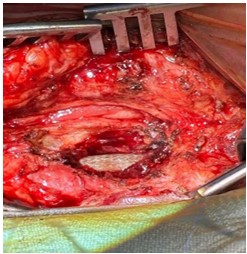
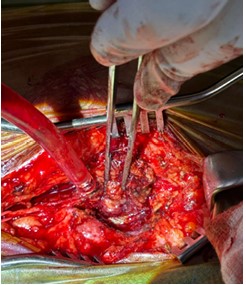
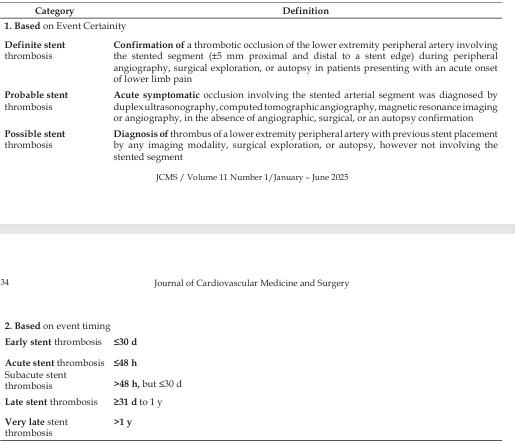
Vascular access site complications, including infections, have become increasingly prevalent with the rise of interventional procedures. This case report presents a 48-year-old male with a history of coronary artery disease who developed a rare intra-arterial abscess following angioplasty and stenting of the right superficial femoral artery through the left femoral access. Initially, the patient underwent percutaneous coronary intervention (PCI) via the right femoral artery, followed by peripheral angioplasty and stenting for right femoral artery stenosis. Postprocedure, he developed a superficial abscess at the right groin, which persisted despite initial drainage and medical therapy. Surgical exploration during debridement revealed extensive arterial destruction, with complete femoral artery destruction, thrombosis both proximal and distal to the stent, and a localized infected stent. The patient was initiated on culture-directed antibiotic therapy. This case highlights the rare but severe complication of intra-arterial abscess formation following endovascular procedures, with significant potential for stent thrombosis, vessel rupture, and arterial destruction. It underscores the critical need for routine antibiotic prophylaxis, vigilant post-procedural surveillance, and prompt intervention in cases of stent infection. Furthermore, it emphasizes the importance of deferring revascularization procedures until the infection has resolved to mitigate the risk of further complications.
References
- 1. Hamraoui K, Ernst SM, van Dessel PF, et al. Efcacyandsafetyofpercutaneoustreatment of iatrogenic femoral artery pseudoaneurysm by biodegradable collagen injection. J Am CollCardiol. 2002;39(8):1297-1304.
- 2. Messina LM, Brothers TE, Wakeeld TW, et al. Clinical characteristics and surgical management of vascular complications in patients undergoing cardiac catheterization: interventional versus diagnostic procedures. J Vasc Surg. 1991;13(5):593-600.
- 3. Lindsay SL, Kerridge R, Collett BJ. Abscess following cannulation of the radial artery. Anaesthesia. 1987;42:654-657.
- 4. Mohammad S. Angioplasty and stenting for peripheral arterial disease of the lower limbs [Internet]. Escardio.org. Available from: https://www.escardio.org/Journals/E Journal-of-Cardiology-Practice/Volume-16/ Angioplasty-and-stenting-for-peripheral arterial-disease-of-the-lower-limbs.
- 5. Johanning JM, Franklin DP, Elmore JR, Han DC. Femoral artery infections associated with percutaneous arterial closure devices. J Vasc Surg. 2001;34(6):983-985.
- 6. Frazee BW, Flaherty JP. Septic endarteritis of the femoral artery following angioplasty. Rev Infect Dis. 1991;13(4):620-623
- 7. Bosman WM, Borger van der Burg BL, Schuttevaer HM, Thoma S, HedemanJoosten PP. Infections of intravascular bare metal stents: a case report and review of literature. Eur J VascEndovasc Surg. 2014;47(1):87-99.
- 8. Parsons RE, Sanchez LA, Marin ML, et al. Comparison of endovascular and conventional vascular prostheses in an experimental infection model. J Vasc Surg. 1996;24(6):920 926.
- 9. Lauri C, Iezzi R, Rossi M, Tinelli G, Sica S, Signore A, et al. Imaging modalities for the diagnosis of vascular graft infections: A consensus paper amongst different specialists. J Clin Med. 2020;9(5):1510.
- 10. Banerjee S, Sarode K, Mohammad A, et al. Femoropopliteal artery stent thrombosis: Report from the Excellence in Peripheral Artery Disease Registry. CircCardiovascInterv. 2016;9(2):e002730.
- 11. Paget DS, Bukhari RH, Zayyat EJ, Lohr JM, Roberts WH, Welling RE. Infectibility of endovascular stents following antibiotic prophylaxis or after arterial wall incorporation. Am J Surg. 1999;178(3):219-24.
- 12. Hearn AT, James KV, Lohr JM, Thibodeaux LC, Roberts WH, Welling RE. Endovascular stent infection with delayed bacterial challenge. Am J Surg. 1997;174(2):157-9.
- 13. Hogg ME, Peterson BG, Pearce WH, Morasch MD, Kibbe MR. Bare metal stent infections: Case report and review of the literature. J Vasc Surg. 2007;46(4):813-20.
- 14. Pruitt A, Dodson TF, Najibi S, Thourani V, Sherman A, Cloft H, et al. Distal septic emboli and fatal brachiocephalic artery mycoticpseudoaneurysm as a complication of stenting. J Vasc Surg. 2002;36(3):625-8.
Data Sharing Statement
There are no additional data available.
Funding
This research received no funding.
Author Contributions
All authors contributed significantly to the work and approve its publication.
Ethics Declaration
none
Acknowledgements
No Information Provided
Conflicts of Interest
No conflicts of interest in this work.
About this article

Cite this article
Lahiri R, Jhalani I, Saini I. Intra-Arterial Abscess with Complete Destruction of Artery Following Angioplasty and Stenting of Stenosed Common Femoral Artery. J Cardiovasc Med Surg. 2025;11(1):31-5.
Licence:
Attribution-Non-commercial 4.0 International (CC BY-NC 4.0)This license enables reusers to distribute, remix, adapt, and build upon the material in any medium or format for noncommercial purposes only, and only so long as attribution is given to the creator.
| Received | Accepted | Published |
|---|---|---|
| February 25, 2025 | April 04, 2025 | April 15, 2025 |
DOI: 10.21088/jcms.2454.7123.103424.5
Keywords
Intra-arterial AbscessStentsArterial ThrombosisFemoral ArteryVascular Surgical ProcedureSearch for Similar Articles
Similar Articles
- Giant Intra-cardiac Lipoma in the Right Atrium
- Case Report: Neurophysiological Facilitation of Respiration in an Infant with...
- Left Coronary Artery Fistula Masquerading as Coronary Insufficiency: A Rare Sur...
- Hemodynamic Monitoring by Point-of-Care Ultrasound: A Multiorgan, Physiology-Dri...
- Aortotomy Closure after Cardiac Valve Replacements: Nightmare for Surgeons
Article Level Metrics
Last UpdatedMonday 22 June 2026, 12:32:07 (IST)
681
Accesses
5
121
00
Citations
NA
NA
NA
Download citation
Article Keywords
Keyword Highlighting
Highlight selected keywords in the article text.
Timeline
| Received | February 25, 2025 |
| Accepted | April 04, 2025 |
| Published | April 15, 2025 |
licence
Attribution-Non-commercial 4.0 International (CC BY-NC 4.0)
This license enables reusers to distribute, remix, adapt, and build upon the material in any medium or format for noncommercial purposes only, and only so long as attribution is given to the creator.