Full Text (PDF)
Journal of Dermatology 8(2):p 99-101, July-December 2023. | DOI: NA
Review Article
Innovative Skin Graft Harvesting Board
Ravi Kumar Chittoria, Furqan Mohammed Ahmed, Padmalakshmi Bharathi Mohan
Author Information
Licence:
Attribution-Non-commercial 4.0 International (CC BY-NC 4.0)This license enables reusers to distribute, remix, adapt, and build upon the material in any medium or format for noncommercial purposes only, and only so long as attribution is given to the creator
Journal of Dermatology 8(2):p 99-101, July-December 2023. | DOI: NA
How Cite This Article:
Ahmed FM, Mohan PB, Chittoria RK. Innovative Skin Graft Harvesting Board. RFP J Dermatol. 2023;8(2):99–101.Timeline
Received : March 16, 2023
Accepted : April 28, 2023
Published : December 30, 2023
Abstract
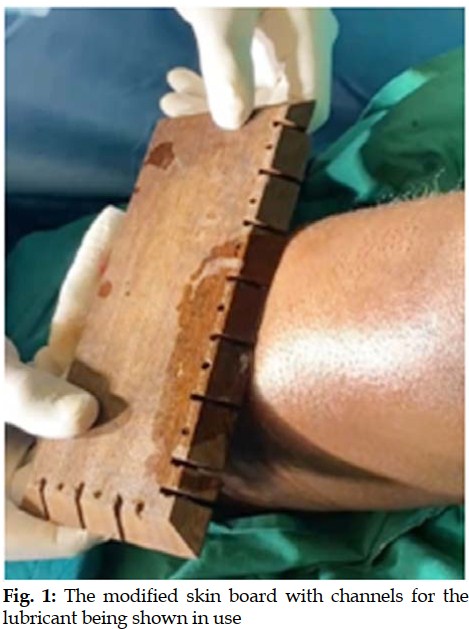
Skin boards are a pair of wooden boards used during skin harvesting to flatten the surface and ease the passage of the oncoming skin knife. The skin board is used to tense the skin by pressing the board against the skin and then pulling the two boards apart therefore creating a tension on the skin and flattening the surface. For the easy passage of the knife a lubricant is used on the skin (example Vaseline). The conventional skin boards scrape away most of this lubricant while stretching the skin. A modification has been made to the conventional skin boards by adding small channels on the surface of the board which lets lubricant slide through it and thus the lubricant remains on the skin to be harvested. This modification does not reduce the capacity of the skin board to tense the skin and provides a flat well lubricated surface for the skin knife to pass.
References
- 1. Reverdin JL. Greffesepidermiques. Bulletin dela Societe Imperialede Chirurgie de Paris. 1869; 10:51.
- 2. Lawson G. On the transplantation of portions of skin for the closure of large granulating surfaces. Transactions of the Clinical Society of London. 1871; 4: 49.
- 3. Ollier L. Greffescutaneeou auto plastiques. Le bulletin—Académie Nationale de Médecine de Paris. 1872; 1: 243.
- 4. Thiersh C. Uber die feinerenanatomischenver and erungenbeiaufheilung von Haut auf granulationen. Verhandlungen der Deutschen Gesellschaftfür Chirurgie. 1874; 3: 69. 5.
- 5. Blair VP, Brown JB. The use and uses of large split skin grafts of intermediate thickness. Surgery Gynecology & Obstetrics. 1929; 49: 82.
- 6. Brown JB, McDowell F. Skin Grafting. 2nd edition. Philadelphia, Pa, USA: JB Lippincott; 1949.
- 7. Valencia IC, Falabella AF, Eaglstein WH. Skin grafting. Dermatologic Clinics. 2000; 18(3):521– 532.
- 8. Ratner D. Skin grafting: from here to there. Dermatologic Clinics. 1998; 16(1):75–90.
- 9. Mutallik S, Ginzburg A. Surgical management of stable vitiligo: a review with personal experience. Dermatologic Surgery. 2000; 26 (3):248–254.
- 10. Lee SS, Tsai CC, Lai CS, Lin SD. An easy method for preparation of postage stamp autografts. Burns. 2000; 26(8):741–749.
- 11. Harashina T, Iso R. The treatment of leukoderma after burns by a combination of dermabrasion and “chip” skin grafting. British Journal of Plastic Surgery. 1985; 38(3):301–305.
- 12. Ragnell A. The secondary contracting tendency of free skin grafts. British Journal of Plastic Surgery. 1952; 5(1):6–24.
- 13. Silverstein P, McManus WF, Pruitt BA., Jr Subcutaneous tissue infiltration as an adjunct to split-thickness skin grafting. The American Journal of Surgery. 1972; 123(5):624–625.
- 14. Kishi K, Ninomiya R, Okabe K, et al. Treatment of giant congenital melanocytic nevi with enzymatically separated epidermal sheet grafting. Journal of Plastic, Reconstructive and Aesthetic Surgery. 2010; 63(6):914–920.
- 15. Fatah MF, Ward CM. The morbidity of splitskin graft donor sites in the elderly: the case for mesh-grafting the donor site. British Journal of Plastic Surgery. 1984; 37(2):184–190.
- 16. Tanner JC, Vandeput J, Olley JF. The mesh skin graft. Plastic and Reconstructive Surgery. 1964; 34:287–292.
- 17. Sakurai A, Fukuda O. The effect of tie over pressure on skin graft “take” Japanese Journal of Plastic and Reconstructive Surgery. 1984;4: 917.
- 18. Murakami M, Hyakusoku H, Ishimaru S. External wire frame fixation of eyelid graft. British Journal of Plastic Surgery. 2003; 56 (3):312–313.
- 19. Lewis JS, O’Brien CM, Martin DL. The “tie-over dressing” refined. Plastic and Reconstructive Surgery. 2001; 108(1):264–265.
- 20. Misra A, Belcher HJ. A new loop suture tie-over the technique for skin graft dressings. Journal of Hand Surgery. 2002; 27(2):129–133.
- 21. Akhavani MA, McKinnell T, Kang NV. Quilting of full thickness grafts in the hand. Journal of Plastic, Reconstructive and Aesthetic Surgery. 2010; 63(9):1534–1537.
Data Sharing Statement
There are no additional data available
Funding
This research received no funding
Author Contributions
All authors contributed significantly to the work and approve its publication
Ethics Declaration
This article does not involve any human or animal subjects, and therefore does not require ethics approval
Acknowledgements
Information Not Provided
Conflicts of Interest
No conflicts of interest in this work.
About this article

Cite this article
Ahmed FM, Mohan PB, Chittoria RK. Innovative Skin Graft Harvesting Board. RFP J Dermatol. 2023;8(2):99–101.
Licence:
Attribution-Non-commercial 4.0 International (CC BY-NC 4.0)This license enables reusers to distribute, remix, adapt, and build upon the material in any medium or format for noncommercial purposes only, and only so long as attribution is given to the creator
| Received | Accepted | Published |
|---|---|---|
| March 16, 2023 | April 28, 2023 | December 30, 2023 |
DOI: NA
Keywords
InnovativeSkinGraftHarvestingBoardSearch for Similar Articles
Similar Articles
- Role of Topical Cholecalciferol Granules in the Recovery and Management of Therm...
- Chitosan Liquid Wound Dressing in the Use of Deep Scald Burns
- Role of Biocellulose Occlusive Dressing in Partial Thickness Burn Wound Manageme...
- Artificial Intelligence in the Digital Transformation of Dermatology: Current E...
- Artificial Intelligence in Dermatology in India: A PRISMA-Compliant Systematic...
Article Level Metrics
Last UpdatedSaturday 05 September 2026, 18:18:10 (IST)
1128
Accesses
12
109
00
Citations
NA
NA
NA
Download citation
Article Keywords
Keyword Highlighting
Highlight selected keywords in the article text.
Timeline
| Received | March 16, 2023 |
| Accepted | April 28, 2023 |
| Published | December 30, 2023 |
licence
Attribution-Non-commercial 4.0 International (CC BY-NC 4.0)
This license enables reusers to distribute, remix, adapt, and build upon the material in any medium or format for noncommercial purposes only, and only so long as attribution is given to the creator