Full Text (PDF)
Indian Journal of Library and Information Sciences 19(2):p 177-184, May. Aug 2025. | DOI: https://doi.org/10.21088/ijlis.0973.9548.19225.4
Original Article
Information Seeking Behaviour among PG Students of Chaudhary Charan Singh University Meerut: An Analytical Study
Vijay Laxmi Bhardwaj, Jamal Ahmad Siddiqui
Author Information
Licence:
Attribution-Non-commercial 4.0 International (CC BY-NC 4.0)This license enables reusers to distribute, remix, adapt, and build upon the material in any medium or format for noncommercial purposes only, and only so long as attribution is given to the creator.
Indian Journal of Library and Information Sciences 19(2):p 177-184, May. Aug 2025. | DOI: https://doi.org/10.21088/ijlis.0973.9548.19225.4
How Cite This Article:
Bhardwaj VL, Siddiqui JA. Information seeking behaviour among PG students of Chaudhary Charan Singh University Meerut: an analytical study. Ind J Lib Inf Sci. 2025;19(2):177-184.Timeline
Received : February 25, 2025
Accepted : April 04, 2025
Published : August 16, 2025
Abstract
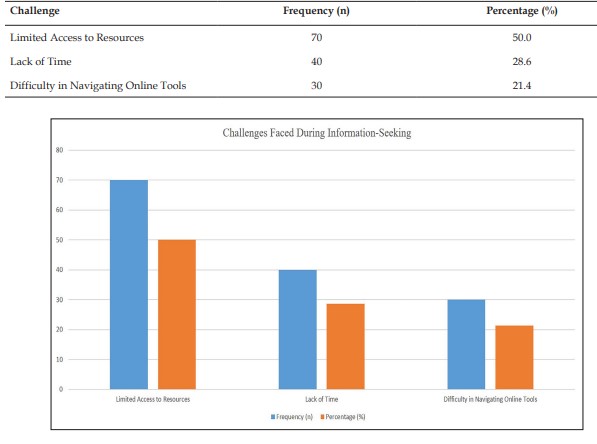
An essential part of being a student, particularly for postgraduate (PG) students who pursue more advanced coursework and research, is actively seeking out new information. Using a descriptive research strategy, this study looks at how PG students at Ch. Charan Singh University seek for information. The major goal was to examine the trends, preferences, and dif culties that students had when trying to get information. Stratified random sampling was used to pick 140 students, with the goal of achieving diversity in demographics, majors, and class sizes. In addition to secondary sources like university records and library usage statistics, data were gathered through a structured questionnaire. Students most frequently sought information once every week, according to the data, from online resources and the university library. Difficulty in navigating online tools and restricted access to resources were mentioned as challenges. To better assist students in their academic endeavours, the study emphasizes the need of raising awareness of university facilities, improving digital literacy, and increasing access to resources.
References
- 1. Dhiman, Bharat. (2021). Newspaper Reading Habits among UG and PG Students of Kurukshetra University: A Case Study. The International Journal of Interdisciplinary Organizational Studies. 16. 2021.
- 2. Foster, A.E. (2004). A nonlinear model of information seeking behavior. Journal of the American Society for Information Science and Technology, 55(3), 228-237.
- 3. Ganaie, Shabir & Rather, Mudasir. (2014). Information-Seeking Behavior among PG Students of University of Kashmir: An Analytical Study. Journal of Advancements in Library Sciences. 1. 64-72.
- 4. Järvelin, K., & Wilson, T.D. (2003). On conceptual models for information seeking and retrieval research. Information Research, 9(1), 1-63.
- 5. Kaur, B., & Verma, R. (2009). Use and impact of electronic journals in the Indian Institute of Technology, Delhi, India. The Electronic Library, 27(4), 611-622.
- 6. Kumar, Dr. Devendra & Singh, Rajkumar & Siddiqui, Jamal. (2011). Newspaper Reading Habits of University Students: A Case Study of Chaudhary Charan Singh University, India.
- 7. Madhusudhan, M. (2010). Use of electronic resources by research scholars of Kurukshetra University. The Electronic Library, 28(4), 492-506.
- 8. Pal, Mr & Chauhan, Singh & Kumar, Dr. Devendra. (2014). User Satisfaction on University Library: A Case Study of Chaudhary Charan Singh University. KIIT Journal of Library and Information Management. 1. 75-86.
- 9. Partap, Bhanu. (2019). Reading Habits in Digital Age: A Study of Research Fraternity of CCS Haryana Agricultural University, Hisar (India). 32. 16-26.
- 10. Sani, S. (2017). Information needs and seeking behaviour of diploma students of the Federal College of Agricultural Production Technology, Kano. African Research Review Journal, 11(2), 223-236.
- 11. Silva, A., & Chandrawamsa, P. (2016). Information needs and information seeking behaviour of students at higher educational institutes: With special reference to CINEC Maritime Campus. Sociology and Anthropology, 4(6), 494-499.
- 12. Sinha, M.K. (2015). A Study on Information Needs and Information Seeking Pattern of Public Library Users of Barak Valley, South Assam. IOSR Journal of Humanities and Social Science (IOSR-JHSS), 20(8), 13-36.
- 13. Sinha, Manoj & Bhattacharjee, Sudip & Bhattacharjee, Sucheta. (2013). Current Trends in Technology and Science A Study on ICT Literacy and Internet Use Pattern among College Library Users of Barak Valley, South Assam, North East India. Current Trends in Science and Technology. 2. 2279-535.
- 14. Sinha, Manoj & Das, Pulak. (2015). A Study on Information Needs and Information Seeking Behaviour of Rural Population with Special Reference to Barak Valley, South Assam (North East India): A Survey.
- 15. Sinha, Manoj. (2015). A Study on Information Needs and Information Seeking Pattern of Public Library Users of Barak Valley, South Assam. IOSR Journal of Humanities And Social Science (IOSR-JHSS), e-ISSN: 2279-0837, p-ISSN: 2279-0845. 20. 2279-837. 10.9790/0837- 20851336.
- 16. Smith, J.A. (2005). Information needs and seeking behavior of university students: A case study. Journal of Academic Libraries, 30(2), 123-135.
Data Sharing Statement
There are no additional data available.
Funding
This research received no funding.
Author Contributions
All authors contributed significantly to the work and approve its publication.
Ethics Declaration
This article does not involve any human or animal subjects, and therefore does not require ethics approval.
Acknowledgements
Information not provided.
Conflicts of Interest
The authors report no conflicts of interest in this work.
About this article

Cite this article
Bhardwaj VL, Siddiqui JA. Information seeking behaviour among PG students of Chaudhary Charan Singh University Meerut: an analytical study. Ind J Lib Inf Sci. 2025;19(2):177-184.
Licence:
Attribution-Non-commercial 4.0 International (CC BY-NC 4.0)This license enables reusers to distribute, remix, adapt, and build upon the material in any medium or format for noncommercial purposes only, and only so long as attribution is given to the creator.
| Received | Accepted | Published |
|---|---|---|
| February 25, 2025 | April 04, 2025 | August 16, 2025 |
DOI: https://doi.org/10.21088/ijlis.0973.9548.19225.4
Keywords
Information-Seeking BehaviourDigital ResourcesLibrary UsageAcademic ChallengesSearch for Similar Articles
Similar Articles
- Scientometric Portrait of Dr. Anil Kumar Dhiman, an Information Scientist-Part I...
- A Study on Humanities Students’ Literacy Skills at Alagappa University in Using...
- Awareness and Utilization of Artificial Intelligence Tools (ChatGPT) among Stude...
- Global Trends on Artificial Intelligence in Science Research: A Scientometric Ob...
- Information Needs of Persons with Visual Impairments: A Socioeconomic Analysis
Article Level Metrics
Last UpdatedThursday 10 September 2026, 02:52:51 (IST)
3922
Accesses
21
738
00
Citations
NA
NA
NA
Download citation
Article Keywords
Keyword Highlighting
Highlight selected keywords in the article text.
Timeline
| Received | February 25, 2025 |
| Accepted | April 04, 2025 |
| Published | August 16, 2025 |
licence
Attribution-Non-commercial 4.0 International (CC BY-NC 4.0)
This license enables reusers to distribute, remix, adapt, and build upon the material in any medium or format for noncommercial purposes only, and only so long as attribution is given to the creator.