Full Text (PDF)
Indian Journal of Anesthesia and Analgesia 10(2):p 65-69, April-June 2023. | DOI: https://doi.org/10.21088/ijaa.2349.8471.10223.3
Original Article
Impact of Misophonia on Anxiety and Depression Among Intensive Care Unit Patient: A Survey
Swarnalingam Thangavelu, Ramya Chandran, A. Divakaran null
Author Information
Licence:
Attribution-Non-commercial 4.0 International (CC BY-NC 4.0)This license enables reusers to distribute, remix, adapt, and build upon the material in any medium or format for noncommercial purposes only, and only so long as attribution is given to the creator.
Indian Journal of Anesthesia and Analgesia 10(2):p 65-69, April-June 2023. | DOI: https://doi.org/10.21088/ijaa.2349.8471.10223.3
How Cite This Article:
Swarnalingam Thangavelu, Ramya Chandran, A. Divakaran/Impact of Misophonia on Anxiety and Depression Among Intensive Care Unit Patient: A Survey/Indian J Anesth Analg. 2023;10(2) 65-69.Timeline
Received : April 25, 2022
Accepted : June 28, 2022
Published : July 30, 2022
Abstract
Background: Misophonia is a disorder were certain sounds triggers the emotional and physiological responses of the particular individual. Studies states that it is caused by increased autonomic nervous system activity to particular sounds leads to irritation, anger and anxiety and reduces the tolerance capacity to particular sounds which leads to anxiety and depression. This study deals about impact of misophonic on hospital related anxiety and depression among intensive care unit patients.
Method: 43 patients fulfil the inclusion criteria and they were surveyed initially whether they have disturbance to particular sound in intensive care unit after a week of admission and they were noted as misophonic sounds and their disturbance level were scored with Amsterdam misophonia scale A-MISO-S. On the same day patients were scored for hospital anxiety and depression questionnaire (HADS). Participants were participated through direct interview on bedside. Scoring was done based on the method given in the questionnaire.
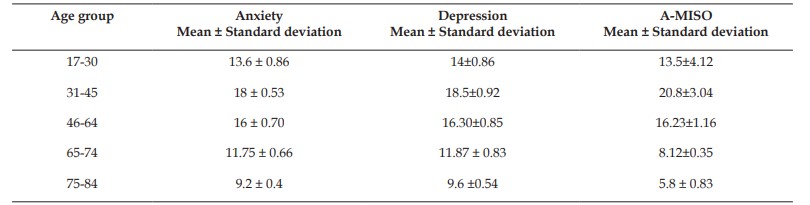
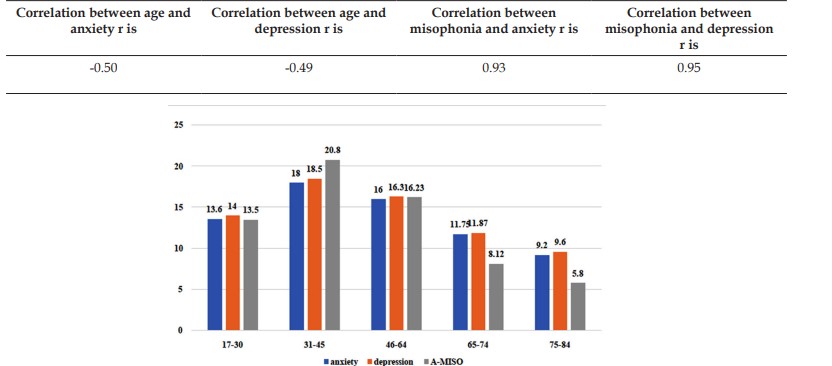
Result: Subjects were categorized into five different age groups. Young adult (17-30), middle aged adulty (31-45), old adults (46-64), youngest old (65-74), middle old (75-84). The result shows that middle aged adult and old adult experiences highest level of anxiety, depression and misophonia with mean value of (18±0.53, 18.5±0.92 and 20.8±3.04) and (16±0.70, 16.38±0.85 and 16.23±1.16) where as, young adult around (13.6±0.86, 14±0.86 and 13.5±4.12). The least amount of depression was experienced by individuals with age more than 65.
Conclusion: From the result it concluded that misophonia is directly related for anxiety and depression in intensive care unit patient. The significant difference in misophonia between anxiety and depression indicates that early management of symptoms or identification of psychological stress among intensive care unit patients is needed to prevent future complications.
References
- 1. Klein KE, Bena JF, Mulkey M, Albert NM. Sustainability of a nurse-driven early progressive mobility protocol and patient clinical and psychological health outcomes in a neurological intensive care unit. Intensive Crit Care Nurs. 2018 Apr;45:11–7.
- 2. Akansel N, Kaymakçi Ş. Effects of intensive care unit noise on patients: a study on coronary artery bypass graft surgery patients. J Clin Nurs. 2008 Jun;17(12):1581–90.
- 3. Lipshutz AK, Gropper MA. Acquired neuromuscular weakness and early mobilization in the intensive care unit. Anesthesiology. 2013 Jan;118(1):202–15.
- 4. Quirk J. Malnutrition in critically ill patients in internsive care units. Br J Nurs. 2000 May;9(9):537–41.
- 5. Graf C. Functional Decline in Hospitalized Older Adults: It’s often a consequence of hospitalization, but it doesn’t have to be. Am J Nurs. 2006 Jan;106(1):58–67.
- 6. Azoulay E, Chevret S, Leleu G, Pochard F, Barboteu M, Adrie C, et al. Half the families of intensive care unit patients experience inadequate communication with physicians. Crit Care Med. 2000 Aug;28(8):3044–9.
- 7. Park SP, Seo JG, Lee WK. Osmophobia and allodynia are critical factors for suicidality in patients with migraine. J Headache Pain. 2015 Dec;16(1):1–6.
- 8. Jastreboff MM, Jastreboff PJ. Components of decreased sound tolerance: hyperacusis, misophonia, phonophobia. ITHS News Lett. 2001 Jul;2(5-7):1–5.
- 9. Cavanna AE, Seri S. Misophonia: current perspectives. Neuropsychiatr Dis Treat. 2015 Aug;11:2117–23.
- 10. Turner RJ, Lloyd DA. Stress Burden and the Lifetime Incidence of Psychiatric Disorder in Young Adults: Racial and Ethnic Contrasts. Arch Gen Psychiatry. 2004 May;61(5):481–8.
- 11. Freeman D, Gittins M, Pugh K, Antley A, Slater M, Dunn G. What makes one person paranoid and another person anxious? The differential prediction of social anxiety and persecutory ideation in an experimental situation. Psychol Med. 2008 Aug;38(8):1121–32.
- 12. Therrien Z, Hunsley J. Assessment of anxiety in older adults: a systematic review of commonly used measures. Aging Ment Health. 2012 Jan;16(1):1–6.
- 13. Jebeile H, Gow ML, Baur LA, Garnett SP, Paxton SJ, Lister NB. Association of pediatric obesity treatment, including a dietary component, with change in depression and anxiety: a systematic review and meta-analysis. JAMA Pediatr. 2019 Nov;173(11):e192841.
- 14. Bagby RM, Ryder AG, Schuller DR, Marshall MB. The Hamilton Depression Rating Scale: has the gold standard become a lead weight? Am J Psychiatry. 2004 Dec;161(12):2163–77.
- 15. Banker SM, Na S, Beltrán J, Koenigsberg HW, Foss-Feig JH, Gu X, et al. Disrupted Computations of Social Control in OCD and Misophonia. Available at SSRN 4007578.
- 16. Sarigedik E, Gulle BT. A Study on Validation of Amsterdam Misophonia Scale in Turkish and Misophonia’s Prevalence in Turkish High School/College Student Population. Psychiatry Behav Sci. 2021;11(4):258–66.
- 17. Bjelland I, Dahl AA, Haug TT, Neckelmann D. The validity of the Hospital Anxiety and Depression Scale: an updated literature review. J Psychosom Res. 2002 Feb;52(2):69–77.
- 18. Granja C, Teixeira-Pinto A, Costa-Pereira A. Quality of life after intensive care–evaluation with EQ-5D questionnaire. Intensive Care Med. 2002 Jul;28(7):898–907.
- 19. Tshokovu P. The lived experiences of patients admitted to an intensive care unit in a public hospital in Ugu District [dissertation]. [Durban (South Africa)]: University of KwaZulu-Natal; 2021.
- 20. Davydow DS, Gifford JM, Desai SV, Bienvenu OJ, Needham DM. Depression in general intensive care unit survivors: a systematic review. Intensive Care Med. 2009 May;35(5):796–809.
- 21. Chahraoui K, Laurent A, Bioy A, Quenot JP. Psychological experience of patients 3 months after a stay in the intensive care unit: A descriptive and qualitative study. J Crit Care. 2015 Jun;30(3):599–605.
Data Sharing Statement
All raw data and code are available upon request.
Funding
This research received no funding.
Author Contributions
All authors contributed significantly to the work and approve its publication.
Ethics Declaration
This article does not involve any human or animal subjects, and therefore does not require ethics approval.
Acknowledgements
Infoamation not provided.
Conflicts of Interest
The authors report no conflicts of interest in this work.
About this article

Cite this article
Swarnalingam Thangavelu, Ramya Chandran, A. Divakaran/Impact of Misophonia on Anxiety and Depression Among Intensive Care Unit Patient: A Survey/Indian J Anesth Analg. 2023;10(2) 65-69.
Licence:
Attribution-Non-commercial 4.0 International (CC BY-NC 4.0)This license enables reusers to distribute, remix, adapt, and build upon the material in any medium or format for noncommercial purposes only, and only so long as attribution is given to the creator.
| Received | Accepted | Published |
|---|---|---|
| April 25, 2022 | June 28, 2022 | July 30, 2022 |
DOI: https://doi.org/10.21088/ijaa.2349.8471.10223.3
Keywords
MisophoniaIntensive Care UnitAnxietyDepressionSearch for Similar Articles
Similar Articles
- Awake Fibreoptic Intubation for Airway Management in Massive Thyroid Enlargement...
- A Case of Thoracotomy with One Lung Ventilation for Carcinoma Oesophagus
- A Case of Empyema for Thoracotomy and Decortication-Anaesthesia Management
- Full Mouth Rehabilitation in a 3-Year-Old Female Child with Repaired Tetralogy o...
- Do Gel Manicures Affect SpO2 Readings ? A Clinical Investigation
Article Level Metrics
Last UpdatedMonday 13 July 2026, 05:09:33 (IST)
5647
Accesses
14
678
00
Citations
NA
NA
NA
Download citation
Article Keywords
Keyword Highlighting
Highlight selected keywords in the article text.
Timeline
| Received | April 25, 2022 |
| Accepted | June 28, 2022 |
| Published | July 30, 2022 |
licence
Attribution-Non-commercial 4.0 International (CC BY-NC 4.0)
This license enables reusers to distribute, remix, adapt, and build upon the material in any medium or format for noncommercial purposes only, and only so long as attribution is given to the creator.