Full Text (PDF)
Indian Journal of Library and Information Sciences 16(2):p 101-109, May-August 2022. | DOI: https://doi.org/10.21088/ijlis.0973.9548.16222.4
Review Article
Impact of library Automation Services in Government First Grade College Libraries in Kolar District: A Survey
Author Information
Licence:
Attribution-Non-commercial 4.0 International (CC BY-NC 4.0)This license enables reusers to distribute, remix, adapt, and build upon the material in any medium or format for noncommercial purposes only, and only so long as attribution is given to the creator.
Indian Journal of Library and Information Sciences 16(2):p 101-109, May-August 2022. | DOI: https://doi.org/10.21088/ijlis.0973.9548.16222.4
How Cite This Article:
K C Babu Prasad/Impact of library Automation Services in Government First Grade College Libraries in Kolar District: A Survey/Indian J Lib Inf Sci 2022;16(2):101–109.Timeline
Received : January 04, 2021
Accepted : February 12, 2022
Published : August 25, 2022
Abstract
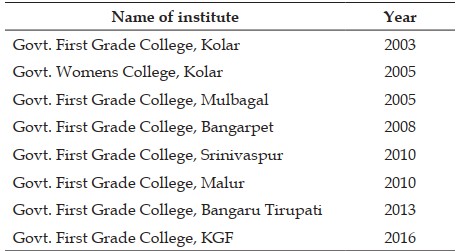
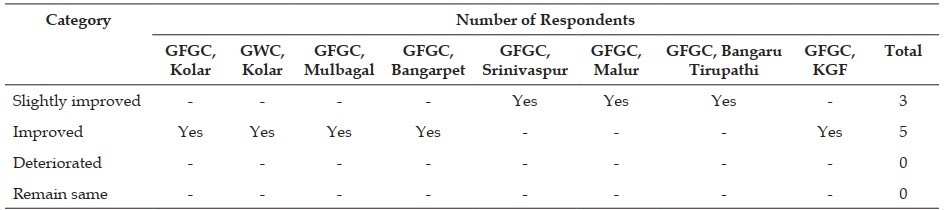
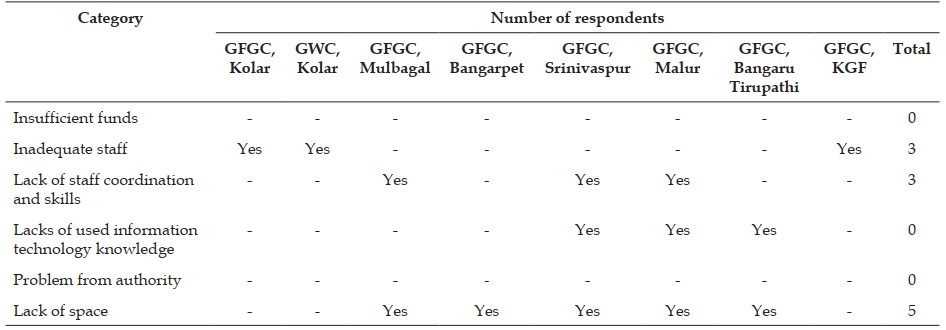
To investigate the impact of Library automation services in Government First Grade college libraries in kolar district. The investigators used a questionnaire and interviews. They chose samples on the basis of a stratified sampling method and administered the questionnaire according to a random method for collecting the data. In this study revealed that 7 of 8 libraries are completely automated. Seventy per cent of librarians believe that automation has improved their library’s services, while 85 per cent of users believe that an automated library system is better than the traditional manual system. Of the eight libraries, one library has a shortage of general staff to deal with automation services. The investigators could only select all the institutions for his study. Although so many studies of the same kind have already been conducted on library automation services in different areas of world, this paper revealed the current status of library automation services in Government First grade college libraries in kolar district.
References
- 1. Ahmad, P. and Iqbal, Z. (2009), “Library automation of Al-Barkaat institute of management.
- 2. Anas,M. and Iqbal,J. (2014) “Impact of automation on Library services in selected management institutes at Aligarh: A survey”, The Electronic Library,Vol.32 No.3 pp. 296-307.
- 3. Studies (ABIMS), Aligarh with the help of Alice for Windows (AFW): a case study”, Indian Journal of Library and Information Science, Vol. 3 No. 2, pp.81-86.
- 4. Amekuedee, J.-O. (2005), “An evaluation of library automation in some Ghanaian university libraries”, The Electronic Library, Vol. 23 No. 4, pp. 442-452.
- 5. Jayaprakash, M. and Balasubramania, M. (2011), “Status of automation in university libraries of
- 6. Tamilnadu: a survey”, European Journal of Scientific Research, Vol. 53 No. 1, pp. 17-24.
- 7. Kumar, B. (2003), “Automation in university libraries of Haryana”, ILA Bulletin, Vol. 39 No. 3, pp. 15-21.
- 8. Ossai-Ugbah, N.B. (2010), “The impact of automated library services and usage on student’s academic performance in Nigerian universities”, International Journal of Library and Information Science, Vol. 2 No. 9, pp. 169-176.
- 9. Rai, N. and Kumar, S. (2011), “Comparative features of integrated library management software systems available in Delhi”, The Electronic Library, Vol. 29 No. 1, pp. 121-146.
- 10. Sani, A. and Tiamiyu, M. (2005), “Evaluation of automated services in Nigerian universities”, The Electronic Library, Vol. 23 No. 3, pp. 274-288.
- 11. Suku, J. and Pillai, M. (2005), “Perspectives on automation of university libraries in Kerala: status, problems and prospects”, Journal of Academic Librarianship, Vol. 31 No. 2, pp. 151-159.
- 12. Thapa, N. and Sahoo, K.C. (2007), “Problems and prospects of automation: a survey of special
- 13. Libraries in Bhopal”, Library Progress, Vol. 25 No. 1, pp. 71-83.
- 14. Vyas, S.D. (1997), “Library automation and networking in India: problems and prospects”, World Libraries, Vol. 8 No. 1, pp. 27-35.
Data Sharing Statement
There are no additional data available. All raw data and code are available upon request.
Funding
This research received no funding.
Author Contributions
All authors contributed significantly to the work and approve its publication.
Ethics Declaration
This article does not involve any human or animal subjects, and therefore does not require ethics approval.
Acknowledgements
We would like to express our gratitude to the patients, their families, and all those who have contributed to this study.
Conflicts of Interest
No conflicts of interest in this work.
About this article

Cite this article
K C Babu Prasad/Impact of library Automation Services in Government First Grade College Libraries in Kolar District: A Survey/Indian J Lib Inf Sci 2022;16(2):101–109.
Licence:
Attribution-Non-commercial 4.0 International (CC BY-NC 4.0)This license enables reusers to distribute, remix, adapt, and build upon the material in any medium or format for noncommercial purposes only, and only so long as attribution is given to the creator.
| Received | Accepted | Published |
|---|---|---|
| January 04, 2021 | February 12, 2022 | August 25, 2022 |
DOI: https://doi.org/10.21088/ijlis.0973.9548.16222.4
Keywords
Library automationGovernment First grade college libraries in kolar districtSearch for Similar Articles
Similar Articles
- Scientometric Portrait of Dr. Anil Kumar Dhiman, an Information Scientist-Part I...
- A Study on Humanities Students’ Literacy Skills at Alagappa University in Using...
- Awareness and Utilization of Artificial Intelligence Tools (ChatGPT) among Stude...
- Global Trends on Artificial Intelligence in Science Research: A Scientometric Ob...
- Information Needs of Persons with Visual Impairments: A Socioeconomic Analysis
Article Level Metrics
Last UpdatedThursday 10 September 2026, 05:17:28 (IST)
3923
Accesses
10
738
00
Citations
NA
NA
NA
Download citation
Article Keywords
Keyword Highlighting
Highlight selected keywords in the article text.
Timeline
| Received | January 04, 2021 |
| Accepted | February 12, 2022 |
| Published | August 25, 2022 |
licence
Attribution-Non-commercial 4.0 International (CC BY-NC 4.0)
This license enables reusers to distribute, remix, adapt, and build upon the material in any medium or format for noncommercial purposes only, and only so long as attribution is given to the creator.