Full Text (PDF)
Journal of Orthopedic Education 10(3):p 109-114, September - December 2024. | DOI: http://dx.doi.org/10.21088/joe.2454a.7956.10324.6
Case Report
Ilizarov’s Accordion Manoeuvre for Treating Tibial Shaft Infected Non-union with Extensive Bone Loss: A Case Report
J S R G Saran, , J S R G Saran1 , Praneeth Divi2 , Vishal Patil3
Author Information
Licence:
Journal of Orthopedic Education 10(3):p 109-114, September - December 2024. | DOI: http://dx.doi.org/10.21088/joe.2454a.7956.10324.6
How Cite This Article:
J S R G Saran, Praneeth Divi, Vishal Patil, Ilizarov’s Accordion Manoeuvre for Treating Tibial Shaft Infected Non-union with Extensive Bone Loss: A Case Report. Jr. Orth. Edu. 2024;10(3):109–114
Timeline
Received : N/A
Accepted : N/A
Published : N/A
Abstract
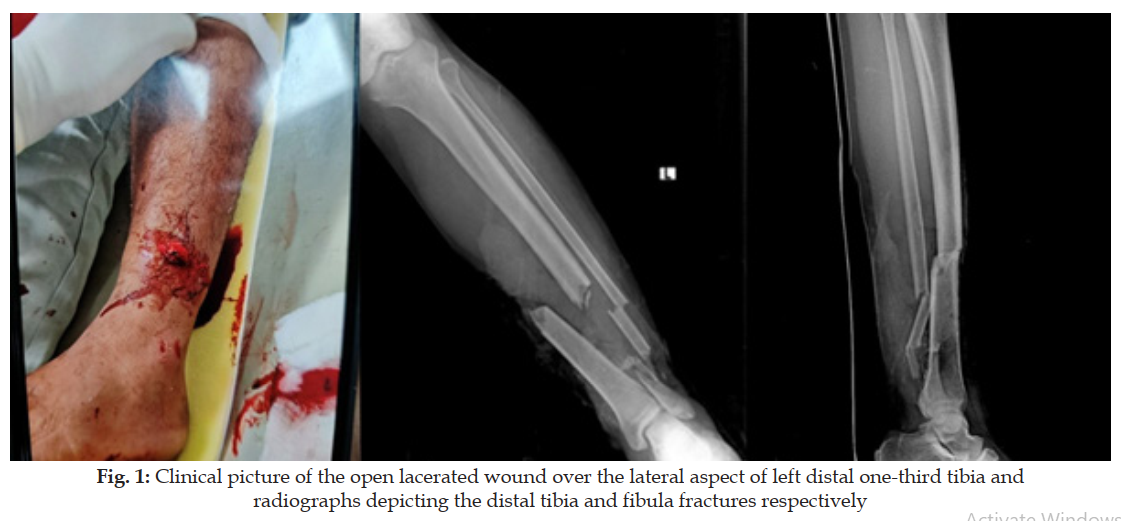
Introduction: The most commonest long bone to be fractured in an acute traumatic setting is tibia followed by femur. Due to low soft tissue coverage over the bone, they have a higher propensity to end up in open fractures. The fracture variety is described based on location as well as on the type of shearing injury. Due to the delicate inherent vascularity to the tibia bone, in an acute setting with high shearing mechanism, there is a higher chance for the primary fixation to fail due to the fractured ends going into non-union or mal-union. We report a case of a middle aged man, who met with a road traffic accident (RTA) and had presented to the casualty with an open injury and deformity of the left leg. Case presentation: A comprehensive history and clinical examination revealed a lacerated wound on the lateral aspect of the distal third of the left leg, accompanied by swelling and visible deformity, though vital signs remained stable. Radiographs confirmed fractures of the distal third of tibia and fibula. Initial treatment involved wound debridement with application of an AO external fixator, but due to the extent of contamination it led to a bone infection that required resection, resulting in a 55-millimeter segmental bone loss. Following careful pre-operative planning, a four-ring Ilizarov external fixator (IEF) was applied, along with a proximal corticotomy and the accordion manoeuvre. The patient was monitored with serial radiographs for nearly 30 months, during which a 71-millimeter bone regenerate was achieved. The external fixator was then removed, and the patient was fitted with a knee-ankle-foot orthosis (KAFO) for four weeks, along with supportive physiotherapy. Post-surgery, the patient is now able to fully bear weight, has achieved 90° knee flexion, experiences limited ankle movement, and has a 3-centimeter limb length discrepancy. Conclusion: Open tibia fractures are in itself a challenge to treat and if primary reduction fails, the main mode of management would include limb salvage procedures of which IEF application holds the torch to all other techniques. Removal of the infected bone segment and application of four ring IEF construct gave satisfactory results in regaining the bone regenerate
References
No records found.
About this article

Cite this article
J S R G Saran, Praneeth Divi, Vishal Patil, Ilizarov’s Accordion Manoeuvre for Treating Tibial Shaft Infected Non-union with Extensive Bone Loss: A Case Report. Jr. Orth. Edu. 2024;10(3):109–114
Licence:
| Received | Accepted | Published |
|---|---|---|
| N/A | N/A | N/A |
DOI: http://dx.doi.org/10.21088/joe.2454a.7956.10324.6
Keywords
Segmental bone loss tibiaIlizarov external fixatorAccordion manoeuvre.Search for Similar Articles
Similar Articles
- Open Tibial Fracture: The Treatment of Soft-tissue Defects of the Lower Leg afte...
- Joint Forces: Orthopedics and General Medicine in Tackling Musculoskeletal Manif...
- Application of Nanotechnology and Stem Cell Therapy in Musculoskeletal Disorders...
- Novel Surgical and Antibiotic Strategy for Treating Septic Arthritis after Total...
- Terrible Triad of Elbow
Article Level Metrics
Last UpdatedSaturday 22 August 2026, 05:18:16 (IST)
1967
Accesses
9
237
00
Citations
NA
NA
NA
Download citation
Article Keywords
Keyword Highlighting
Highlight selected keywords in the article text.
Timeline
| Received | N/A |
| Accepted | N/A |
| Published | N/A |