Full Text (PDF)
Journal of Biochemistry and Biophysics 10(2):p 43-50, July-December 2025. | DOI: https://doi.org/10.21088/rfpjbb.2582-3558.10225.1
Original Article
How Alloying Affects the Critical Temperature of Low-Temperature Superconductors: A BCS–McMillan Framework Study
Author Information
Licence:
Attribution-Non-commercial 4.0 International (CC BY-NC 4.0)This license enables reusers to distribute, remix, adapt, and build upon the material in any medium or format for noncommercial purposes only, and only so long as attribution is given to the creator.
Journal of Biochemistry and Biophysics 10(2):p 43-50, July-December 2025. | DOI: https://doi.org/10.21088/rfpjbb.2582-3558.10225.1
How Cite This Article:
Dharmendra Kumar. How Alloying Affects the Critical Temperature of Low-Temperature Superconductors: A BCS–McMillan Framework Study. RFP Jour. of Bio. and Biophy. 2025; 10(2): 43–50.Timeline
Received : October 07, 2025
Accepted : December 01, 2025
Published : December 25, 2025
Abstract
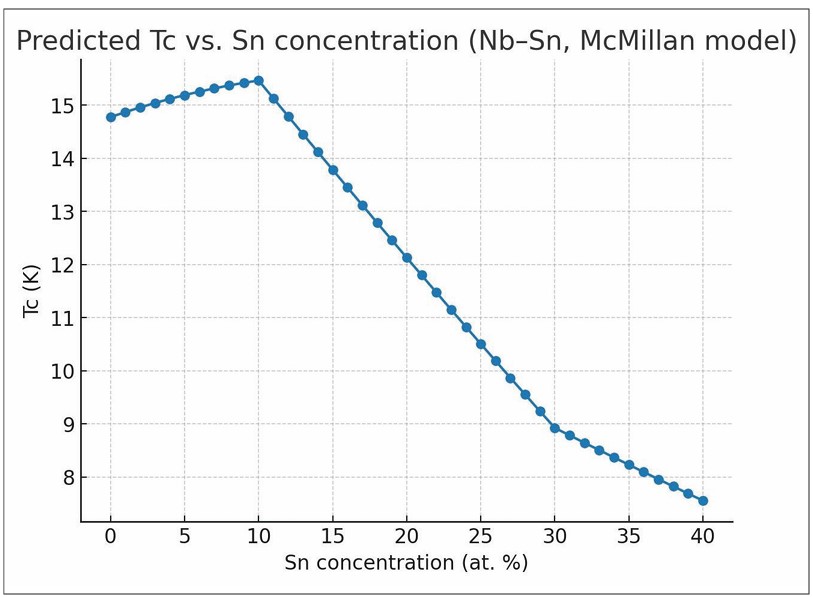
The interplay between alloying and superconductivity remains a central topic in condensed matter physics, particularly in low-temperature superconductors where electron–phonon interactions dominate. In this study, we investigate how alloying influences the superconducting transition temperature (TcT_cTc ) within the BCS–McMillan theoretical framework. By introducing phenomenological concentration-dependent modifications to the Debye temperature (ΘD\Theta_ DΘD ) and electron–phonon coupling constant (λ\lambdaλ), we model the non monotonic behavior of TcT_cTc in representative Nb–Sn alloy systems. Our results reveal that moderate alloying enhances superconductivity by increasing the density of states at the Fermi level and strengthening electron–phonon coupling, while excessive substitution suppresses TcT_cTc due to disorder and phonon softening. Comparison with experimental data for Nb–Sn and emerging high-entropy alloys confirms that alloying acts as a tuning parameter for superconducting properties, albeit limited by disorder-induced suppression. This framework provides both a pedagogical and predictive model for exploring superconductivity in complex alloy systems. Background: The relationship between alloying and superconductivity remains a critical focus in condensed matter physics, particularly in low-temperature superconductors (LTS) where the electron–phonon mechanism dominates. Aim: To model and interpret how alloying influences the superconducting critical temperature (Tc) within the BCS–McMillan theoretical framework. Objectives: Journal of Biochemistry and Biophysics 1. To establish a phenomenological relationship between alloy concentration and Tc. 2. To identify competing mechanisms enhancement from increased electron phonon coupling versus suppression due to disorder. 3. To validate theoretical predictions against Nb–Sn experimental data. 4. To extend the model’s applicability to emerging high-entropy superconductors. Material: Theoretical modeling based on McMillan’s extension of BCS theory. The alloying dependence of Debye temperature (ΘD) and electron–phonon coupling constant (λ) were parameterized as concentration-dependent functions. Result: The model predicts a non-monotonic dependence of Tc on alloying concentration. Moderate alloying enhances Tc by increasing λ and density of states at the Fermi level, whereas excessive substitution suppresses superconductivity through phonon softening and disorder scattering. Conclusion: Alloying serves as a tuning mechanism for superconductivity. The BCS–McMillan framework successfully reproduces experimental trends in Nb–Sn and provides insights applicable to high-entropy alloys.
References
- 1. Bardeen J, Cooper LN, Schrieffer JR. Microscopic theory of superconductivity. Phys Rev. 1957;108:1175–1204.
- 2. McMillan WL. Transition temperature of strong-coupled superconductors. Phys Rev. 1968;167:331–344.
- 3. Allen PB, Dynes RC. Transition temperature of strong-coupled superconductors reanalyzed. Phys Rev B. 1975;12:905–922.
- 4. Dynes RC. Disorder and the superconducting transition temperature. Solid State Commun. 1972;10:615–618.
- 5. Matthias BT. Empirical relation between superconductivity and valence electron concentration. Phys Rev. 1955;97:74–76.
- 6. Grimvall G. The Electron–Phonon Interaction in Metals. North-Holland, Amsterdam; 1981.
- 7. Flükiger R, Seibt E, Wühl H. Effect of stoichiometry on the superconducting properties of Nb3Sn. J Low Temp Phys. 1975;21:39–50.
- 8. Larbalestier DC, Godeke A, Yamamoto A. Development of Nb3Sn superconductors for fusion and particle accelerator applications. Supercond Sci Technol. 2005;18:R1–R13.
- 9. Guo Q, Sun Y, Sakurai H, et al. Strongly correlated electronic superconductivity in noncentrosymmetric Re–Os high/medium entropy alloys. Acta Mater. 2025;276:119498.
- 10. Sakurai H, Sun Y, Tamegai T, et al. Superconductivity in multi-principal element alloys: structure, disorder, and stability. Phys Rev Mater. 2023;7:054802.
- 11. Weht R, Pickett WE. Disorder and superconductivity: the case of Nb3Sn. Phys Rev Lett. 1998;81:2502–2505
Data Sharing Statement
There are no additional data available. All raw data and code are available upon request
Funding
This research received no funding
Author Contributions
All authors contributed significantly to the work and approve its publication
Ethics Declaration
This article does not involve any human or animal subjects, and therefore does not require ethics approval
Acknowledgements
We would like to express our gratitude to the patients, their families, and all those who have contributed to this study
Conflicts of Interest
No conflicts of interest in this work.
About this article

Cite this article
Dharmendra Kumar. How Alloying Affects the Critical Temperature of Low-Temperature Superconductors: A BCS–McMillan Framework Study. RFP Jour. of Bio. and Biophy. 2025; 10(2): 43–50.
Licence:
Attribution-Non-commercial 4.0 International (CC BY-NC 4.0)This license enables reusers to distribute, remix, adapt, and build upon the material in any medium or format for noncommercial purposes only, and only so long as attribution is given to the creator.
| Received | Accepted | Published |
|---|---|---|
| October 07, 2025 | December 01, 2025 | December 25, 2025 |
DOI: https://doi.org/10.21088/rfpjbb.2582-3558.10225.1
Keywords
SuperconductivityAlloying EffectsBcs TheoryMcmillan EquationElectron–Phonon CouplingCritical TemperatureNb–Sn AlloysHigh Entropy SuperconductorsSearch for Similar Articles
Similar Articles
- Emergent Quantum Phenomena in Topological and Moiré Condensed Matter Systems: Re...
- The Molecular Architecture of Fragility: A Biophysical and Biochemical Dissectio...
- Silent Carcinogens at Home: Understanding Cancer Risks in Indian Kitchens
- Beyond Tone and Tissue: A Biochemical and Biophysical Perspective on Post-partum...
- GLP-1 Therapies as Essential Medicines: Opportunities and Barriers for Diabetes...
Article Level Metrics
Last UpdatedWednesday 30 September 2026, 18:59:41 (IST)
1328
Accesses
17
238
00
Citations
NA
NA
NA
Download citation
Article Keywords
Keyword Highlighting
Highlight selected keywords in the article text.
Timeline
| Received | October 07, 2025 |
| Accepted | December 01, 2025 |
| Published | December 25, 2025 |
licence
Attribution-Non-commercial 4.0 International (CC BY-NC 4.0)
This license enables reusers to distribute, remix, adapt, and build upon the material in any medium or format for noncommercial purposes only, and only so long as attribution is given to the creator.