Full Text (PDF)
Indian Journal of Surgical Nursing 11(2):p 41-43, May-August 2022. | DOI: https://doi.org/10.21088/ijsn.2277.467X.11222.4
Original Article
Guideline Based Management of Inhalational Burns
Ravi Kumar Chittoria, Boney George Joseph, Jacob Antony Chakiath
Author Information
Licence:
Attribution-Non-commercial 4.0 International (CC BY-NC 4.0)This license enables reusers to distribute, remix, adapt, and build upon the material in any medium or format for noncommercial purposes only, and only so long as attribution is given to the creator.
Indian Journal of Surgical Nursing 11(2):p 41-43, May-August 2022. | DOI: https://doi.org/10.21088/ijsn.2277.467X.11222.4
How Cite This Article:
Boney George Joseph, Ravi Kumar Chittoria, Jacob Antony Chakiath/Guideline Based Management of Inhalational Burns/ Indian J Surg Nurs. 2022;11(2):41–43.Timeline
Received : April 29, 2022
Accepted : May 30, 2022
Published : August 30, 2022
Abstract
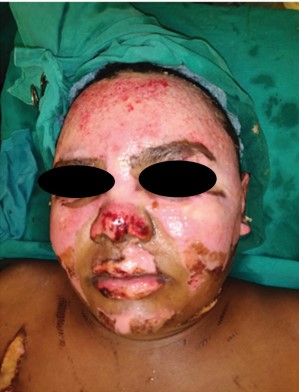
Majority of the fire-related deaths results not from burns but from inhalation of the toxic products of combustion and inhalation injury has high mortality rate especially when patients require ventilator support for more than 1 week after injury. Early diagnosis of bronchopulmonary injury is thus critical for survival and is conducted primarily clinically, based on a history of closed space exposure, facial burns, and carbonaceous debris in mouth, pharynx, or sputum. Chest radiographs are routinely normal until complications, such as infections, have developed. Neither normal oxygenation nor normal chest radiographs exclude the diagnosis of inhalational burns. However, signs such as hoarseness, carbonaceous sputum, wheeze, and dyspnea are strongly suggestive of inhalation injury. A proper guideline-based management is needed for early diagnosis of inhalational burns and also for keeping a check on unwanted interventions. Here we present a case report on a patient who suffered thermal burns due to kerosene over face, breast and right upper limb who on presentation had clinical signs suggestive of inhalational burns and was managed with International Society For Burn Injuries (ISBI) guidelines.
References
- 1. Heimbach DM, Waeckerle JF. Inhalation injuries. Ann Emerg Med 1988;17(12):1316–20.
- 2. Pruitt Jr BA, Cioffi WG, Shimazu T, Ikeuchi H, Mason Jr AD.Evaluation and management of patients with inhalation injury. J Trauma 1990;30(12 Suppl): S63––S68.
- 3. McCall JE, Cahill TJ. Respiratory care of the burn patient. J Burn Care Rehabil 2005;26(3):200––206.
- 4. Mlcak RP, Suman OE, Herndon DN. Respiratory management of inhalation injury. Burns 2007; 33:2-13.
Data Sharing Statement
There are no additional data available. All raw data and code are available upon request.
Funding
This research received no funding.
Author Contributions
All authors contributed significantly to the work and approve its publication.
Ethics Declaration
This article does not involve any human or animal subjects, and therefore does not require ethics approval.
Acknowledgements
We would like to express our gratitude to the patients, their families, and all those who have contributed to this study.
Conflicts of Interest
No conflicts of interest in this work.
About this article

Cite this article
Boney George Joseph, Ravi Kumar Chittoria, Jacob Antony Chakiath/Guideline Based Management of Inhalational Burns/ Indian J Surg Nurs. 2022;11(2):41–43.
Licence:
Attribution-Non-commercial 4.0 International (CC BY-NC 4.0)This license enables reusers to distribute, remix, adapt, and build upon the material in any medium or format for noncommercial purposes only, and only so long as attribution is given to the creator.
| Received | Accepted | Published |
|---|---|---|
| April 29, 2022 | May 30, 2022 | August 30, 2022 |
DOI: https://doi.org/10.21088/ijsn.2277.467X.11222.4
Keywords
InhalationalburnbronchoscopySearch for Similar Articles
Similar Articles
Article Level Metrics
Last UpdatedFriday 24 July 2026, 06:43:43 (IST)
1071
Accesses
1
216
00
Citations
NA
NA
NA
Download citation
Article Keywords
Keyword Highlighting
Highlight selected keywords in the article text.
Timeline
| Received | April 29, 2022 |
| Accepted | May 30, 2022 |
| Published | August 30, 2022 |
licence
Attribution-Non-commercial 4.0 International (CC BY-NC 4.0)
This license enables reusers to distribute, remix, adapt, and build upon the material in any medium or format for noncommercial purposes only, and only so long as attribution is given to the creator.