Full Text (PDF)
Journal of Pharmaceutical and Medicinal Chemistry 9(2):p 51-58, July - December 2023. | DOI: https://doi.org/10.21088/jpmc.2395.6615.9223.1
Original Article
Formulation & Evaluation of Famotidine Transdermal Patches by using Different Polymers
Lakshman Vinod Kumar V, Lakshmana Rao A, Sai Datri A, Pranati S, Hari Babu S, Karthik S, Shaher Banu, Ratna Lahari S
Author Information
Licence:
Attribution-Non-commercial 4.0 International (CC BY-NC 4.0)This license enables reusers to distribute, remix, adapt, and build upon the material in any medium or format for noncommercial purposes only, and only so long as attribution is given to the creator.
Journal of Pharmaceutical and Medicinal Chemistry 9(2):p 51-58, July - December 2023. | DOI: https://doi.org/10.21088/jpmc.2395.6615.9223.1
How Cite This Article:
Lakshman Vinod Kumar V, Lakshmana Rao A, Sai Datri A, et al./Formulation & Evaluation of Famotidine Transdermal Patches by using Different Polymers/J Pharmaceut Med Chem. 2023;9(2): 51-58.Timeline
Received : June 01, 2023
Accepted : August 30, 2023
Published : December 25, 2023
Abstract
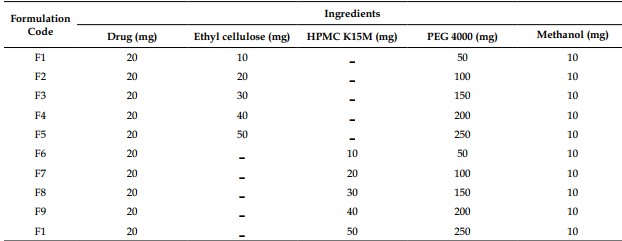
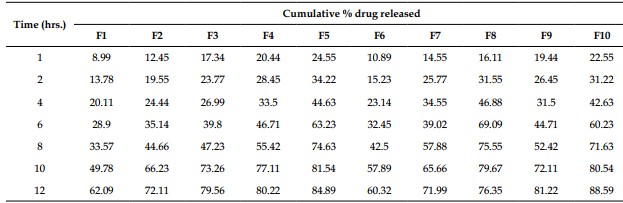
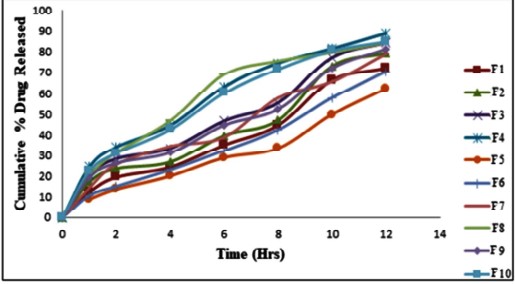
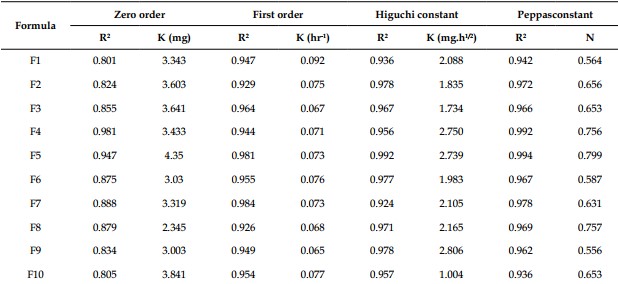
Purpose: The main objective of the present research investigation is to formulate transdermal patches of famotidine using different polymers. Famotidineis a H2 blockers. Methods: The transdermal patches of famotidine were prepared employing different concentrations of HPMC, and Ethyl cellulose. Results and Discussion: All patches exhibited satisfactory characteristics regarding integrity, flexibility, dispersion of drug, and other quality control parameters. In the invitro release studies of transdermal patches, formulation F10 showed the prolonged release of drug (88%) for 12 h, which indicates the maximum availability of the drug. The kinetic studies were carried out and it was found that all the formulations follow zero order and the release mechanism of drugs was found to be diffusion rate limited, Non-Fickian mechanism which was confirmed by Korsmeyer–Peppas model. Conclusion: This suggests the transdermal application of Famotidine holds the promised controlled release of the drug for an extended period of time.
References
- 1. Wokovich AM, Prodduturi S, Doub WH, Hussain AS, Buhse LF. Transdermal drug delivery system (TDDS) adhesion as a critical safety, efficacy and quality attribute. Eur J Pharm Biopharm 2006;64:1- 8.
- 2. Shivakumar HN, Murthy SN. Topical and transdermal drug delivery. In: Kulkarni VS, editor. Handbook on Non-invasive Drug Delivery Systems. USA: Elsevier Inc. 2010;1-36.
- 3. https://www.drugs.com/famotidine.html
- 4. Safila Naveed, Farya Zafar.UV Spectro [photometric Assay of Famotidine Formulations. 2014;1(3):28-31
- 5. Desai BG. Effect of enhancers on permeation kinetics of captopril for transdermal system. Asian J Pharma. 2008;2(1):35–37.
- 6. Kharia A. Formulation and evaluation of transdermal patch for treatment of inflammation. Int J Pharm Sci Res. 2019;10(5):2375–2384.
- 7. John L. Formulation and evaluation of amlodipine transdermal patches using ethylcellulose. Int Res J Pharm. 2013;4(10):84–88.
- 8. Kumar JA. Transdermal drug delivery system. Int J Pharm Sci Rev Res. 2010;3(2):49–54.
- 9. El-Gendy. Transdermal delivery of Salbutamol sulphate: Formulation and evaluation. Pharm Dev Technol. 2009;14(2):216–225.
- 10. Rao PR, Diwan PV. Formulation and in Vitro Evaluation of Polymeric Films of Diltiazem Hydrochloride and Indomethacin for Transdermal Administration. Drug Dev Ind Pharm. 1998;24(4):327–36.
- 11. Chandak AR, Verma PRP. Design and Development of Hydroxypropyl Methycellulose (HPMC) Based Polymeric Films of Methotrexate: Physicochemical and Pharmacokinetic Evaluations. Yakugaku Zasshi. 2008;128(7):1057–66.
- 12. Bhatia C, Sachdeva M, Bajpai M. Formulation and evaluation of transdermal patch of pregabalin. Int J Pharm Sci Res. 2012;3(2):569– 75.
- 13. Bharkatiya M. Development and characterization of transdermal patches of metoprolol tartrate. Asian J Pharm Clin Res. 2010;3(2):130–4.
- 14. Costa P, Lobo JMS. Modeling and comparison of dissolution profiles. Eur J Pharm Sci. 2001;13(2):123– 33.
- 15. Aggarwal G. Formulation, in vitro and in vivo evaluation of matrixtype transdermal patches containing olanzapine. Pharm Dev Technol. 2011;18 (4):916–25.
Data Sharing Statement
There are no additional data available. All raw data and code are available upon request.
Funding
This research received no funding.
Author Contributions
All authors contributed significantly to the work and approve its publication.
Ethics Declaration
This article does not involve any human or animal subjects, and therefore does not require ethics approval.
Acknowledgements
We would like to express our gratitude to the patients, their families, and all those who have contributed to this study.
Conflicts of Interest
No conflicts of interest in this work.
About this article

Cite this article
Lakshman Vinod Kumar V, Lakshmana Rao A, Sai Datri A, et al./Formulation & Evaluation of Famotidine Transdermal Patches by using Different Polymers/J Pharmaceut Med Chem. 2023;9(2): 51-58.
Licence:
Attribution-Non-commercial 4.0 International (CC BY-NC 4.0)This license enables reusers to distribute, remix, adapt, and build upon the material in any medium or format for noncommercial purposes only, and only so long as attribution is given to the creator.
| Received | Accepted | Published |
|---|---|---|
| June 01, 2023 | August 30, 2023 | December 25, 2023 |
DOI: https://doi.org/10.21088/jpmc.2395.6615.9223.1
Keywords
FamotidineTransdermal patchesHPMCEthyl celluloseSearch for Similar Articles
Similar Articles
- Pharmaceutical Care in Primary Healthcare: A Study of Nurses
- Artificial Intelligence in Pharmaceutical Research and Development: From Target...
- Developing a Structured Teaching Program for Precision Medicine in Nursing Pract...
- Comprehensive Scientific Review on the Natural Process of Aging, Anti-Aging Mech...
- Formulation and Evaluation of Curcumin Lozenges to Treat Throat Infections
Article Level Metrics
Last UpdatedTuesday 27 October 2026, 03:42:20 (IST)
1383
Accesses
7
118
00
Citations
NA
NA
NA
Download citation
Article Keywords
Keyword Highlighting
Highlight selected keywords in the article text.
Timeline
| Received | June 01, 2023 |
| Accepted | August 30, 2023 |
| Published | December 25, 2023 |
licence
Attribution-Non-commercial 4.0 International (CC BY-NC 4.0)
This license enables reusers to distribute, remix, adapt, and build upon the material in any medium or format for noncommercial purposes only, and only so long as attribution is given to the creator.