Full Text (PDF)
Journal of Forensic Chemistry and Toxicology 11(1):p 32-39, Jan-June 2025. | DOI: 10.21088/jfct.2454.9363.11125.4
Review Article
Examination of Blood with the help of Chemicals and Scientific Instruments
Neeraj Kumar, Richa Singh, Lucky Kumar Sahu, Atul Kumar Tiwari, Kunvar Dileep Pratap Singh, Dev Brat Mishra
Author Information
Licence:
Attribution-Non-commercial 4.0 International (CC BY-NC 4.0)This license enables reusers to distribute, remix, adapt, and build upon the material in any medium or format for noncommercial purposes only, and only so long as attribution is given to the creator.
Journal of Forensic Chemistry and Toxicology 11(1):p 32-39, Jan-June 2025. | DOI: 10.21088/jfct.2454.9363.11125.4
How Cite This Article:
Kumar N, Singh R, et al. Examination of Blood with the help of Chemicals and Scientific Instruments. J Forensic Chem Toxicol. 2025;11(1):32-9.Timeline
Received : April 12, 2025
Accepted : May 17, 2025
Published : June 12, 2025
Abstract
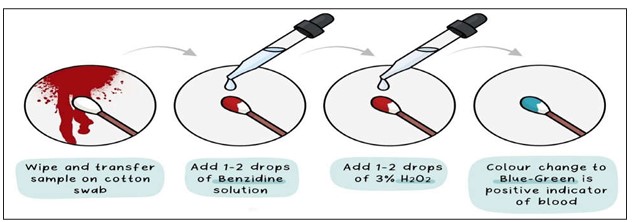
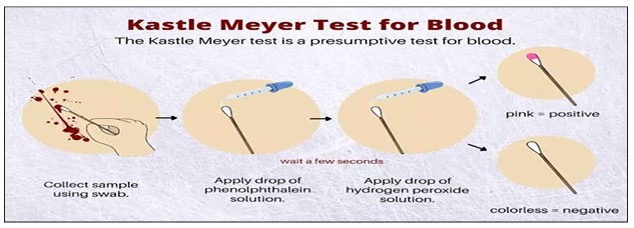
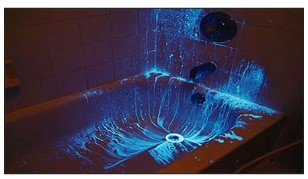
Blood, avital biological uid, plays a nessential rolein sustaining life by transporting oxygen and nutrients, eliminating waste, regulating body temperature, and defending against infections. Blood, which is made up of red blood cells, white blood cells, platelets, and plasma, is extremely important for forensic purposes because of its DNA content and capacity to provide information about crimes. Blood at a crime scene can disclose information about the nature of the crime, identity of individuals involved, weapon used, and the sequence of events. Bloodstain patterns, trails, and smears assist in reconstructing the crime scene and determining positions and movements of both victim and perpetrator. In forensic science, blood detection begins with presumptive tests such as the Benzidine, Phenolphthalein (Kastle-Meyer), Leucomalachite Green, and Fluorescence tests. These rapid and sensitive methods rely on the peroxidase activity of hemoglobin to indicate possible blood presence, although they may yield false positives. The Teichmann and Takayama tests, which react with the heme components in blood togeneratecharacteristiccrystals, areusedas con rmatory tests toverify the existenceofblood.Advancedidenti cationmethodsincludeRamanspectroscopy, whichoffersmolecular-levelinsightsduetoitsnon-destructiveandhighlyspeci c nature. Immunoassays, including ELISA and RSID kits, detect blood through antibody-antigeninteractionsandare increasinglybeingadaptedfor elduse. Additionally, spectrographic techniques like FTIR and NIR hyperspectral imaging aid in blood stain detection and differentiation from other substances. While blood evidence may not always hold direct legal weight in court, it plays a crucial role in corroborating or challenging testimonies, establishing crime timelines, and linking suspectstocrimescenes. Itsscienti creliabilityandinterpretivepowermakeit a“silentwitness”thatsigni cantlycontributestocrimeinvestigationandjustice delivery.
References
- 1. S.H. James, J.J. Nordby, Forensic Science: An Introduction to Scienti c and Investigative Techniques, CRC Press, 2002 exhibit.
- 2. B. Budowle, J.L. Leggitt, D.A. Defenbaugh, K.M. Keys, S.F. Malkiewicz, The presumptive reagent fuorescein for detection of dilute bloodstains and subsequent STR typing of recovered DNA, J. Forens. Sci. 45 (5) (2000) 1090–1092.
- 3. F. Barni, S.W. Lewis, A. Berti, G.M. Miskelly, G. Lago, Forensic application of the luminol reaction as a presumptive test for latent blood detection, Talanta 72 (2007) 896–913.
- 4. Li, R., 2015. Forensic Biology. Edn 2, CRC Press Taylor & Francis Group, Boca Raton, pp: 6, 232-240.
- 5. Gaensslen, R.E., Camp, F.R., 1983.Sourcebook in Forensic Serology, Immunology, and Biochemistry, National Institute of Justice, Washington, DC, pp:45- 53.
- 6. K. Virkler, I.K. Lednev, Raman spectroscopy offers great potential for the non-destructive con rmatory identi cation of body uids, Forensic Sci. Int. (2008).
- 7. K. Virkler, I.K. Lednev, Raman spectroscopic signature of semen and its potential application toforensicbody uididenti cation, Forensic Sci. Int. 193 (2009) 56–62.
- 8. K. Virkler, I.K. Lednev, Blood species identi cationforforensicpurposesusingRaman spectroscopy combined with advanced statistical analysis, Anal. Chem. 81(2009) 7773–7777.
- 9. K. De Wael, L. Lepot, F. Gason, B. Gilbert, In search of blood—detection of minute particles using spectroscopic methods, Forensic Sci. Int. 180 (2008) 37–42.
- 10. Wu G., Zaman M.H. (2012). Low-cost tools for diagnosing and monitoring HIV infection in low-resource settings. Bulletion of the World Health Organisation. Vol. 90, pp. 914-920.
- 11. Turrina S., Filippini G., Atzei R., Zaglia E., De Leo D. (2008). Validation studies of rapid stain identi cationblood(RSID-blood)kitinforensic caseworks. Forensic Science International: Genetics Supplement Series. Vol. 1, pp. 74-75
- 12. Casey D.G., Price J. (2010). The sensitivity andspeci cityoftheRSID™-salivakitforthe detection of human salivary amylase in the Forensic Science Laboratory, Dublin, Ireland. Forensic Science International. Vol. 194, pp. 67-71
- 13. Old J., Schweers B.A., Boonlayangoor P.W., Fischer B., Miller K.W.P., Reich K. (2011). Development validationofRSID™-Semen:A Lateral Flow Immunochromatographic Strip test for the Forensic Detection of Semen. Journal of Forensic Sciences. Vol. 57, pp. 489-499.
- 14. RapidStain Identi cationofHumanBlood, Technical information sheet, Independent Forensics, Hillside, IL.
- 15. Lin A.C., Hsieh H.M., Tsai L.C., Linacre A, Lee J.C. (2007) Forensic applications of infrared imaging for the detection and recording of latent evidence. J Forensic Sci 52: 1148-1150.
- 16. De Forest P.R., Bucht R., Kammerman F., Weinger B., Gunderson L. (2009) Blood on Black-Enhanced Visualization of Bloodstains on Dark Surfaces. Report to the U.S. Department of Justice.
- 17. Schuler R.L., Kish P.E., Plese C.A. (2012) Preliminary observations on the ability of hyperspectral imaging to provide detection and visualization of bloodstain patterns on black fabrics. J Forensic Sci 57: 1562-1569.
- 18. Finnis J., Lewis J., Davidson A (2013) Comparison of methods for visualizing blood on dark surfaces. Sci Justice 53: 178-186.
Data Sharing Statement
There are no additional data available. All raw data and code are available upon request.
Funding
This research received no funding.
Author Contributions
All authors contributed significantly to the work and approve its publication.
Ethics Declaration
This article does not involve any human or animal subjects, and therefore does not require ethics approval.
Acknowledgements
No Information provided
Conflicts of Interest
No conflicts of interest in this work.
About this article

Cite this article
Kumar N, Singh R, et al. Examination of Blood with the help of Chemicals and Scientific Instruments. J Forensic Chem Toxicol. 2025;11(1):32-9.
Licence:
Attribution-Non-commercial 4.0 International (CC BY-NC 4.0)This license enables reusers to distribute, remix, adapt, and build upon the material in any medium or format for noncommercial purposes only, and only so long as attribution is given to the creator.
| Received | Accepted | Published |
|---|---|---|
| April 12, 2025 | May 17, 2025 | June 12, 2025 |
DOI: 10.21088/jfct.2454.9363.11125.4
Keywords
BloodCrime SceneRBCWBCPlateletBenzidinePhenophthaleinRaman SpectroscopySpectrographicSearch for Similar Articles
Similar Articles
- Simultaneous Determination and Method Validation For Opioids, Cannabinol and Nic...
- Algorithm for Investigating Suspected Mothball Poisoning
- Analytical Advances in Date Rape Drug Detection: A Comparative Study of Metaboli...
- An Empirical Assessment of Dermatoglyphics & Psychological Profiling of Juvenile...
- Detection of Mustard Oil Adulteration in Kanpur City
Article Level Metrics
Last UpdatedTuesday 08 September 2026, 21:52:10 (IST)
1386
Accesses
5
143
00
Citations
NA
NA
NA
Download citation
Article Keywords
Keyword Highlighting
Highlight selected keywords in the article text.
Timeline
| Received | April 12, 2025 |
| Accepted | May 17, 2025 |
| Published | June 12, 2025 |
licence
Attribution-Non-commercial 4.0 International (CC BY-NC 4.0)
This license enables reusers to distribute, remix, adapt, and build upon the material in any medium or format for noncommercial purposes only, and only so long as attribution is given to the creator.