Full Text (PDF)
Indian Journal of Diabetes and Endocrinology 1(1):p 05-10, January - June 2019. | DOI:
Original Article
Evaluation of Hyperbaric Oxygen Therapy for Diabetic Wounds and Transcutaneous Oximetry as a Predictor of Wound Healing: A prospective Study at Prana HBOT Center Mumbai
Author Information
Licence:
Indian Journal of Diabetes and Endocrinology 1(1):p 05-10, January - June 2019. | DOI:
How Cite This Article:
Manoj Gupta. Evaluation of Hyperbaric Oxygen Therapy for Diabetic Wounds and Transcutaneous Oximetry as a Predictor of Wound Healing: A prospective Study at Prana HBOT Center Mumbai. Indian Journal of Diabetes and Endocrinology. 2019;1(1):5-10.
Timeline
Received : N/A
Accepted : N/A
Published : N/A
Abstract
Background: It is general trend amongst patients with diabetes that usually they are at risk for developing foot ulcers irrespective of age, gender, symptoms, or adequacy of glycemic control. HBO therapy is currently approved for a variety of tissue healing and other applications. Transcutaneous Oximetry [TCOM] is a simple, reliable noninvasive technique for the objective assessment of wound perfusion and oxygenation. Its definitive role in predicting the wound healing has not yet been proven.
Objective: We undertook a prospective study to evaluate the role of Hyper Baric Oxygen Therapy in healing of diabetic wounds and to determine whether Transcutaneous Oximetry can predicts healing. Study
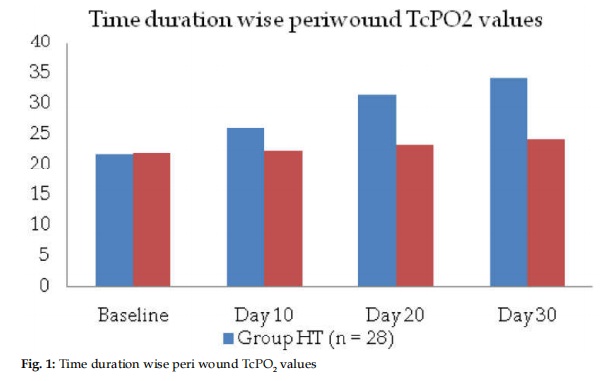
Design: A prospective study was performed to realize the aim and objectives of this study. Place of Study: The study was carried out at the Prana HBO Centre, which is owned by the Investigator and located in the Northern parts of Mumbai, in India. Methods: The center has one Sechrist Monoplace hyperbaric chamber and a TCOM machine with 3 electrodes. The oxygen gas supply is from oxygen cylinders of 7000 liters’ capacity each. The data was collected from all the patient files, which are stored at the center. Transcutaneous Oximetry monitoring system was utilized for measuring tissue oxygenation (TcPO2 ) in all the patients of both groups.
Observation and Discussion: There was 68% reduction in wound area (mean baseline area of 22 cm 2 decreased to 7 cm 2 at 30 day of therapy, as per there mean value in group HT by using paired t test, there is highly significantly improvement in wound with p value 0.00001. Hyperbaric oxygen therapy increases the chances of healing of ulcers by decreasing exudates and very well promotes granulation tissue, as well the wound size decreases and wound tissue type and healing is improvised.
Conclusion: Hyperbaric Oxygen Therapy definitely has an adjunctive play in management of non healing ulcers usually in diabetic patients.
References
No records found.
About this article

Cite this article
Manoj Gupta. Evaluation of Hyperbaric Oxygen Therapy for Diabetic Wounds and Transcutaneous Oximetry as a Predictor of Wound Healing: A prospective Study at Prana HBOT Center Mumbai. Indian Journal of Diabetes and Endocrinology. 2019;1(1):5-10.
Licence:
| Received | Accepted | Published |
|---|---|---|
| N/A | N/A | N/A |
DOI:
Keywords
Transcutaneous Oximetry; Hyperbaric Oxygen Therapy; Ulcers.Search for Similar Articles
Similar Articles
- The Gut-Glycemic Axis in the Indian Geriatric Population: Evaluating Pre and Pro...
- Impact of One Mineral Density among Postmenopausal Women with Gestational DM usi...
- Evaluate the Knowledge about Hyperparathyroidism and Hyperthyroidism among Nursi...
- Comparative Study to Evaluate the Knowledge Level about Acromegaly and Gigantis...
- HbA1c in Diabetes: Indian Perspectives on Measurement, Interpretation, and Clini...
Article Level Metrics
Last UpdatedTuesday 08 September 2026, 02:21:38 (IST)
1133
Accesses
9
135
00
Citations
NA
NA
NA
Download citation
Article Keywords
Keyword Highlighting
Highlight selected keywords in the article text.
Timeline
| Received | N/A |
| Accepted | N/A |
| Published | N/A |