Full Text (PDF)
Journal of Forensic Chemistry and Toxicology 9(2):p 71-74, July-December 2023. | DOI: http://dx.doi.org/10.21088/jfct.2454.9363.9223.1
Original Article
Elimination of Chromium (Vl) from Industrial Effluent through the Utilization of Water Hyacinth weed
Nand Lal, Anuradha Tiwari, Ashish Kr Singh, Tamanna Begam, Neelam Pal
Author Information
Licence:
Attribution-Non-commercial 4.0 International (CC BY-NC 4.0)This license enables reusers to distribute, remix, adapt, and build upon the material in any medium or format for noncommercial purposes only, and only so long as attribution is given to the creator
Journal of Forensic Chemistry and Toxicology 9(2):p 71-74, July-December 2023. | DOI: http://dx.doi.org/10.21088/jfct.2454.9363.9223.1
How Cite This Article:
Tiwari A, Lal N, Singh AK, et al. Elimination of chromium (VI) from industrial effluent through the utilization of water hyacinth weed. J Forensic Chem Toxicol. 2023;9(2):71–74.Timeline
Received : April 08, 2023
Accepted : May 31, 2023
Published : December 12, 2023
Abstract
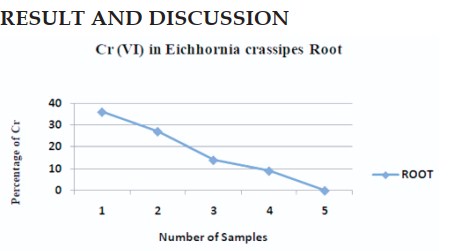
Biosorption is a physico-chemical binding of a substance to biological material. Water hyacinth has been successfully utilized for the removal of chromium (VI) from waste water samples. The plants were divided in to two part (i) root (ii) foliage. Each part was dried at 750 C for 48 hours and then its weighed was taken. The tissue samples weight then ash in the muffle-furnace at 3500 C for 5 hours. Ash samples were digested with acids (HNO3, HCl) and diluted with 100 ml of distilled water. The detection of chromium (VI) carried out by Atomic Adsorption Spectrophotometer (AAS). This method of removing chromium from water is cost-effective, eco-friendly, and has been shown to be effective in laboratory studies.
References
- 1. Amitrajeet A Batabyal, Tanneries in Kanpur and pollution in the Ganga: A theoretical analysis, Regio Sci Poli & Practi, 2022.
- 2. Satyendra Kumar Garg, Manikant Tripathi & Thiruneela Kantam Srinath, Strategies for chromium bioremediation of tannery effluent; Review of environmental contamination and toxicology, 2012;217:75-140.
- 3. A Singh, S Porwal, A Verma, Hexavalent chromium :toxic and genotoxic effects and its bioremediation strategies, Biomed J Sci & Tech Res 2021;35:27637- 27642.
- 4. Anupama kumari, Samirkumarsinha, Nipunika rani & Ravinder kr. Sinha Assessment of heavy metal pollution in water rediment, and fish of the river Ganga atvaranasi India, Aratrian J. of Geosci; 2021; 14; 2346.
- 5. Oluwasegiomoloso, Kathlein Mortimer william R. wise, Luai Jransit Sustainability research in the lecture industry; A critical review of. progrex and opportunities for future research, J of cleaner prod., 2021; 285 1—11.
- 6. Saikia D.K., Mathur R.P., Srivastava S.R., Heavy metal in water sediment of upper ganga, Ind J Environ Health, 1988; 31:11-17.
- 7. Lazarids K.N., Charalanbous Ch., Removal of trivalent and hexavalent chromium from binary aqueous solution by composite alginate-goethite beads, Water Res 2005; 39:4385-4396.
- 8. Wilson M.W., Edyneam R.G., Biosorption for the removal of heavy metals from industrial waste water, ICHEME Symposium series No. 132,185-196.
- 9. M.E. Losi, C. Amrhein & W.T. Franken berger Jr., Environmental biochemistry of chromium, Reviews of Environ Contaminanf Toxico, ;136:99-121.
- 10. Ernie D., Tombado, Orlean G., Dela Cruz, Ernesto J., Guades, Evalution of water hyacinth ash, extract and fiber in concrete: Aliteratue review, Advan in civil engin mater, 2023;57:55-62.
- 11. M.A. Bote, V.R. Naik, K.B. Jagadeesh gouda, Review on water hyacinth weed as a potential biofuel crop to meet collective energy needs, Materi Sci for energy tech, 2020;3:397-406.
- 12. Md. Arman Arefin, Fazlur Rashid Amirul Islam, A review of biofuel production from floating aquatic plants: an emerging source of bio renewable energy, Biofpr, 2021;15:574-591.
- 13. Akshay Jain, Bhasker Jyoti Bora, Rakesh Kumar, Abdulrajak Buradi, Recent Advan. In thermofluids and manufaengin, 2022;106:377-388.
- 14. Weiping Su, Qingping Sun, Meisheng Xia, Zhengshun Wen and Zhiteng Yao, The resource utilization of water hyacinth (Eichhornia crassipes [Mart.]solms) and its challenges, Resources, 2018;46:2-9.
- 15. Hooshyar Hossini, Behna Shafie, Amir Dengham Niri, Manbouben Nazari, Aylin Jahanban Esfahlan, Mohammad Ahmadpour, Zazmara, Mannan Ahmadimanesh, Pouran Makndoumi, Nazam Mirzaei & Edris Hoseinzaden, A comprehensive review on human health effects of chromium: insights on indused toxicity, Environ Sci and pollu rese, 2022;29:70686-70705.
- 16. Ammar Malik, Messaoad Hachemi, Villemin Didier, New approach of depollution of solid chromium leather waste by the use of organic chelates: Economical and environmental impacts, J of Hazar Mater, 2009;170:156-162.
Data Sharing Statement
There are no additional data available.
Funding
This research received no funding.
Author Contributions
All authors contributed significantly to the work and approve its publication.
Ethics Declaration
This article does not involve any human or animal subjects, and therefore does not require ethics approval
Acknowledgements
Information Not Provided
Conflicts of Interest
No conflicts of interest in this work.
About this article

Cite this article
Tiwari A, Lal N, Singh AK, et al. Elimination of chromium (VI) from industrial effluent through the utilization of water hyacinth weed. J Forensic Chem Toxicol. 2023;9(2):71–74.
Licence:
Attribution-Non-commercial 4.0 International (CC BY-NC 4.0)This license enables reusers to distribute, remix, adapt, and build upon the material in any medium or format for noncommercial purposes only, and only so long as attribution is given to the creator
| Received | Accepted | Published |
|---|---|---|
| April 08, 2023 | May 31, 2023 | December 12, 2023 |
DOI: http://dx.doi.org/10.21088/jfct.2454.9363.9223.1
Keywords
BiosorptionWater HyacinthEffluentSearch for Similar Articles
Similar Articles
- Lethal Poisoning Cases: The Poisoning Cases of India: A Review Study
- Deciphering the Secrets of Magic Pen Inks: A Review
- From Effluents to Exposure: Wastewater-Based Epidemiology in Occupational and En...
- Sub Standard and Falsified Drugs Toxicity: An Alarming Concern of Today
- Detection and Identification of Kerosene in Turpentine Oil: A Review
Article Level Metrics
Last UpdatedSunday 16 August 2026, 09:06:07 (IST)
1119
Accesses
4
106
00
Citations
NA
NA
NA
Download citation
Article Keywords
Keyword Highlighting
Highlight selected keywords in the article text.
Timeline
| Received | April 08, 2023 |
| Accepted | May 31, 2023 |
| Published | December 12, 2023 |
licence
Attribution-Non-commercial 4.0 International (CC BY-NC 4.0)
This license enables reusers to distribute, remix, adapt, and build upon the material in any medium or format for noncommercial purposes only, and only so long as attribution is given to the creator