Full Text (PDF)
Indian Journal of Obstetrics and Gynecology 10(1):p 13-17, January – March 2022. | DOI: https://doi.org/10.21088/ijog.2321.1636.10122.2
Original Article
Effectiveness of Educational Nurturing Regarding Birth Preparedness on Knowledge and Application of Birth Preparedness among Primi Mothers & Their Caretakers During Delivery
Roy Bhowmik S, Vandna null, Pandey S, Sachan R
Author Information
Licence:
Attribution-Non-commercial 4.0 International (CC BY-NC 4.0)This license enables reusers to distribute, remix, adapt, and build upon the material in any medium or format for noncommercial purposes only, and only so long as attribution is given to the creator
Indian Journal of Obstetrics and Gynecology 10(1):p 13-17, January – March 2022. | DOI: https://doi.org/10.21088/ijog.2321.1636.10122.2
How Cite This Article:
Vandna, Roy Bhowmik S, Pandey S, et. al./Effectiveness of Educational Nurturing Regarding Birth Preparedness on Knowledge and Application of Birth Preparedness among Primi Mothers & Their Caretakers During Delivery/Indian J Obstet Gynecol. 2022;10(1):13–17.Timeline
Received : October 20, 2021
Accepted : November 12, 2021
Published : March 30, 2022
Abstract
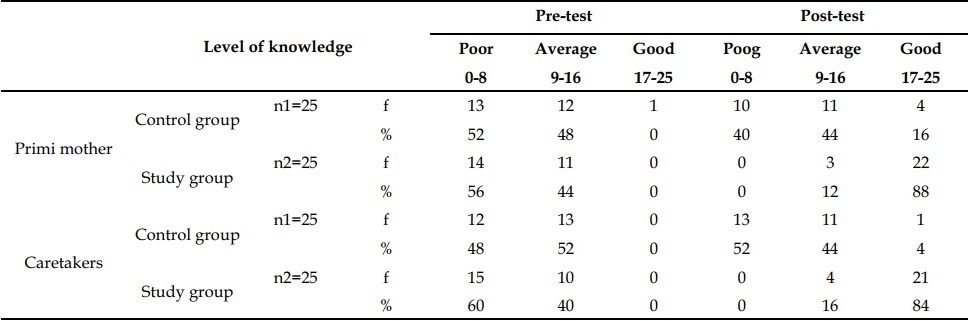
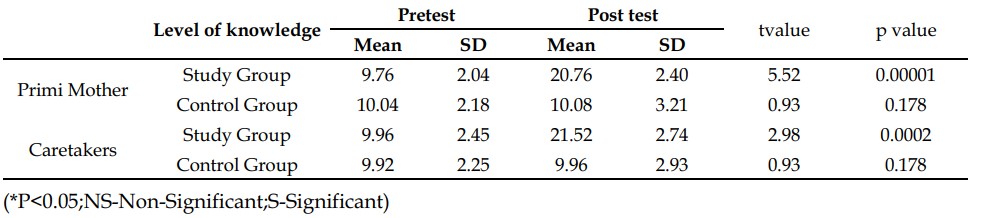
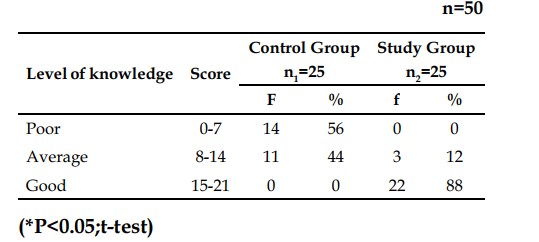
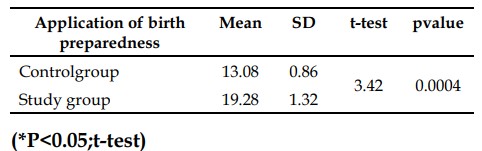
Introduction: Birth preparedness is a practice that helps pregnant mothers, their family members, and communities to deal effectively for childbirths and how to overcome with the emergencies. It is a core component of healthy motherhood service that are worldwide practiced. Aims: To assess the effectiveness on educational Nurturing regarding Birth Preparedness on knowledge and Application of Birth Preparedness among primi mothers & their caretakers during delivery. Settings and Design: Tertiary care hospital and quasi experimental design was adopted. Methods and Material: In this study 50 primi mothers and 50 caretakers of those primi mothers were selected by purposive sampling technique. The study group received pamphlet regarding birth preparedness and control group followed the hospital routines. Data related to knowledge collected before and after the study intervention from both the study groups by self structured questionnaire (r=0.84%) anddata related to application from caretakersafter the study intervention is by checklist (r=0.84%) Statistical analysis used: In this study chi square, t test and p test are adopted for this study. Results: There was signifeicant difference found in knowledgeamong primimother(p=0.00001) and caretakers (p=0.0002) in study group before and after the intervention. The results also showed that in study group there was significant difference in application (p=0.0004) among caretakers regarding birth preparedness. Conclusions: This study suggests that study group of primiwomen and caretakers having good knowledge after the intervention. So educational nurturing increased the knowledge and application among primi mothers & their caretakers.
References
- 1. Acharya A, Kaur R, Prasuna J, Rasheed N. Making Pregnancy Safer—Birth Preparedness and Complication Readiness Study Among Antenatal Women Attendees of A Primary Health Center, Delhi. Indian Journal of Community Medicine. 2021;(Indian J Community Med. 2015 Apr-Jun; 40(2): 127–134.).1
- 1. JHPIEGO and Maternal and Neonatal Health (MNH) Program (2004) Birth Preparedness and Complication Readiness, Tools and Indicators for Maternal and New Born Health. John Hopkins, Bloomberg School of Public Health, Center for Communication Programs, Family Care International, 2004 2
- 2. Maternal health [Internet]. Unicef.org. 2021 [cited 18 January 2021]. Available from: https://www.unicef.org/india/what-we-do/maternal-health3
- 3. Antenatal care - UNICEF DATA. UNICEF DATA. 2020. Available from: https://data.unicef.org/topic/maternal-health/antenatalcare/4
- 4. WHO, “Birth and emergency preparedness in antenatal care,” in Standards for Maternal and Neonatal Care, Integrated Management of Pregnancy and Childbirth (IMPAC), 2006, https://www.who.int/reproductivehealth/publications/maternal_perinatal_health/emergency_preparedness_antenatal_care.pdf. View at: Google Scholar5
- 5. Education for Childbirth | GLOWM [Internet]. Glowm.com. 2008]. Available from: https://www.glowm.com/section_view/heading/education-for-childbirth/item/1096
- 6. Natural childbirth.2017; Available from: https://www.britannica.com/science/natural-childbirth-biology7
- 7. Garcia D. Smith. Bradley Method: What It Is and How It Works. Healthline.2020. Available from: https://www.healthline.com/health/pregnancy/bradleymethod#how-it-works8
- 8. Wilderman, I., 2016. Integral of Pain Relief as an Innovative Method of Pain Measurement. Journal of Pain & Relief, 06(01). 9
- 9. Nhm.gov.in. 2010. Available from: https:// nhm.gov.in/images/pdf/programmes/maternal-health/guidelines/sba_guidelines_for_skilled_attendance_at_birth.pdf 10
- 10. National Rural Health Mission. Nhm.gov.in. Available from: https://nhm.gov.in/images/ pdf/communitisation/asha/book-no-6.pdf11
- 11. Acharya, A., Kaur, R., Prasuna, J. and Rasheed, N., 2015. Making Pregnancy Safer-Birth Preparedness and Complication Readiness Study Among Antenatal Women Attendees of A Primary Health Center, Delhi. Indian Journal of Community Medicine, 40(2), p.127.12
- 12. Murki, A., Kamineni, V. and Kota, V., 2017. Birth preparedness and complication readiness in pregnant women attending urban tertiary care hospital. Journal of Family Medicine and Primary Care, 6(2), p.297.13
- 13. McLeish, J., Harvey, M., Redshaw, M. and Alderdice, F., 2020. A qualitative study of firsttime mothers’ experiences of postnatal social support from health professionals in England. Women and Birth,.14
- 14. Baraki Z, Wendem F, Gerensea H, Teklay H. Husbands involvement in birth preparedness and complication readiness in Axum town, Tigray region, Ethiopia, 2017. BMC Pregnancy and Childbirth. 2019;19(1).15
- 15. Munkhondya, B., Munkhondya, T., Msiska, G., Kabuluzi, E., Yao, J. and Wang, H., 2020. A qualitative study of childbirth fear and preparation among primigravid women: The blind spot of antenatal care in Lilongwe, Malawi. International Journal of Nursing Sciences, 7(3), pp.303-312.16
Data Sharing Statement
There are no additional data available. All raw data and code are available upon request.
Funding
This research received no funding.
Author Contributions
All authors contributed significantly to the work and approve its publication.
Ethics Declaration
This article does not involve any human or animal subjects, and therefore does not require ethics approval.
Acknowledgements
We would like to express our gratitude to the patients, their families, and all those who have contributed to this study.
Conflicts of Interest
No conflicts of interest in this work.
About this article

Cite this article
Vandna, Roy Bhowmik S, Pandey S, et. al./Effectiveness of Educational Nurturing Regarding Birth Preparedness on Knowledge and Application of Birth Preparedness among Primi Mothers & Their Caretakers During Delivery/Indian J Obstet Gynecol. 2022;10(1):13–17.
Licence:
Attribution-Non-commercial 4.0 International (CC BY-NC 4.0)This license enables reusers to distribute, remix, adapt, and build upon the material in any medium or format for noncommercial purposes only, and only so long as attribution is given to the creator
| Received | Accepted | Published |
|---|---|---|
| October 20, 2021 | November 12, 2021 | March 30, 2022 |
DOI: https://doi.org/10.21088/ijog.2321.1636.10122.2
Keywords
Nurturing RegardingBirth PreparednessKnowledge and Application of BirthMothers & Their Caretakers During DeliverySearch for Similar Articles
Similar Articles
- Fibromyoma: A Clinical Dilemma
- Optimizing Obstetric Care: A Review of Indications and Outcomes for First-Time C...
- A Rare Case of Geriatric Endometrial Adenocarcinoma Presenting with Nonpuerperal...
- Relationship between Hypothyroidism and Gestational Diabetes Mellitus: A Prospec...
- Influence of Maternal Anthropometry and Hemoglobin on Neonatal Anthropometry
Article Level Metrics
Last UpdatedTuesday 08 September 2026, 16:32:52 (IST)
3505
Accesses
15
580
00
Citations
NA
NA
NA
Download citation
Article Keywords
Keyword Highlighting
Highlight selected keywords in the article text.
Timeline
| Received | October 20, 2021 |
| Accepted | November 12, 2021 |
| Published | March 30, 2022 |
licence
Attribution-Non-commercial 4.0 International (CC BY-NC 4.0)
This license enables reusers to distribute, remix, adapt, and build upon the material in any medium or format for noncommercial purposes only, and only so long as attribution is given to the creator