Full Text (PDF)
Indian Journal of Anesthesia and Analgesia 13(1):p 7-13, Jan-March 2026. | DOI: https://doi.org/10.21088/ijaa.2349.8471.13126.1
Original Article
Double Blind RCT comparing Dexmedetomidine with Magnesium Versus Lignocaine for Pressor response attenuation to Laryngoscopy
Ekta Eknath Mohite, Reena Nebu
Author Information
Licence:
Attribution-Non-commercial 4.0 International (CC BY-NC 4.0)This license enables reusers to distribute, remix, adapt, and build upon the material in any medium or format for noncommercial purposes only, and only so long as attribution is given to the creator.
Indian Journal of Anesthesia and Analgesia 13(1):p 7-13, Jan-March 2026. | DOI: https://doi.org/10.21088/ijaa.2349.8471.13126.1
How Cite This Article:
Nebu R, Mohite EE, et al. Double blind RCT comparing dexmedetomidine with magnesium versus lignocaine for pressor response attenuation to laryngoscopy. Ind J Anesth Analg. 2026;13(1):7-13.Timeline
Received : October 20, 2025
Accepted : December 20, 2025
Published : March 30, 2026
Abstract
Aims and Objectives: To compare hemodynamic responses to direct laryngoscopy and endotracheal intubation with intravenous dexmedetomidine combined with either magnesium sulphate or lignocaine. Study Site and Design: Hospital-based, double-blinded randomized controlled study at a Municipal General Hospital.
Study Population and Sample Size: 128 adult patients (ASA I-II) scheduled for elective surgery under general anaesthesia, divided into two groups of 64 each.
Methodology: Patients received premedication with study drugs. Standardized anaesthesia induction was followed. Vital parameters like heart rate, blood pressures (SBP, DBP, MAP), SpO2, and ECG were recorded at baseline, preinduction, and at 1, 3, 5, 10, and 15 minutes post-induction. Postoperative analgesia and recovery times were monitored.
Statistical Analysis: Data were analysed using SPSS v22. Continuous variables were expressed as mean ± SD and compared using unpaired t-tests; categorical variables were analysed using Chi-square tests. Trends over time were evaluated; significance was set at p<0.05.
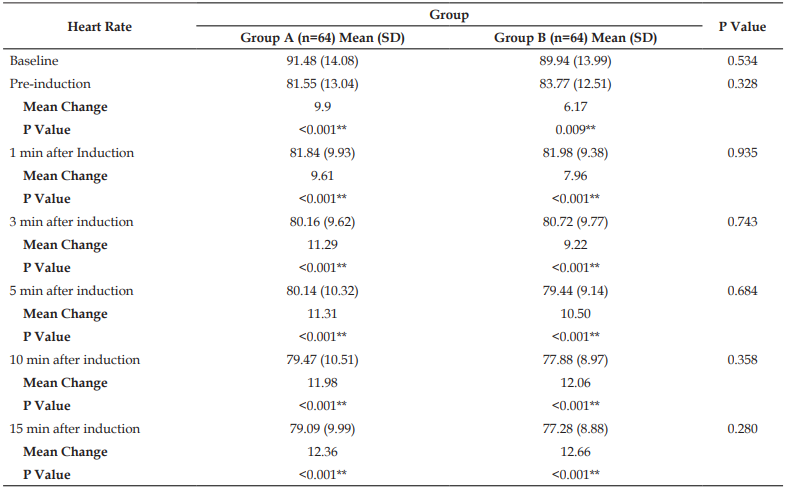
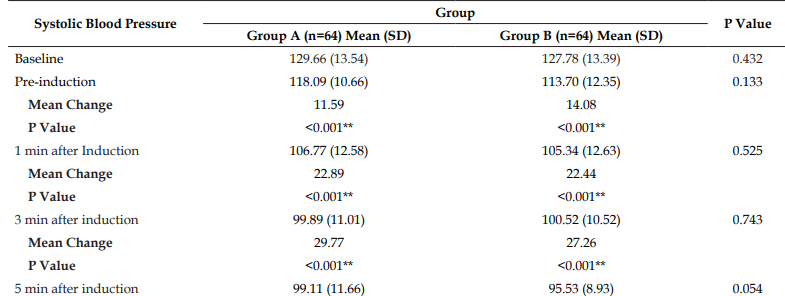
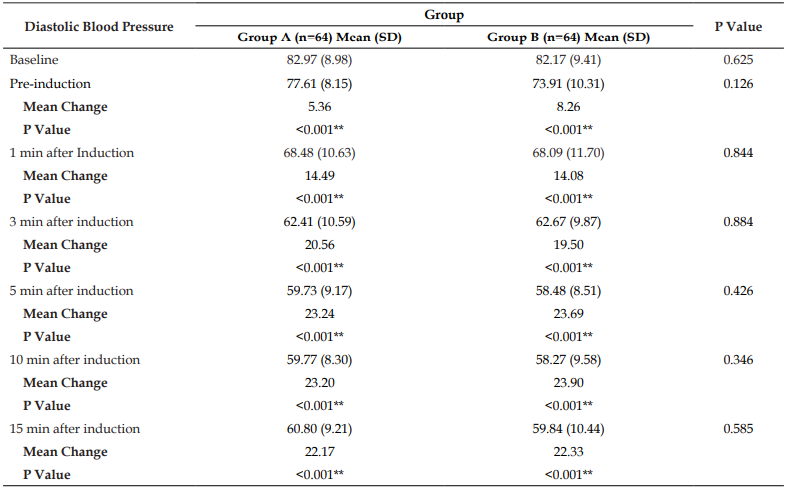
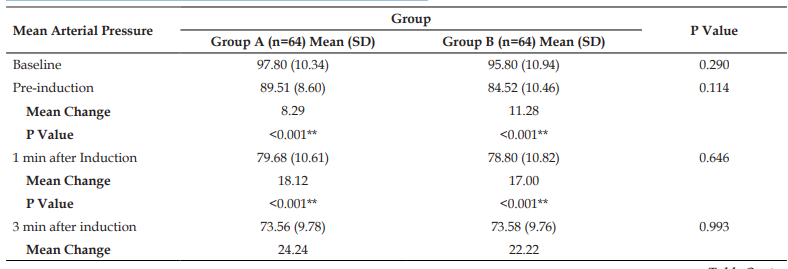
Results: Demographics including age, gender, ASA grade, BMI, and comorbidities were comparable (p>0.05). Both drug combinations maintained stable hemodynamics during and after intubation, with no significant differences in HR, BP, MAP, SpO2, or ECG. Postoperative analgesia and induction-to-extubation times were similar (p>0.05).
Conclusion: Dexmedetomidine combined with either magnesium sulphate or lignocaine effectively attenuates the hemodynamic response to laryngoscopy and intubation, with stable perioperative parameters and comparable safety profiles. Both combinations are suitable for ASA I-II patients.
References
- 1. Kovac AL. Controlling the hemodynamic response to laryngoscopy and endotracheal intubation. J Clin Anesth. 1996;8(1):63-79.
- 2. Shribman AJ, Smith G, Achola KJ. Cardiovascular and catecholamine responses to laryngoscopy with and without tracheal intubation. Br J Anaesth. 1987;59(3):295-9.
- 3. Lowrie A, Johnston PL, Fell D, Robinson SL. Cardiovascular and plasma catecholamine responses at tracheal extubation. Br J Anaesth. 1992;68(3):261-3.
- 4. Hassan HG, el-Sharkawy TY, Renck H, Mansour G, Hasanein A. Hemodynamic and catecholamine responses to laryngoscopy with vs. without endotracheal intubation. Acta Anaesthesiol Scand. 1991;35(5):442-7.
- 5. Figueredo E, Garcia-Fuentes EM. Assessment of the efficacy of esmolol on the haemodynamic changes induced by laryngoscopy and tracheal intubation: a meta-analysis. Acta Anaesthesiol Scand. 2001;45(8):1011-22.
- 6. Altura BM, Altura BT. Magnesium and vascular tone and reactivity. Blood Vessels. 1978;15(1-3):5-16.
- 7. Dubé L, Granry JC. The therapeutic use of magnesium in anesthesiology, intensive care and emergency medicine: a review. Can J Anaesth. 2003;50(7):732-46.
- 8. Koinig H, Wallner T, Marhofer P, Andel H, Höchtl C, Erlacher W. Magnesium sulfate reduces intra- and postoperative analgesic requirements. Anesth Analg. 1998;87(1):206-10.
- 9. Gerlach AT, Dasta JF. Dexmedetomidine: an updated review. Ann Pharmacother. 2007;41(2):245-52.
- 10. Bloor BC, Ward DS, Belleville JP, Maze M. Effects of intravenous dexmedetomidine in humans. II. Hemodynamic changes. Anesthesiology. 1992;77(6):1134-42.
- 11. Aho M, Scheinin M, Lehtinen AM, Erkola O, Vuorinen J, Korttila K. Intramuscularly administered dexmedetomidine attenuates hemodynamic and stress hormone responses to gynecologic laparoscopy. Anesth Analg. 1992;75(6):932-9.
- 12. Hamill JF, Bedford RF, Weaver DC, Colohan AR. Lidocaine before endotracheal intubation: intravenous or laryngotracheal? Anesthesiology. 1981;55(5):578-81.
- 13. Stoelting RK. Circulatory changes during direct laryngoscopy and tracheal intubation: influence of duration of laryngoscopy with or without prior lidocaine. Anesthesiology. 1977;47(4):381-4.
- 14. Benowitz NL, Meister W. Clinical pharmacokinetics of lignocaine. Clin Pharmacokinet. 1978;3(3):177-201.
- 15. Miller RD, Eriksson LI, Fleisher LA, Wiener-Kronish JP, Cohen NH, Young WL. Miller’s Anesthesia. 8th ed. Philadelphia (PA): Elsevier Saunders; 2015.
- 16. Kayhan Z, Aldemir D, Mutlu S, Özalp G. Which is responsible for the haemodynamic response due to laryngoscopy and endotracheal intubation? Catecholamines, vasopressin or angiotensin? Eur J Anaesthesiol. 2005;22(10):780-5.
- 17. Puri GD, Marudhachalam KS, Chari P, Suri RK. The effect of magnesium sulphate on hemodynamics and its efficacy in attenuating the response to endotracheal intubation in patients with coronary artery disease. Anesth Analg. 1998;87(4):808-11.
- 18. Wijeysundera DN, Naik JS, Beattie WS. Alpha-2 adrenergic agonists to prevent perioperative cardiovascular complications: a meta-analysis. Am J Med. 2003;114(9):742-52.
- 19. Abou-Madi MN, Keszler H, Yacoub O. Cardiovascular reactions to laryngoscopy and tracheal intubation following small and large intravenous doses of lidocaine. Can Anaesth Soc J. 1977;24(1):12-9.
- 20. Muchhal KK, Alam M. Comparative study of dexmedetomidine, magnesium sulphate and lignocaine in attenuation of pressor response during laryngoscopy and tracheal intubation. Anesth Essays Res. 2020;14(3):442-8.
- 21. Srivastava VK, Agrawal S, Kumar S, Sharma S. Comparative evaluation of esmolol and dexmedetomidine for attenuation of sympathomimetic response to laryngoscopy and intubation in neurosurgical patients. J Anaesthesiol Clin Pharmacol. 2015;31(2):186-90.
- 22. Gunalan S, Venkatraman R, Sivaraman G, Sunder P. Comparative evaluation of bolus administration of dexmedetomidine and fentanyl for stress attenuation during laryngoscopy and endotracheal intubation. J Clin Diagn Res. 2015;9(9):UC06-9.
- 23. Collinsworth KA, Kalman SM, Harrison DC. The clinical pharmacology of lidocaine as an antiarrhythmic drug. Circulation. 1974;50(6):1217-30.
- 24. Tariq S, Yaqoob KM. Comparison of intravenous lignocaine and intravenous dexmedetomidine for attenuation of hemodynamic stress response to laryngoscopy and endotracheal intubation. Pak Armed Forces Med J. 2024;74(4):1138-42.
- 25. Mohan A, Saha G. A comparative study of the efficacy of intravenous magnesium sulphate and intravenous dexmedetomidine in attenuating haemodynamic response to laryngoscopy and endotracheal intubation. Indian J Clin Anaesth. 2023;10(4):351-7.
- 26. Dube S, Gosavi K. Comparative study of dexmedetomidine, lignocaine and their combination for the attenuation of hemodynamic response during laryngoscopy and intubation. Indian J Clin Anaesth. 2022;9(1):27-31.
- 27. Rishardhan P, Chavan RV. Comparative study of magnesium sulphate and dexmedetomidine in the attenuation of pressor response to intubation and on intraoperative haemodynamic parameters in laparoscopic cholecystectomy. MedPulse Int J Anaesthesiol. 2021;19(3):105-110.
- 28. Eniya P. Comparison of intravenous lignocaine and dexmedetomidine for attenuation of hemodynamic stress response to laryngoscopy and endotracheal intubation. Indian J Anaesth Analg. 2020;7(4):873-8.
- 29. Mahajan L, Kaur M, Gupta R, Aujla KS, Singh A, Kaur A. Attenuation of the pressor responses to laryngoscopy and endotracheal intubation with intravenous dexmedetomidine versus magnesium sulphate under bispectral index-controlled anaesthesia: a placebo-controlled prospective randomised trial. Indian J Anaesth. 2018;62(5):337-43.
- 30. Balata A, Abdel Latif H. Dexmedetomidine versus magnesium sulphate or lidocaine for blunting stress response to direct laryngoscopy and endotracheal intubation in abdominal surgeries. Zagazig Univ Med J. 2018;24(6):492-500.
- 31. Gupta H, Vyas S. A comparative study of efficacy of intravenous dexmedetomidine and intravenous esmolol for attenuation of stress response during laryngoscopy and endotracheal intubation. Int J Basic Clin Pharmacol. 2016;5:1803-8.
- 32. Honarmand A, Safavi M, Adibi P. Different doses of intravenous magnesium sulfate on cardiovascular changes following the laryngoscopy and tracheal intubation: a double-blind randomized controlled trial. J Res Pharm Pract. 2015;4(2):79-84.
Data Sharing Statement
There are no additional data available. All raw data and code are available upon request.
Funding
This research received no funding.
Author Contributions
Whether all authors contributed significantly to the work and approve its publication.
Ethics Declaration
This article does not involve any human or animal subjects, and therefore does not require ethics approval.
Acknowledgements
We would like to express our gratitude to the patients, their families, and all those who have contributed to this study.
Conflicts of Interest
The authors report no conflicts of interest in this work.
About this article

Cite this article
Nebu R, Mohite EE, et al. Double blind RCT comparing dexmedetomidine with magnesium versus lignocaine for pressor response attenuation to laryngoscopy. Ind J Anesth Analg. 2026;13(1):7-13.
Licence:
Attribution-Non-commercial 4.0 International (CC BY-NC 4.0)This license enables reusers to distribute, remix, adapt, and build upon the material in any medium or format for noncommercial purposes only, and only so long as attribution is given to the creator.
| Received | Accepted | Published |
|---|---|---|
| October 20, 2025 | December 20, 2025 | March 30, 2026 |
DOI: https://doi.org/10.21088/ijaa.2349.8471.13126.1
Keywords
DexmedetomidineMagnesium SulphateLignocaineHemodynamic ResponseLaryngoscopySearch for Similar Articles
Similar Articles
- Case of Cleft Palate and Hyperthyroidism for Abdominal Hysterectomy
- Taming the Neurogenic Storm: Targeted Pharmacotherapy for Central Fever in Neuro...
- Intraoperative Endotracheal Tube Cuff Herniation During Prone Lumbar Spine Surge...
- A Case of Meningomyelocele in a 6 month Old Infant: Anaesthesia Management
- Prolonged Paediatric Foreign Body Extraction: Challenges Bring Out Innovations
Article Level Metrics
Last UpdatedTuesday 20 October 2026, 08:32:13 (IST)
12961
Accesses
64
1037
00
Citations
NA
NA
NA
Download citation
Article Keywords
Keyword Highlighting
Highlight selected keywords in the article text.
Timeline
| Received | October 20, 2025 |
| Accepted | December 20, 2025 |
| Published | March 30, 2026 |
licence
Attribution-Non-commercial 4.0 International (CC BY-NC 4.0)
This license enables reusers to distribute, remix, adapt, and build upon the material in any medium or format for noncommercial purposes only, and only so long as attribution is given to the creator.