Full Text (PDF)
Indian Journal of Forensic Medicine and Pathology 18((2 Suppl)):p 103-113, April-June 2025. | DOI: https://doi.org/10.21088/ijfmp.0974.3383.18225.10
Original Article
Deciphering the Nexus: Analysing Social Dynamics in Cybercrime Investigations through Interpretive Structural Modeling in Forensic Science
Monika Singh, Manjeet Kumar, Vinny Sharma
Author Information
Licence:
Attribution-Non-commercial 4.0 International (CC BY-NC 4.0)This license enables reusers to distribute, remix, adapt, and build upon the material in any medium or format for noncommercial purposes only, and only so long as attribution is given to the creator.
Indian Journal of Forensic Medicine and Pathology 18((2 Suppl)):p 103-113, April-June 2025. | DOI: https://doi.org/10.21088/ijfmp.0974.3383.18225.10
How Cite This Article:
Singh M, Kumar M, Sharma V. Deciphering the Nexus: Analysing Social Dynamics in Cybercrime Investigations through Interpretive Structural Modeling in Forensic Science. Indian J Forensic Med Pathol. 2025;18(2 Suppl):103-113.Timeline
Received : June 22, 2024
Accepted : June 05, 2025
Published : June 30, 2025
Abstract
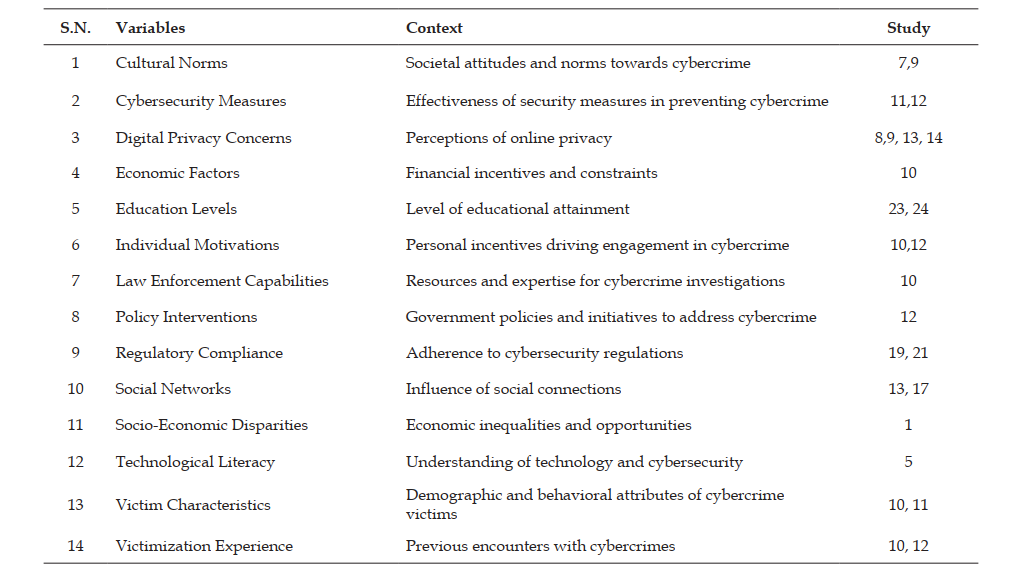
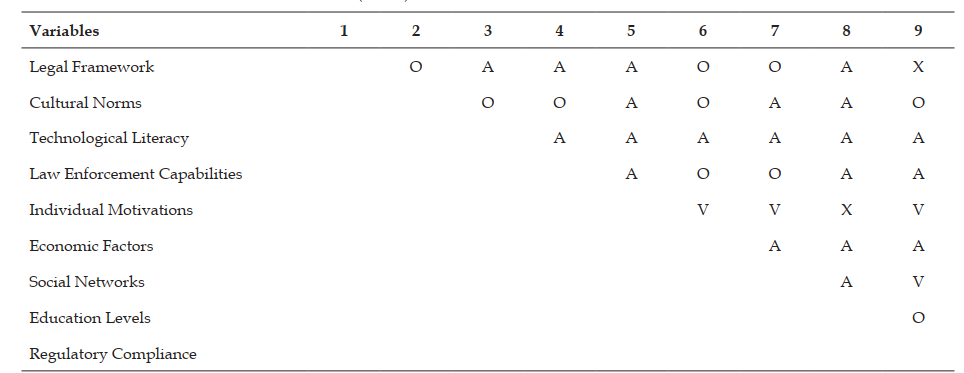
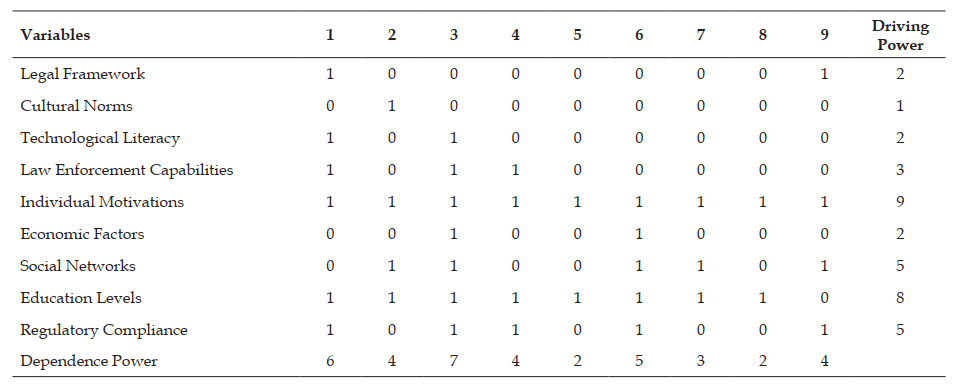
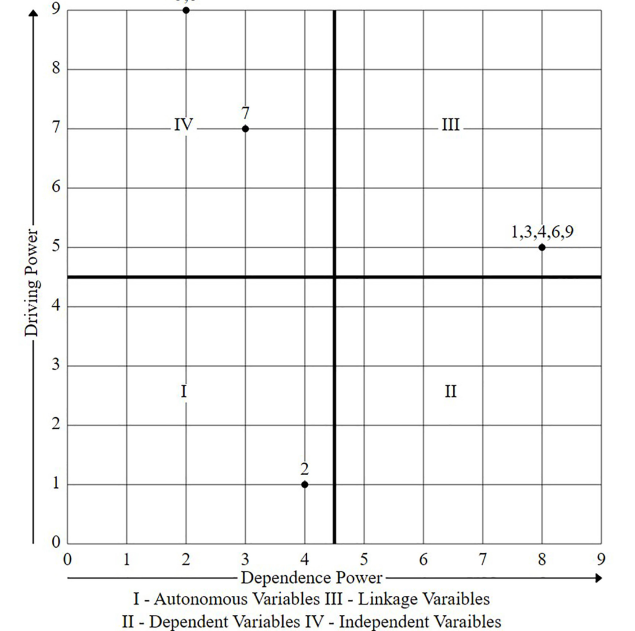
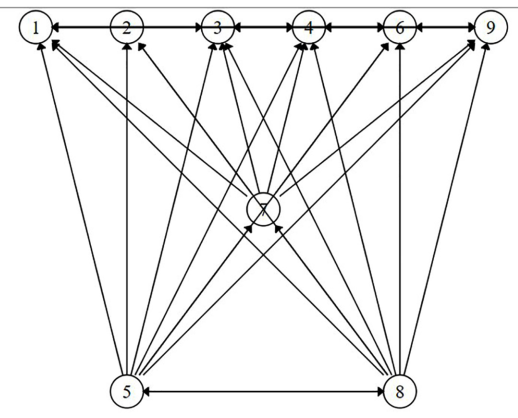
Cybercrime has evolved into a pervasive and multifaceted challenge, influenced by an array of social factors that often confound traditional forensic methodologies. This paper endeavors to identify and analyze key social factors contributing to cybercrime investigations within the domain of forensic science. Employing Interpretive Structural Modeling (ISM), this study delves into the intricate interrelationships among these social factors to provide a comprehensive understanding of their impact on cybercrime investigations. Through an exhaustive literature review, significant social factors influencing cybercrime forensics are identified and analyzed. Drawing upon empirical evidence and expert insights, an ISM model is constructed to visualize the complex network of interactions among these factors. The model serves as a valuable tool for elucidating the dynamics of cybercrime investigations and identifying areas for intervention and improvement. The findings of this study underscore the profound influence of social factors on cybercrime investigations, shedding light on the complexities inherent in forensic analysis of digital crimes. By recognizing and understanding these social dynamics, forensic practitioners and law enforcement agencies can develop more effective strategies and methodologies for combating cyber threats and prosecuting cybercriminals.
References
- 1. Barrick, J., & Lallie, H.S. (2016). An Examination of the Relationship between Unemployment and Cyber Crime Rates. International Journal of Cyber Criminology, 10(1), 26-41.
- 2. Bokhari, S.A.A. (2024). Factors Influencing Implementation of Cybersecurity Laws in Developing Economies: Evidence with Quantitative Analysis from Pakistan. Authorea Preprints.
- 3. Brenner, S.W. (2009). Cyberthreats: The Emerging Fault Lines of the Nation State. Oxford University Press.
- 4. Brenner, S.W. (2009). Law in an Era of “Smart” Technology. Cambridge University Press.
- 5. Casey, E. (2011). Digital Evidence and Computer Crime: Forensic Science, Computers, and the Internet. Academic Press.
- 6. D’Arcy, J., Herath, T., & Shoss, M.K. (2009). Understanding employee responses to stressful information security requirements: A coping perspective. MIS Quarterly, 33(2), 229-249.
- 7. Fontela, E., & Gabus, A. (1976). The DEMATEL Observational Method: An Objective Way to Order Variables According to Their Causal Influence. European Journal of Operational Research, 40(3), 247-252.
- 8. Atlam, H.F., Alenezi, A., Alassafi, M.O., Alshdadi, A.A., & Wills, G.B. (2020). Security, cybercrime and digital forensics for IoT. Principles of internet of things (IoT) ecosystem: Insight paradigm, 551-577.
- 9. Higgins, G.E., Wolfe, S.E., & Marcum, C. D. (2019). Social structure, culture, and cybercrime: an analysis across 50 states. Journal of Criminal Justice, 62, 46-55.
- 10. Holt, T.J. (2015). Cybercrime: The Transformation of Crime in the Information Age. Polity Press.
- 11. Holt, T.J., & Bossler, A.M. (2016). Cybercrime and Digital Forensics: An Introduction. Routledge.
- 12. Holt, T.J., & Bossler, A.M. (2016). Examining the applicability of lifestyle-routine activitiestheory for cybercrime victimization. Deviant Behavior, 37(3), 263-280
- 13. Kumar, S., & Vaidya, O.S. (2006). Development of decision support system for selection of advanced manufacturing system: Application of interpretive structural modelling. International Journal of Production Research, 44(2), 321-344.
- 14. Malatji, M., & Tolah, A. (2024). Artificial intelligence (AI) cybersecurity dimensions: a comprehensive framework for understanding adversarial and offensive AI. AI and Ethics, 1-28.
- 15. Mohammed, K.H., Mohammed, Y.D., & Solanke, A.A. (2019). Cybercrime and digital forensics: Bridging the gap in legislation, investigation and prosecution of cybercrime in Nigeria. International Journal of Cybersecurity Intelligence & Cybercrime, 2(1), 56-63.
- 16. Mohanty, S.N., Singh, T., Goel, R., Baral, S. K., & Kumar, R. (2024). A study on building awareness in cyber security for educational system in India using interpretive structural modellings. International Journal of System Assurance Engineering and Management, 1-11.
- 17. PwC. (2020). Cybercrime: Protecting Against the Growing Threat. Retrieved from https:// www.pwc.com/us/en/services/consulting/ cybersecurity/library/cybercrime-pulsesurvey.html
- 18. Sharma, S. (2024, February). Digital Forensics: Legal Standards and Practices in Cybercrime Investigation. In 2024 4th International Conference on Innovative Practices in Technology and Management (ICIPTM) (pp. 1-6). IEEE.
- 19. Sousa-Silva, R. (2024). ‘We Attempted to Deliver Your Package’: Forensic Translation in the Fight Against Cross-Border Cybercrime. International Journal for the Semiotics of LawRevue internationale de Sémiotiquejuridique, 1-27.
- 20. Stys, Y., & Balachandran, M. (2017). Cybercrime Investigation and Forensic Methods. In Handbook of Electronic Security and Digital Forensics (pp. 1-28). Springer, Cham.
- 21. Visser, C., Markus, A., de Poot, C., Kop, N., & Weggeman, M. (2024). Sensemaking and evidence in criminal investigations of organised crime: A literature review. International Journal of Police Science & Management, 26(1), 37-52.
- 22. Warfield, J.N. (1974). Developing Interconnected Matrices in Structural Modeling. IEEE Transactions on Systems, Man, and Cybernetics, (1), 11-28.
- 23. Widodo, A.M., Biyanto, T.R., Pappachan, P., & Colace, F. (2024). Recent Advances in Digital Forensics and Cybercrime Investigation. Digital Forensics and Cyber Crime Investigation, 42-69.
- 24. Zhang, B., & Zhou, W. (2024). An empirical study of “public security centralism” in modern China and its legal and political ramifications. International Journal of Law, Crime and Justice, 76, 100648.
Data Sharing Statement
There are no additional data available. All raw data and code are available upon request.
Funding
This research received no funding.
Author Contributions
All authors contributed significantly to the work and approve its publication.
Ethics Declaration
This article does not involve any human or animal subjects, and therefore does not require ethics approval.
Acknowledgements
We would like to express our gratitude to the patients, their families, and all those who have contributed to this study.
Conflicts of Interest
No conflicts of interest.
About this article

Cite this article
Singh M, Kumar M, Sharma V. Deciphering the Nexus: Analysing Social Dynamics in Cybercrime Investigations through Interpretive Structural Modeling in Forensic Science. Indian J Forensic Med Pathol. 2025;18(2 Suppl):103-113.
Licence:
Attribution-Non-commercial 4.0 International (CC BY-NC 4.0)This license enables reusers to distribute, remix, adapt, and build upon the material in any medium or format for noncommercial purposes only, and only so long as attribution is given to the creator.
| Received | Accepted | Published |
|---|---|---|
| June 22, 2024 | June 05, 2025 | June 30, 2025 |
DOI: https://doi.org/10.21088/ijfmp.0974.3383.18225.10
Keywords
CybercrimeForensic ScienceSocial FactorsInterpretive Structural ModelingSearch for Similar Articles
Similar Articles
- Sudden Death in a 7-year-old Child Due to Neoplasm: A Case Report
- Bites of Burden: Snake Bite Envenoming in India, Regional Venom Differences, Tr...
- Forensic View of Suicide in Healthcare Workers
- Tracing Identity from Teeth to Technology: Artificial Intelligence in Forensic...
- Chemical Constituents in Latent Fingermarks as Indicators of Lifestyle using Gas...
Article Level Metrics
Last UpdatedFriday 29 May 2026, 21:42:00 (IST)
6121
Accesses
29
1577
00
Citations
NA
NA
NA
Download citation
Article Keywords
Keyword Highlighting
Highlight selected keywords in the article text.
Timeline
| Received | June 22, 2024 |
| Accepted | June 05, 2025 |
| Published | June 30, 2025 |
licence
Attribution-Non-commercial 4.0 International (CC BY-NC 4.0)
This license enables reusers to distribute, remix, adapt, and build upon the material in any medium or format for noncommercial purposes only, and only so long as attribution is given to the creator.