Full Text (PDF)
Indian Journal of Genetics and Molecular Research 12(2):p 55-58, July - December 2023. | DOI: https://doi.org/10.21088/ijgmr.2319.4782.12223.2
Original Article
Cytogenetics of Multiple Myeloma
Amudha S, Drishya Rangaraj null, Veronica Preetha Tilak, Raina. M. Pasanna, Mary Margaret A
Author Information
Licence:
Attribution-Non-commercial 4.0 International (CC BY-NC 4.0)This license enables reusers to distribute, remix, adapt, and build upon the material in any medium or format for noncommercial purposes only, and only so long as attribution is given to the creator.
Indian Journal of Genetics and Molecular Research 12(2):p 55-58, July - December 2023. | DOI: https://doi.org/10.21088/ijgmr.2319.4782.12223.2
How Cite This Article:
Amudha S, Rangaraj D, Tilak VP, et al. Cytogenetics of Multiple Myeloma. Indian J Genet Mol Res. 2023;12(2):55-8.Timeline
Received : May 08, 2023
Accepted : June 15, 2023
Published : December 10, 2023
Abstract
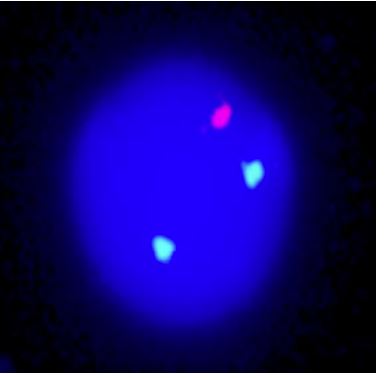
Multiple myeloma is a type of cancer that affects the plasma cells in the bone marrow. In this abstract, we discuss the cytogenetic abnormalities in multiple myeloma patients and their correlation with age and gender. We also describe the techniques used for cytogenetic analysis in the Indian population. Our study included 70 patients with multiple myeloma, and cytogenetic analysis was performed using conventional karyotyping and Fluorescence In-situ Hybridization (FISH) techniques. We observed a higher incidence of cytogenetic abnormalities in patients above 60 years of age, with male predominance. FISH analysis showed a higher detection rate of cytogenetic abnormalities compared to conventional karyotyping. FISH also provided additional information on the extent and complexity of the chromosomal aberrations. It is a cytogenetic technique that uses fluorescently labelled probes to detect genetic abnormalities in the chromosomes of cells obtained from bone marrow. This analysis can provide valuable information about the type and stage of the disease, Translocations t(4;14),t(14;16), t(6;14), and t(14;20) were associated with anaemia, t(4;14) was associated with a higher serum monoclonal protein and plasma cell proliferation. Monosomy 13 is associated with a short survival rate with transition monoclonal gammopathy. In conclusion, our study confirms the age and male predominance in multiple myeloma and highlights the importance of cytogenetic analysis in the diagnosis and prognosis of the disease. By studying the chromosomal abnormalities in MM, we can gain insights into the underlying causes of the disease. In this study, we will discuss the cytogenetics of MM and explore how it can help understand the genetics of cancer. The study highlights the chromosomal abnormalities associated with MM and its implications for diagnosis and prognosis.
References
- 1. Avet-Loiseau H, Attal M, Moreau P, Caillot D, Fermand JP, Hulin C, et al. Cytogenetic abnormalities are strong prognostic markers in multiple myeloma. Blood. 2011 Jan 20;117(2):559-65.
- 2. Boersma-Vreugdenhil GR, Peeters T, Bast BJ, Lokhorst HM. Translocation of the IgH locus is an early ubiquitous in multiple myeloma as detected by immune-FISH. Blood. 2003 Feb 15;101(4):1653-5. doi: 10.1182/blood-2002-09-2968.
- 3. Chng WJ, Sarma R, Tan D. The prognostic significance of cytogenetic abnormalities in multiple myeloma: a review of the recent literature. Leuk Lymphoma. 220 Mar;50(6):925-41.
- 4. Giri VN, Knudsen KE, Kelly WK, Abida W, Andriole GL, Bangma CH, et al. Role of genetic testing for inherited cancer. J Clin Oncol. 2018 Feb 1;36(4):414-24.
- 5. Kyle RA, Rajkumar SV. Multiple myeloma. N Engl J Med. 2004 Oct 28;351(18):1860-73.
- 6. Lahuerta JJ, Mateos MV, Martínez-López J, Grande C, Blade J. Prognostic factors in multiple myeloma. Best Pract Res Clin Haematol. 2018 Dec;31(4):316-25.
- 7. Mikulasova A, Wardell CP, Murison A, Boyle EM, Jackson GH, Davies FE. The spectrum of somatic mutations in monoclonal gammopathy of undetermined significance indicates a less complex genomic landscape than that in multiple myeloma. Haematologica. 2021 Mar 1;106(3):787-95.
- 8. Rajkumar SV, Dimopoulos MA, Palumbo A, Blade J, Merlini G, Mateos MV, et al. International Myeloma Working Group updated the criteria for the diagnosis of multiple myeloma. Lancet Oncol. 2014 Nov;15(12):e538-48.
- 9. Rajkumar SV, Kumar S. Multiple myeloma: diagnosis and treatment. Mayo Clin Proc. 2016 Jan;91(1):101-19. doi: 10.1016/j.mayocp.2015.10.004.
- 10. Rajkumar SV. Multiple myeloma: 2018 update on diagnosis, risk-stratification, and management. Am J Hematol. 2018 Aug;93(8):981-1114.
- 11. Vande Donk WNCJ, Palumbo C, Yong KL. Multiple myeloma. Lancet. 2021 Feb 6;397(10273):530-47.
Data Sharing Statement
There are no additional data available. All raw data and code are available upon request.
Funding
This research received no funding.
Author Contributions
All authors contributed significantly to the work and approve its publication.
Ethics Declaration
This article does not involve any human or animal subjects, and therefore does not require ethics approval.
Acknowledgements
Information not provided.
Conflicts of Interest
No conflicts of interest in this work.
About this article

Cite this article
Amudha S, Rangaraj D, Tilak VP, et al. Cytogenetics of Multiple Myeloma. Indian J Genet Mol Res. 2023;12(2):55-8.
Licence:
Attribution-Non-commercial 4.0 International (CC BY-NC 4.0)This license enables reusers to distribute, remix, adapt, and build upon the material in any medium or format for noncommercial purposes only, and only so long as attribution is given to the creator.
| Received | Accepted | Published |
|---|---|---|
| May 08, 2023 | June 15, 2023 | December 10, 2023 |
DOI: https://doi.org/10.21088/ijgmr.2319.4782.12223.2
Keywords
Fluorescence in situ hybridisationChromosomal translocationsPlasma cellSearch for Similar Articles
Similar Articles
- Success After Unexplained Multiple Miscarriages using PGT-A and PGT-M for RELN G...
- A Translational Strategy to Overcome Platinum Resistance in Ovarian Cancer via...
- Bridging Classic Cytogenetics with Modern Chromosomics: A Historical and Scienti...
- Mitochondrial D-Loop and HBB Gene Profiling in Antenatal Hemoglobinopathy Carrie...
- Histopathologic Features of High Grade Serous Ovarian Carcinomas Associated with...
Article Level Metrics
Last UpdatedTuesday 25 August 2026, 12:50:13 (IST)
1461
Accesses
26
316
00
Citations
NA
NA
NA
Download citation
Article Keywords
Keyword Highlighting
Highlight selected keywords in the article text.
Timeline
| Received | May 08, 2023 |
| Accepted | June 15, 2023 |
| Published | December 10, 2023 |
licence
Attribution-Non-commercial 4.0 International (CC BY-NC 4.0)
This license enables reusers to distribute, remix, adapt, and build upon the material in any medium or format for noncommercial purposes only, and only so long as attribution is given to the creator.