Full Text (PDF)
Physiotherapy and Occupational Therapy Journal 16(1):p 9-15, January-March 2023. | DOI: DOI: http://dx.doi.org/10.21088/potj.0974.5777.16123.1
Original Article
Correlation between Alexithymia and Neck Pain in Smartphone Addicted users of Paramedical Students from South Gujarat: A Cross Sectional Study
Amit S. Patel, Azima M. Sheikh, Ankita H. Yadav, Tazmin Z. Shaikh, Heena N. Patel
Author Information
Licence:
Attribution-Non-commercial 4.0 International (CC BY-NC 4.0)This license enables reusers to distribute, remix, adapt, and build upon the material in any medium or format for noncommercial purposes only, and only so long as attribution is given to the creator.
Physiotherapy and Occupational Therapy Journal 16(1):p 9-15, January-March 2023. | DOI: DOI: http://dx.doi.org/10.21088/potj.0974.5777.16123.1
How Cite This Article:
Patel AS, Sheikh AM, Yadav AH, Shaikh TZ, Patel HN. Correlation between alexithymia and neck pain in smartphone addicted users of paramedical students from South Gujarat – A cross sectional study. Physiother Occup Ther J. 2023;16(1):9-15.Timeline
Received : October 12, 2022
Accepted : November 25, 2022
Published : March 29, 2023
Abstract
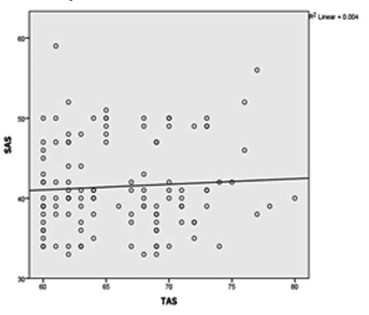
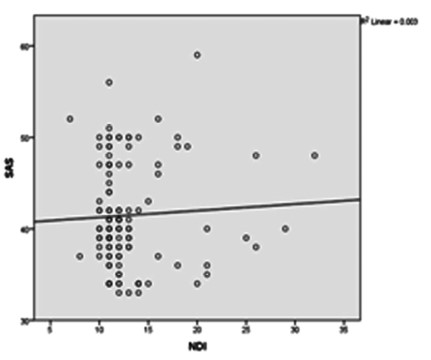
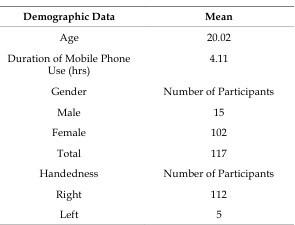
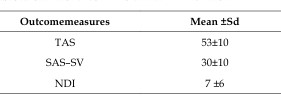
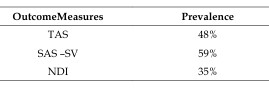
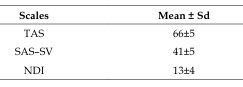
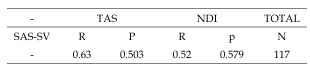
Introduction: In the present era, the increasing use of Smartphone as brought about numerous musculoskeletal discomforts of which Neck Pain is the common and overuse of smartphone can lead to Smartphone Addiction (SA) which is related to Alexithymia in a south gujarat region. Method: A group of students of age groups 17-27 years were recruited from different colleges of South Gujarat through convenient sampling technique. The prevalence of Alexithymia was calculated from enrolled 457 subjects and 117 subjects were enrolled on basis of inclusion criteria. The addiction level to a smartphone was measured using Smartphone Addiction Scale Short Version (SAS-SV), Alexithymia was measured using Toronto Alexithymia Scale (TAS) & the Neck disability was measured using the Neck Disability Index (NDI). Result: The study showed Alexithymics with a prevalence of 52% and SA with a prevalence of 59%.The Spearmen correlation analysis of the result clearly showed that there was a moderate positive correlation between SAS-SV & TAS (r=0.63, p>0.05) and also between SAS-SV & NDI (r=0.52, p>0.05) but there was no significant correlation between the variables (r >0.05). Conclusion: The study concluded that the Smartphone addicted subjects showed significant features of alexithymia, neck pain and disability in this age group due to excessive smartphone use.
References
- 1. İbrahim Gündog mus1 , Mehmet Sinan Aydın2, and Ayhan Algül3 (2021):The Relationship of Smartphone Addiction and Alexithymia. Psychiatric Investigation.18(9):841-849
- 2. Bilal Kaya(2021) : The mediating role of Alexithymia level of high school students Smartphone Addiction in predicting the identity function. The Turkish Journal on Addiction, 8(2), 139-145
- 3. Yunfei Zou, Ning Xia1, Yunqin Zou Chen and Yufeng (2019) : Smartphone addiction may be associated with adolescent hypertension: a cross sectional study among junior school students in China. BMC Pediatr19, 310
- 4. Richa Rai1, Mohd Asif1*, Charu Chaddha1, Priyanka Sharma, Davinder Kumar Gaur1, MD Sajid Hussain2(2019) : Prevalence of Musculoskeletal Neck Pain due to Text Neck in college going students of NCR. International Journal of Scientific Research and Review. Vol. 8 p 96-106
- 5. De Panfilis C, Rabbaglio P, Rossi C, Zita G, Maggini C. (2003): Body image disturbance, parental bonding and alexithymia in patients with eating disorders. Psychopathology. 36(5):239-46
- 6. Marchesi C, Ossola P, Tonna M, De Panfilis C (2014) : The TAS-20 more likely measures negative affects rather than alexithymia itself in patients with major depression, panic disorder, eating disorders and substance use disorders. Compr Psychiatry. 55(4):972-8
- 7. De Berardis D, Campanella D, Gambi F, La Rovere R, Sepede G, et al. (2007) : Alexithymia, fear of bodily sensations, and somatosensory amplification in young outpatients with panic disorder. Psychosomatics. 48(3):239-46
- 8. Pandey R, Saxena P, Dubey A. (2011) : A. A. Emotion regulation difficulties in alexithymia and mental health. Europe’s Journal of Psychology. Vol. 7
- 9. Binoy Mathew K V 1*, Maryelizabeth Tidiya Walarine2 (2020) Neck pain among smartphone users: an imminent public health issue during the pandemic time.JIDHEALTH. Vol. 3
- 10. Sunil Nepune, U T Ifthikar Ali, mathew A3 (2017) : Text Neck Syndrome–Systematic Review. Imperial journal of interdisciplinary research
- 11. Anjali Suresh, SG Sudhan, Prasanna Mohan, A Thangamani Ramalingam (2021): Impact of Smartphone Addiction on Neck Pain and Disability in University Students. Journal of Clinical & Diagnostic Research. Vol. 15, p1-3. 3p.
- 12. Yashkumar K Agrawal, Deepali Hande (2017) : Effect of activation of deep neck flexor muscle exercise on neck pain due to smartphone addiction. Vol. 4, pp 489-492
- 13. Kwon M, Lee J-Y, Won W-Y, Park J-W, Min J-A, Hahn C. Development, and validation of a smartphone Addiction Scale SASPloS One, 8(2), e56936
- 14. JUSSI KAUHANEN, JUHANI JULKUNEN~ and JUKKA T. SALONEN (1991) Validity and reliability of toranto alexithymia scale (TAS) in a population study.louml of Psychosomoric Research, Vol 36, No. 7. pp. 687-694.
- 15. Vernon H, Mior S. (1991): The Neck Disability Index: A study of reliability and validity. J Manipulative PhysiolTher. 1991 Sep;14(7):409 15
- 16. Lee JI, Song HS.(2014): The Correlation Analysis between Hours of Smartphone use and Neck Pain in the Gachon University Students, Journal of Acupuncture ResearchVolume 31 Issue 2 / Pages.99-109.
- 17. AlAbdulwahab SS, et al (JANUARY 2017) Smartphone use addiction can cause neck disability.
- 18. Hussein Elkholy, et al (APRIL 2020) Rates of alexithymia and its association with smartphone addiction among a sample of university students in Egypt.
- 19. Kholoud T. Alsiwed et al. The prevalence of text neck syndrome and its association with smartphone use among medical students in Jeddah Saudi Arabia Journal of Musculoskeletal Surgery and Research.
- 20. Mantilla, Aino, Luutonen et al. (2010) : Alexithymia, Human Relationships, and Mobile Phone Use Volume 198 – Issue 10 – p 722-727
- 21. Tayana Panova and Xavier Carbonell (2017): Is smartphone addiction really an addiction ? Journal of Behavioral Addictions 7(2), pp. 252 259
Funding
This research received no funding.
Author Contributions
All authors contributed significantly to the work and approve its publication.
Ethics Declaration
This article does not involve any human or animal subjects, and therefore does not require ethics approval
Acknowledgements
Information Not Provided
Conflicts of Interest
No conflicts of interest in this work.
About this article

Cite this article
Patel AS, Sheikh AM, Yadav AH, Shaikh TZ, Patel HN. Correlation between alexithymia and neck pain in smartphone addicted users of paramedical students from South Gujarat – A cross sectional study. Physiother Occup Ther J. 2023;16(1):9-15.
Licence:
Attribution-Non-commercial 4.0 International (CC BY-NC 4.0)This license enables reusers to distribute, remix, adapt, and build upon the material in any medium or format for noncommercial purposes only, and only so long as attribution is given to the creator.
| Received | Accepted | Published |
|---|---|---|
| October 12, 2022 | November 25, 2022 | March 29, 2023 |
DOI: DOI: http://dx.doi.org/10.21088/potj.0974.5777.16123.1
Keywords
alexithymiaSmartphone addictionuniversity studentstoronto alexithymia scale (TAS)smartphone addiction scale - short version (SAS-SV)neck disabillity index(NDI)standard deviation (SD)Search for Similar Articles
Similar Articles
- Cross-Cultural Adaptation, Reliability, and Validity of the Gujarati Version of...
- Physiotherapy Management of Multiple Sclerosis: An Overview of Recent Technologi...
- Converging Technologies in Cardiopulmonary Physiotherapy: A Review of VR, AR, AI...
- Cross-Cultural Adaptation, Reliability, and Validity of the Gujarati Version of...
- Effects of Kinesiotaping in Lateral Epicondylitis: A Narrative Review
Article Level Metrics
Last UpdatedWednesday 29 July 2026, 21:44:33 (IST)
1979
Accesses
5
429
00
Citations
NA
NA
NA
Download citation
Article Keywords
Keyword Highlighting
Highlight selected keywords in the article text.
Timeline
| Received | October 12, 2022 |
| Accepted | November 25, 2022 |
| Published | March 29, 2023 |
licence
Attribution-Non-commercial 4.0 International (CC BY-NC 4.0)
This license enables reusers to distribute, remix, adapt, and build upon the material in any medium or format for noncommercial purposes only, and only so long as attribution is given to the creator.