Full Text (PDF)
Indian Journal of Library and Information Sciences 17(2):p 153-159, May-August 2023. | DOI: https://doi.org/10.21088/ijlis.0973.9548.17223.5
Review Article
Content Analysis of Youtube videos on National Education Policy, 2020
Bulu Maharana, Syed Nilofar Ahmed
Author Information
Licence:
Attribution-Non-commercial 4.0 International (CC BY-NC 4.0)This license enables reusers to distribute, remix, adapt, and build upon the material in any medium or format for noncommercial purposes only, and only so long as attribution is given to the creator.
Indian Journal of Library and Information Sciences 17(2):p 153-159, May-August 2023. | DOI: https://doi.org/10.21088/ijlis.0973.9548.17223.5
How Cite This Article:
Ahmed SN, Maharana B. (2023). Content Analysis of Youtube videos on National Education Policy, 2020. Indian Journal of Library and Information Science, 17(2):153–159.Timeline
Received : February 10, 2023
Accepted : March 20, 2023
Published : August 15, 2023
Abstract
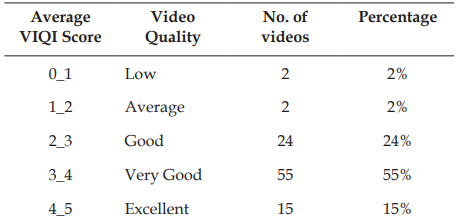
The twenty first century is predominantly driven by digital technologies and the education sector has been hugely influenced by the advent of these technologies. Youtube has become the first classroom for many and the videos are being extensively viewed for the consumption of firsth and information on diverse subjects. In this study, efforts have been made to determine the popularity, quality, and viewer engagement of Youtube videos on NEP-2020 from the analysis of various parameters such as users' subscriptions, views, comments, likes, etc. The study uses the top 100 youtube videos based on the number of view counts. 70% of the videos have a VIQI score of more than 3 (out of 5) which reflects the content quality is high. More than 60% of viewer comments were in favor of NEP-2020.
References
- 1. Primack, B. A., Colditz, J. B., Rosen, E. B., Giles, L. M., Jackson, K. M., & Kraemer, K. L. (2017). Portrayal of alcohol brands popular among underage youth on Youtube: a content analysis. Journal of studies on alcohol and drugs, 78(5), 654-664.
- 2. Basch, C. H., Menafro, A., Mongiovi, J., Hillyer, G. C., & Basch, C. E. (2017). A content analysis of YouTube™ videos related to prostate cancer. American journal of men's health, 11(1), 154-157.
- 3. Sohal, S., & Kaur, H. (2018). A content analysis of YouTube political advertisements: evidence from Indian parliamentary elections. Journal of creative communications, 13(2), 133-156.
- 4. Al-Silwadi, F. M., Gill, D. S., Petrie, A., & Cunningham, S. J. (2015). Effect of social media in improving knowledge among patients having fixed appliance orthodontic treatment: a single-center randomized controlled trial. American Journal of Orthodontics and Dentofacial Orthopedics, 148(2), 231-237.
- 5. Yilmaz, H., & Aydin, M. N. (2020). YouTube™ video content analysis on space maintainers. Journal of Indian Society of Pedodontics and Preventive Dentistry, 38(1), 34.
- 6. AlGhamdi, K. M., & Moussa, N. A. (2012). Internet use by the public to search for health-related information. International journal of medical informatics, 81(6), 363-373.
- 7. Basch, C. H., Kecojevic, A., Berdnik, A., Cadorett, V., & Basch, C. E. (2017). An analysis of widely viewed YouTube videos on anal cancer. International Journal of Preventive Medicine, 8.
- 8. Bezner, S. K., Hodgman, E. I., Diesen, D. L., Clayton, J. T., Minkes, R. K., Langer, J. C., & Chen, L. E. (2014). Pediatric surgery on YouTube™: is the truth out there?. Journal of pediatric surgery, 49(4), 586-589.
- 9. Boston, M., Ruwe, E., Duggins, A., & Willging, J. P. (2005). Internet use by parents of children undergoing outpatient otolaryngology procedures. Archives of Otolaryngology–Head & Neck Surgery, 131(8), 719-722.
- 10. Beall Iii, M. S., Golladay, G. J., Greenfield, M. L. V., Hensinger, R. N., & Biermann, J. S. (2002). Use of the Internet by pediatric orthopaedic outpatients. Journal of Pediatric Orthopaedics, 22(2), 261-264.
- 11. Chang, J. Z., Chen, P. H., & Kuo, S. C. (1999). An appliance to replace prematurely lost maxillary anterior teeth using double stainless steel crowns on abutment teeth. The Journal of Clinical Pediatric Dentistry, 23(4), 285-288.
- 12. De Boer, M. J., Versteegen, G. J., & Van Wijhe, M. (2007). Patients’ use of the Internet for painrelated medical information. Patient education and counseling, 68(1), 86-97.
- 13. ElKarmi, R., Hassona, Y., Taimeh, D., & Scully, C. (2017). YouTube as a source for parents’ education on early childhood caries. International journal of paediatric dentistry, 27(6), 437-443.
- 14. Greene, J. A., Choudhry, N. K., Kilabuk, E., & Shrank, W. H. (2011). Online social networking by patients with diabetes: a qualitative evaluation of communication with Facebook. Journal of general internal medicine, 26(3), 287-292.
- 15. Hansen, C., Interrante, J. D., Ailes, E. C., Frey, M. T., Broussard, C. S., Godoshian, V. J., & Gilboa, S. M. (2016). Assessment of YouTube videos as a source of information on medication use in pregnancy. Pharmacoepidemiology and drug safety, 25(1), 35-44.
- 16. Kisling, E., & Høffding, J. (1979). Premature loss of primary teeth: part IV, a clinical control of Sannerud's space maintainer, type I. ASDC journal of dentistry for children, 46(2), 109-113.
- 17. Knösel, M., & Jung, K. (2011). Informational value and bias of videos related to orthodontics screened on a video-sharing Web site. The Angle Orthodontist, 81(3), 532-539.
- 18. Kırzıoğlu, Z., & Özay Ertürk, M. S. (2004). Success of reinforced fiber material space maintainers. Journal of dentistry for children, 71(2), 158-162.
- 19. Lena, Y., & Dindaroğlu, F. (2018). Lingual orthodontic treatment: a YouTube™ video analysis. The Angle Orthodontist, 88(2), 208-214.
- 20. Madathil, K. C., Rivera-Rodriguez, A. J., Greenstein, J. S., & Gramopadhye, A. K. (2015). Healthcare information on YouTube: a systematic review. Health informatics journal, 21(3), 173-194.
- 21. Nason, K., Donnelly, A., & Duncan, H. F. (2016). YouTube as a patient information source for root canal treatment. International endodontic journal, 49(12), 1194-1200.
- 22. Nason, G. J., Kelly, P., Kelly, M. E., Burke, M. J., Aslam, A., Giri, S. K., & Flood, H. D. (2015). YouTube as an educational tool regarding male urethral catheterization. Scandinavian journal of urology, 49(2), 189-192.
- 23. Noll, D., Mahon, B., Shroff, B., Carrico, C., & Lindauer, S. J. (2017). Twitter analysis of the orthodontic patient experience with braces vs Invisalign. The Angle Orthodontist, 87(3), 377-383.
- 24. Pandey, A., Patni, N., Singh, M., Sood, A., & Singh, G. (2010). YouTube as a source of information on the H1N1 influenza pandemic. American journal of preventive medicine, 38(3), e1-e3.
- 25. Rachel Henzell, M., Margaret Knight, A., Morgaine, K. C., S. Antoun, J., & Farella, M. (2014). A qualitative analysis of orthodontic-related posts on Twitter. The Angle Orthodontist, 84(2), 203-207.
- 26. Singh, A. G., Singh, S., & Singh, P. P. (2012). YouTube for information on rheumatoid arthritis—a wakeup call?. The Journal of rheumatology, 39(5), 899-903.
- 27. Wainstein, B. K., SterlingLevis, K., Baker, S. A., Taitz, J., & Brydon, M. (2006). Use of the Internet by parents of paediatric patients. Journal of paediatrics and child health, 42(9), 528-532.
- 28. Singh AG, Singh S, Singh PP. YouTube for information on rheumatoid arthritis – A wakeup call? J Rheumatol 2012;39:899 903.
- 29. Wainstein BK, Sterling-Levis K, Baker SA, Taitz J, Brydon M. Use of the internet by parents of paediatric patients. J Paediatr Child Health 2006;42:528 32.
Data Sharing Statement
There are no additional data available. All raw data and code are available upon request.
Funding
This research received no funding.
Author Contributions
All authors contributed significantly to the work and approve its publication.
Ethics Declaration
This article does not involve any human or animal subjects, and therefore does not require ethics approval.
Acknowledgements
We would like to express our gratitude to the patients, their families, and all those who have contributed to this study.
Conflicts of Interest
No conflicts of interest in this work.
About this article

Cite this article
Ahmed SN, Maharana B. (2023). Content Analysis of Youtube videos on National Education Policy, 2020. Indian Journal of Library and Information Science, 17(2):153–159.
Licence:
Attribution-Non-commercial 4.0 International (CC BY-NC 4.0)This license enables reusers to distribute, remix, adapt, and build upon the material in any medium or format for noncommercial purposes only, and only so long as attribution is given to the creator.
| Received | Accepted | Published |
|---|---|---|
| February 10, 2023 | March 20, 2023 | August 15, 2023 |
DOI: https://doi.org/10.21088/ijlis.0973.9548.17223.5
Keywords
NEP 2020; Content Analysis; National Education Policy; Higher Education; COVID-19.NEP 2020Content AnalysisNational Education PolicyHigher EducationCOVID-19Search for Similar Articles
Similar Articles
- Scientometric Portrait of Dr. Anil Kumar Dhiman, an Information Scientist-Part I...
- A Study on Humanities Students’ Literacy Skills at Alagappa University in Using...
- Awareness and Utilization of Artificial Intelligence Tools (ChatGPT) among Stude...
- Global Trends on Artificial Intelligence in Science Research: A Scientometric Ob...
- Information Needs of Persons with Visual Impairments: A Socioeconomic Analysis
Article Level Metrics
Last UpdatedThursday 10 September 2026, 03:34:03 (IST)
3922
Accesses
13
738
00
Citations
NA
NA
NA
Download citation
Article Keywords
Keyword Highlighting
Highlight selected keywords in the article text.
Timeline
| Received | February 10, 2023 |
| Accepted | March 20, 2023 |
| Published | August 15, 2023 |
licence
Attribution-Non-commercial 4.0 International (CC BY-NC 4.0)
This license enables reusers to distribute, remix, adapt, and build upon the material in any medium or format for noncommercial purposes only, and only so long as attribution is given to the creator.