Full Text (PDF)
International Journal of Food, Nutrition & Dietetics 12(3):p 108-119, September - December 2024. | DOI: https://doi.org/10.21088/ijfnd.2322.0775.12324.2
Original Article
Consumption of Fermented Rice and Metabolic Health in Adult Persons, West-Bengal, India: A Retrospective Rank-Wise Association
Author Information
Licence:
Attribution-Non-commercial 4.0 International (CC BY-NC 4.0)This license enables reusers to distribute, remix, adapt, and build upon the material in any medium or format for noncommercial purposes only, and only so long as attribution is given to the creator.
International Journal of Food, Nutrition & Dietetics 12(3):p 108-119, September - December 2024. | DOI: https://doi.org/10.21088/ijfnd.2322.0775.12324.2
How Cite This Article:
Rima Ghosh, Consumption of Fermented Rice and Metabolic Health in Adult Persons, West-Bengal, India: A Retrospective Rank-Wise Association. Int J Food Nutr Diet. 2024;12(3):108-119.Timeline
Received : July 15, 2024
Accepted : August 17, 2024
Published : December 30, 2024
Abstract
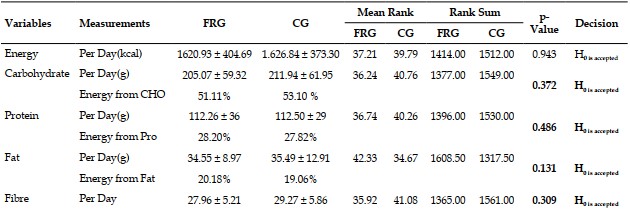
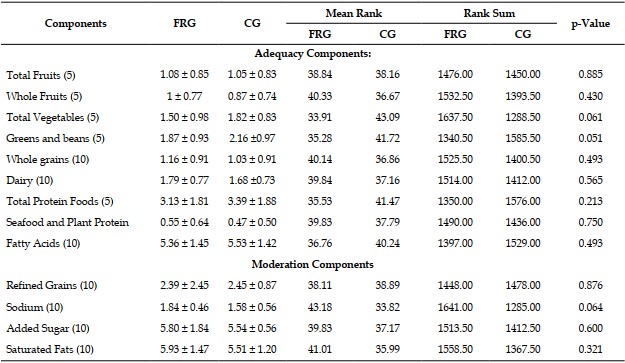
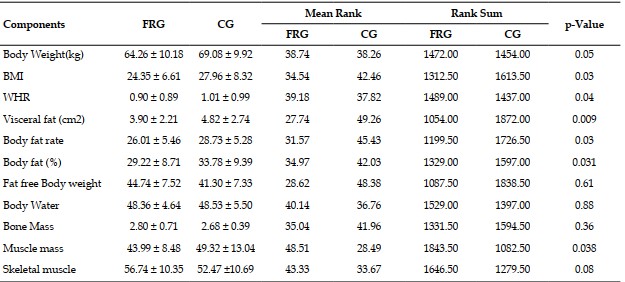
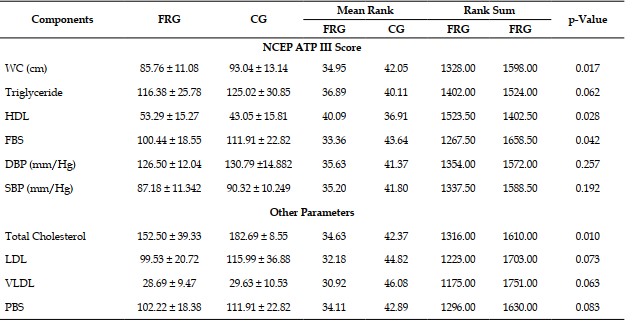
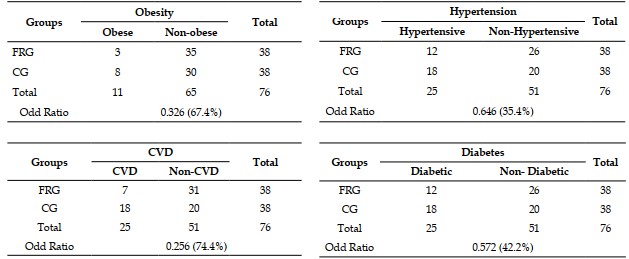
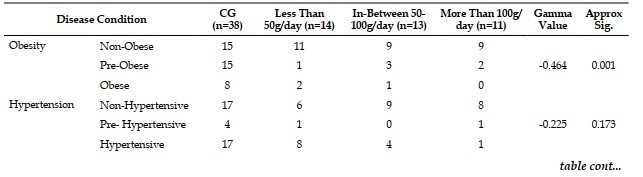
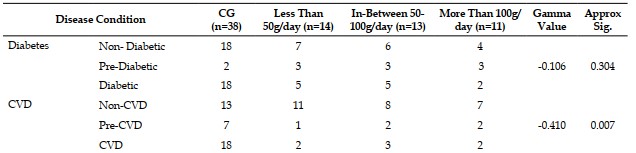
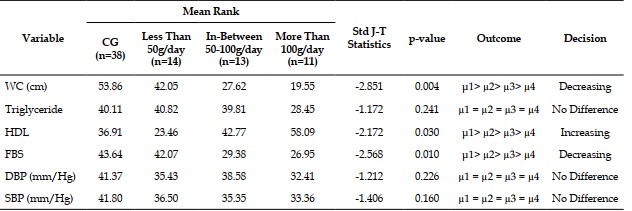
The study is to determine whether eating fermented rice every day improves metabolic health. This retrospective study was conducted in order to compare two groups of people’s daily dietary consumption of fermentation rice and their metabolic health in Kolkata, West Bengal, India. The study observed patients in between the age of 35-60, from various departments, including neurology, cardiology, dermatology, gastroenterology, etc., who visited the tertiary care facility at one of the largest hospitals, SSKM, located in Kolkata from March 2022 to October 2022. Dietary. A validated questionnaire was developed to know the presence and amount of fermented rice in participant’s diet. HEI-2015 (Healthy Eating Index 2015) was used to determine the dietary quality of two groups. Then a semi food frequency questionnaire was developed. Then Man-Whitney U, Goodman Gamma, JonckhereTepstra Test were performed to know whether there was a significant difference between the two groups in terms of biochemical and clinical indicators. Goodman-Krushkal gamma test were also performed to examine the association between consumption of fermented rice and the prevalence of obesity, hypertension, cardio vascular disorders, and type II diabetes. This research is the first to demonstrate how elder persons who regularly consume fermented rice experience improved blood lipid levels and favourable impacts on body weight maintenance.
References
- 1. Jung, S. M., Haddad, E. H., Kaur, A., Sirirat, R., Kim, A. Y., Oda, K., Rajaram, S., & Sabaté, J. (2021). A Non-Probiotic Fermented Soy Product Reduces Total and LDL Cholesterol: A Randomized Controlled Crossover Trial. Nutrients, 13(535), 535. https://doi.org/10.3390/NU13020535
- 2. Tamang, J. P., Shin, D. H., Jung, S. J., & Chae, S. W. (2016). Functional properties of microorganisms in fermented foods. In Frontiers in Microbiology (Vol. 7, Issue APR, p. 578). Frontiers Media S.A. https:// doi.org/10.3389/fmicb.2016.00578
- 3. Rawat, K., Kumari, A., Kumar, S., Kumar, R., & Gehlot, R. (2018). Traditional Fermented Products of India. Int.J.Curr.Microbiol.App.Sci, 7(4), 1873–1883. https://doi.org/10.20546/ijcmas.2018.704.214
- 4. Hor, P. K., Pal, S., Mondal, J., Halder, S. K., Ghosh, K., Santra, S., Ray, M., Goswami, D., Chakrabarti, S., Singh, S., Dwivedi, S. K., Takó, M., Bera, D., & Mondal, K. C. (2022). Antiobesity, Antihyperglycemic, and Antidepressive Potentiality of Rice Fermented Food Through Modulation of Intestinal Microbiota. Frontiers in Microbiology, 13. https://doi.org/10.3389/FMICB.2022.794503
- 5. Gille, D., Schmid, A., Walther, B., & Vergères, G. (2018). Fermented food and non-communicable chronic diseases: A review. Nutrients, 10(4). https://doi.org/10.3390/nu10040448
- 6. Madjd, A., Taylor, M. A., Mousavi, N., Delavari, A., Malekzadeh, R., Macdonald, I. A., & Farshchi, H. R. (2016). Comparison of the effect of daily consumption of probiotic compared with lowfat conventional yogurt on weight loss in healthy obese women following an energy-restricted diet: A randomized controlled trial. American Journal of Clinical Nutrition, 103(2), 323–329. https://doi. org/10.3945/ajcn.115.120170
- 7. Li, K. J., Brouwer-Brolsma, E. M., Burton-Pimentel, K. J., Vergères, G., & Feskens, E. J. M. (2021). A systematic review to identify biomarkers of intake for fermented food products. Genes & Nutrition, 16(1), 5. https://doi.org/10.1186/s12263-021- 00686-4
- 8. Huang, P. L. (2009). A comprehensive definition for metabolic syndrome. DMM Disease Models and Mechanisms, 2(5–6), 231–237. https://doi. org/10.1242/DMM.001180/-/DC1
- 9. High Blood Cholesterol ATP III Guidelines At-AGlance Quick Desk Reference. (n.d.). https://www. nhlbi.nih.gov/files/docs/guidelines/atglance.pdf
- 10. OpenEpi Menu. (n.d.). Retrieved December 28, 2022, from http://www.openepi.com/Menu/OE_ Menu.htm
- 11. Greenland, S., Senn, S. J., Rothman, K. J., Carlin, J. B., Poole, C., Goodman, S. N., & Altman, D. G. (2016). Statistical tests, P values, confidence intervals, and power: a guide to misinterpretations. European Journal of Epidemiology, 31(4), 337. https://doi. org/10.1007/S10654-016-0149-3
- 12. Diet History Questionnaire III (DHQ III) | EGRP/ DCCPS/NCI/NIH. (n.d.). Retrieved October 26, 2023, from https://epi.grants.cancer.gov/dhq3/
- 13. Steinfeldt, L., Anand, J., & Murayi, T. (2013). Food Reporting Patterns in the USDA Automated Multipl e-Pass Method. Procedia Food Science, 2, 145–156. https://doi.org/10.1016/j.profoo.2013.04.022
- 14. Subar, A. F., Kipnis, V., Troiano, R. P., Midthune, D., Schoeller, D. A., Bingham, S., Sharbaugh, C. O., Trabulsi, J., Runswick, S., Ballard-Barbash, R., Sunshine, J., & Schatzkin, A. (2003). Using intake biomarkers to evaluate the extent of dietary misreporting in a large sample of adults: The OPEN study. American Journal of Epidemiology, 158(1), 1–13. https://doi.org/10.1093/AJE/KWG092
- 15. Krebs-Smith, S. M., Pannucci, T. R. E., Subar, A. F., Kirkpatrick, S. I., Lerman, J. L., Tooze, J. A., Wilson, M. M., & Reedy, J. (2018). Update of the Healthy Eating Index: HEI-2015. Journal of the Academy of Nutrition and Dietetics, 118(9), 1591–1602. https:// doi.org/10.1016/J.JAND.2018.05.021
- 16. Panizza, C. E., Shvetsov, Y. B., Harmon, B. E., Wilkens, L. R., Le Marchand, L., Haiman, C., Reedy, J., & Boushey, C. J. (2018). Testing the Predictive Validity of the Healthy Eating Index-2015 in the Multiethnic Cohort: Is the Score Associated with a Reduced Risk of All-Cause and CauseSpecific Mortality? Nutrients, 10(4). https://doi. org/10.3390/NU10040452
- 17. Fuller, N. R., Caterson, I. D., Sainsbury, A., Denyer, G., Fong, M., Gerofi, J., Baqleh, K., Williams, K. H., Lau, N. S., & Markovic, T. P. (2015). The effect of a high-egg diet on cardiovascular risk factors in people with type 2 diabetes: The Diabetes and Egg (DIABEGG) study- A 3-mo randomized controlled trial. American Journal of Clinical Nutrition, 101(4), 705–713. https://doi.org/10.3945/ajcn.114.096925
- 18. Daniel, C. R., Kapur, K., McAdams, M. J., DixitJoshi, S., Devasenapathy, N., Shetty, H., Hariharan, S., George, P. S., Mathew, A., & Sinha, R. (2014). Development of a field-friendly automated dietary assessment tool and nutrient database for India. The British Journal of Nutrition, 111(1), 160. https:// doi.org/10.1017/S0007114513001864
- 19. Choi, I. H., Noh, J. S., Han, J. S., Kim, H. J., Han, E. S., & Song, Y. O. (2013). Kimchi, a Fermented Vegetable, Improves Serum Lipid Profiles in Healthy Young Adults: Randomized Clinical Trial. Journal of Medicinal Food, 16(3), 223. https://doi. org/10.1089/JMF.2012.2563
- 20. Bellikci-Koyu, E., Sarer-Yurekli, B. P., Akyon, Y., Aydin-Kose, F., Karagozlu, C., Ozgen, A. G., Brinkmann, A., Nitsche, A., Ergunay, K., Yilmaz, E., & Buyuktuncer, Z. (2019). Effects of Regular Kefir Consumption on Gut Microbiota in Patients with Metabolic Syndrome: A ParallelGroup, Randomized, Controlled Study. Nutrients 2019, Vol. 11, Page 2089, 11(9), 2089. https://doi. org/10.3390/NU11092089
- 21. Mathur, H., Beresford, T. P., & Cotter, P. D. (2020). Health benefits of lactic acid bacteria (Lab) fermentates. Nutrients, 12(6), 1–16. https://doi. org/10.3390/nu12061679
- 22. Marco, M. L., Heeney, D., Binda, S., Cifelli, C. J., Cotter, P. D., Foligné, B., Gänzle, M., Kort, R., Pasin, G., Pihlanto, A., Smid, E. J., & Hutkins, R. (2017). Health benefits of fermented foods: microbiota and beyond. Current Opinion in Biotechnology, 44, 94–102. https://doi.org/10.1016/J. COPBIO.2016.11.010
Data Sharing Statement
There are no additional data available. All raw data and code are available upon request.
Funding
This research received no funding.
Author Contributions
All authors contributed significantly to the work and approve its publication.
Ethics Declaration
This article does not involve any human or animal subjects, and therefore does not require ethics approval.
Acknowledgements
We would like to express our gratitude to the patients, their families, and all those who have contributed to this study.
Conflicts of Interest
No conflicts of interest in this work.
About this article

Cite this article
Rima Ghosh, Consumption of Fermented Rice and Metabolic Health in Adult Persons, West-Bengal, India: A Retrospective Rank-Wise Association. Int J Food Nutr Diet. 2024;12(3):108-119.
Licence:
Attribution-Non-commercial 4.0 International (CC BY-NC 4.0)This license enables reusers to distribute, remix, adapt, and build upon the material in any medium or format for noncommercial purposes only, and only so long as attribution is given to the creator.
| Received | Accepted | Published |
|---|---|---|
| July 15, 2024 | August 17, 2024 | December 30, 2024 |
DOI: https://doi.org/10.21088/ijfnd.2322.0775.12324.2
Keywords
Fermentted riceMetabolicHealthObesityEthenic foodProcessingSearch for Similar Articles
Similar Articles
- Smart and Sustainable Packaging Approaches for Reducing Heavy Metal Contaminatio...
- Traditional Rhythms for Modern Health: Seed Cycling in the Management of Women’s...
- School-Based Nutrition Education Improves Knowledge and Consumption of Omega-3-R...
- Nutrition as Precision Therapy in Rare Genetic Diseases: Moving beyond Supportiv...
- A Review on Health Risks Associated with the Repetitive use of Cooking Oil and D...
Article Level Metrics
Last UpdatedTuesday 08 September 2026, 04:47:11 (IST)
1810
Accesses
10
248
00
Citations
NA
NA
NA
Download citation
Article Keywords
Keyword Highlighting
Highlight selected keywords in the article text.
Timeline
| Received | July 15, 2024 |
| Accepted | August 17, 2024 |
| Published | December 30, 2024 |
licence
Attribution-Non-commercial 4.0 International (CC BY-NC 4.0)
This license enables reusers to distribute, remix, adapt, and build upon the material in any medium or format for noncommercial purposes only, and only so long as attribution is given to the creator.