Full Text (PDF)
Physiotherapy and Occupational Therapy Journal 18(3):p 229-238, July-Sep 2025. | DOI: 10.21088/potj.0974.5777.18325.6
Original Article
Comparison of International Classification of Functioning, Disability and Health Coreset and Short form Health Survey 36 in Cervical Postural Syndrome
Niraj Kumar, Kajal Kumari, Sharda Sharma, Manjul Nautiyal, Ravindra Singh, Sandeep Kumar
Author Information
Licence:
Attribution-Non-commercial 4.0 International (CC BY-NC 4.0)This license enables reusers to distribute, remix, adapt, and build upon the material in any medium or format for noncommercial purposes only, and only so long as attribution is given to the creator.
Physiotherapy and Occupational Therapy Journal 18(3):p 229-238, July-Sep 2025. | DOI: 10.21088/potj.0974.5777.18325.6
How Cite This Article:
Kumari K, Kumar N, Sharma S, et al. Comparison of International Classification of Functioning, Disability and Health Coreset and Short form Health Survey 36 in Cervical Postural Syndrome. Physio Occup Ther J. 2025;18(3):229-238.Timeline
Received : March 04, 2025
Accepted : June 18, 2025
Published : September 28, 2025
Abstract
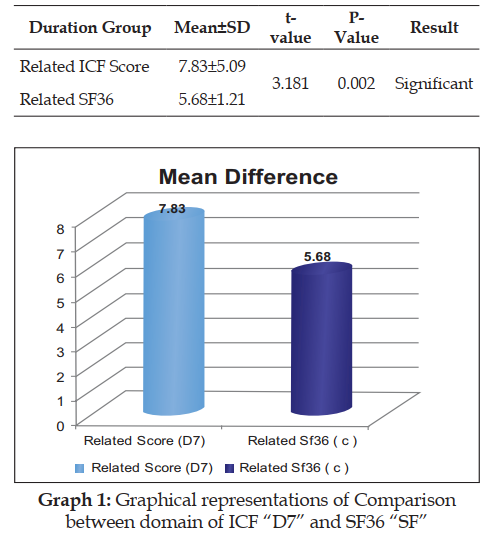
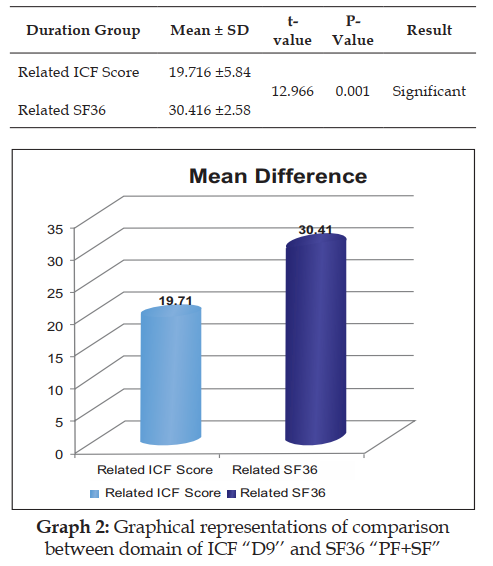
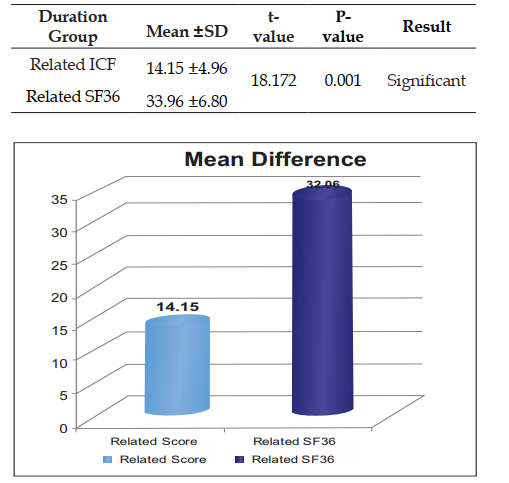
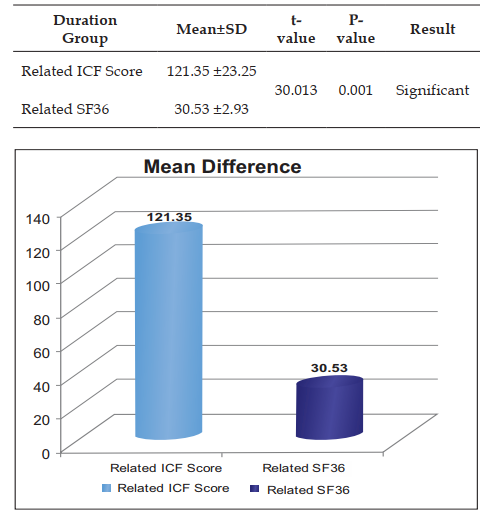
Introduction: Cervical postural syndrome is a common unpleasant and painful posture problem characterized by a protruding chin and rounded shoulders. Neck pain is associated with decreased health-related quality of life. Quality of Life assessed with HRQOL assessment scales. With the newly available International Classification of Functioning, Disability and Health (ICF), a universal framework of functioning and health, the representation of items and scales of SF36 can be compared better. Objective of study: • The assessment of patient with cervical postural syndrome through International Classification of Functioning Disability and Health corset and short form health survey in Cervical Postural Syndrome. • To evaluate and measure the differences in the Quality of Life through the activity and participations component International Classification of Functioning Disability and Health corset and short form health survey 36 in Cervical Postural Syndrome. • To compare the differences in Quality of Life through the activity and participations component of International Classification of Functioning Disability and Health corset and short form health survey 36 in Cervical Postural Syndrome. Method: This observational study was carried out with sixty subjects of cervical postural syndrome with mean age group 30 at PMR, Physiotherapy and Orthopedics OPD of SMIH, Dehradun. After thorough assessment and consent form was signed. Patients were assessed with domain of activities and participants of ICF and Quality of life is assessed by using SF-36 questionnaire simultaneously. Conclusion: Most of the domain of SF 36 of health related questionnaires align well with the activities and participations domains of ICF when it assessing the individual with cervical postural syndrome. Domains of SF36 linked with the domains of ICF, through which related domains, unrelated and gaps were founded. Related domains of SF 36 compared with the related domains of activities and participations of ICF. Result was significant which shows that the ICF was the better assessment tool as compared to the SF36.
References
- 1. Rutuja R. Avaghade, Sandeep B et. al (2023) “ Effectiveness of McKenzie approach and segmental spinal stabilization exercises on neck pain in individuals with cervical postural syndrome: An experimental study.” 2023 10.4103/jehp.jehp_239_23.
- 2. Niraj Kumar, Shama Praveen, Randhir Kumar, Nishu Sharma, Sandeep Kumar. Compare the effectiveness of McKenzie Techniques and Isometric Strengthening Exercise In Patients with Cervical Radiculopathy Volume 07, Issue 11, 2020: PP 679-4691.
- 3. Mersija Kasumovic, Emir Gorcevic et. al (2013) “Cervical Syndrome – the Effectiveness of Physical Therapy Intervention” DOI: 10.5455/ medarh.2013.67.414-417.
- 4. Niraj Kumar, Sandeep Kumar, Bharat Puri et.al. (2020) Compare the effectiveness of between Isometric Strengthening Exercise and Postural Correctionin Patientswith. Neck Pain. European Journal of Molecular & Clinical Medicine, Volume. 07, 11:7265-7280.
- 5. Ilona Ilinca, Eugenia Rosulescu et.al (2017) “The importance of physiotherapy intervention in the functional rehabilitation of patients with cervical postural syndrome” vol. I, no. 29/2017
- 6. Tania Mendes Fernandes , Roberto MendezSanchez et.al (2022)“ A randomized controlled trial on the effects of “Global postural reeducation” versus neck specific exercise on pain, disability, postural control, and neuromuscular features in women with chronic non-specific neck pain”10.23736/ S1973-9087.22.07554-2.
- 7. Erhan Secer, Faruk Tanik et al.(2020) “The Relationship Between Pain Level and Sleep Quality, Quality of Life and Psychological Status in Patients with Chronic Neck pain” https://doi.org/10.30621/jbachs.2020.1230.
- 8. Ester Cerezo-Tellez, Maria Torres-Lacombal et.al.(2018) “Health related quality of life improvement in chronic nonspecific neck pain: secondary analysis from a single blinded, randomized clinical trial” https://doi. org/10.1186/s12955-018-1032-6.
- 9. Grietje E. de Vriesa, Wim Jorritsmab et.al. (2014) “The construct validity of the Short Form-36 Health Survey for patients with nonspecific chronic neck pain” DOI: 10.1097/ MRR.0000000000000102.
- 10. Rabia Tasmeer, Syed Asad Ullah Arslan (2022) “Effect of Forward Head Posture with Neck Disability and Quality of Life in Freelancers” https://doi.org/10.54393/pbmj.v5i5.472.
- 11. Alarcos Cieza & Gerold Stucki (2004)“Content comparison of health-related quality of life (HRQOL) instruments based on the international classification of functioning, disability and health(ICF)” DOI 10.1007/ s11136-004-4773-020.
- 12. Matilde Leonardi, Haejung Lee et al.(2022) “20 Years of ICF—International Classification of Functioning, Disability and Health: Uses and Applications around the World” doi. org/10.3390/ijerph191811321.
- 13. Rosamond H. Maddena and Anita Bundya(2018) “The ICF has made a difference to functioning and disability measurement and statistics” https://doi.org/10.1080/09638288. 2018.1431812.
- 14. Helene L. Soberga, Kaia B. Engebretsena et. al.(2019) “Associations between shoulder pain and functioning on the ICF checklist and the disabilities of the arm, shoulder, and hand scale – a cross-sectional study” https://doi.org /10.1080/09638288.2019.1584252.
- 15. Maryam Saadat, Reza Salehi et.al (2018) “Postural stability in patients with non-specific chronic neck pain: A comparative study with healthy people” https://doi.org/10.14196/ mjiri.32.33.
- 16. Hae Jung Lee, Ju Min Song (2018) “Linking of Items in Two Function-related Questionnaires to the International Classification of Functioning, Disability and Health: Shoulder Pain” https://doi.org/10.18857/ jkpt.2018.30.6.239.
- 17. Neeraj Kumar & Shiv Verma (2016: To Compare the Effect of Strenthening Neck Exercise and Mckenzie Neck Exercise In Neck Pain Subject. British Journal of Medical and Health Research, Volume-3. 10:69-79.
Data Sharing Statement
There are no additional data available.
Funding
This research received no funding.
Author Contributions
All authors contributed significantly to the work and approve its publication.
Ethics Declaration
This article does not involve any human or animal subjects, and therefore does not require ethics approval.
Acknowledgements
Information not provide.
Conflicts of Interest
There was no conflict of interest in this study.
About this article

Cite this article
Kumari K, Kumar N, Sharma S, et al. Comparison of International Classification of Functioning, Disability and Health Coreset and Short form Health Survey 36 in Cervical Postural Syndrome. Physio Occup Ther J. 2025;18(3):229-238.
Licence:
Attribution-Non-commercial 4.0 International (CC BY-NC 4.0)This license enables reusers to distribute, remix, adapt, and build upon the material in any medium or format for noncommercial purposes only, and only so long as attribution is given to the creator.
| Received | Accepted | Published |
|---|---|---|
| March 04, 2025 | June 18, 2025 | September 28, 2025 |
DOI: 10.21088/potj.0974.5777.18325.6
Keywords
Cervical Postural SyndromeICFSF 36Quality of LifeSearch for Similar Articles
Similar Articles
- Cross-Cultural Adaptation, Reliability, and Validity of the Gujarati Version of...
- Physiotherapy Management of Multiple Sclerosis: An Overview of Recent Technologi...
- Converging Technologies in Cardiopulmonary Physiotherapy: A Review of VR, AR, AI...
- Cross-Cultural Adaptation, Reliability, and Validity of the Gujarati Version of...
- Effects of Kinesiotaping in Lateral Epicondylitis: A Narrative Review
Article Level Metrics
Last UpdatedWednesday 29 July 2026, 21:45:23 (IST)
1979
Accesses
20
429
00
Citations
NA
NA
NA
Download citation
Article Keywords
Keyword Highlighting
Highlight selected keywords in the article text.
Timeline
| Received | March 04, 2025 |
| Accepted | June 18, 2025 |
| Published | September 28, 2025 |
licence
Attribution-Non-commercial 4.0 International (CC BY-NC 4.0)
This license enables reusers to distribute, remix, adapt, and build upon the material in any medium or format for noncommercial purposes only, and only so long as attribution is given to the creator.