Full Text (PDF)
Indian Journal of Anesthesia and Analgesia 10(4):p 173-180, October-December 2023. | DOI: https://doi.org/10.21088/ijaa.2349.8471.10423.4
Original Article
Comparison of 0.5% Hyperbaric Bupivacaine with Midazolam Versus 0.5% Hyperbaric Bupivacaine Alone Intrathecally: Prospective Observational Study
Buena R, Mariam Joan Varghese, Jenifer Joab, M.Paul Wilson
Author Information
Licence:
Attribution-Non-commercial 4.0 International (CC BY-NC 4.0)This license enables reusers to distribute, remix, adapt, and build upon the material in any medium or format for noncommercial purposes only, and only so long as attribution is given to the creator.
Indian Journal of Anesthesia and Analgesia 10(4):p 173-180, October-December 2023. | DOI: https://doi.org/10.21088/ijaa.2349.8471.10423.4
How Cite This Article:
Varghese MJ, Fernandez JJ, Buena R, et al. Comparison of 0.5% Hyperbaric Bupivacaine with Midazolam Versus 0.5% Hyperbaric Bupivacaine Alone Intrathecally: Prospective Observational Study. Indian J Anesth Analg. 2023;10(4):173–80.Timeline
Received : September 01, 2023
Accepted : October 10, 2023
Published : October 30, 2023
Abstract
Context: Neuraxial anesthesia is the preferred choice for infraumbilical surgeries due to its advantages. The incorporation of midazolam alongside local anesthetic drugs in spinal anesthesia has demonstrated positive outcomes. This study was undertaken to assess the effectiveness of midazolam in terms of analgesic and anesthetic efficacy, as well as potential adverse effects, in patients undergoing infraumbilical surgeries.
Aims: To compare the analgesic and anaesthetic effect of mixture of midazolam - bupivacaine as compared to bupivacaine alone in patients undergoing infra-umbilical surgeries under spinal anaesthesia.
Settings and Design: The present study is a prospective, observational study.
Methods and Material: Fifty patients posted for elective infra-umbilical surgery were randomly divided into two groups of 25 each for intrathecal drug administration. (n=25). After administration of block, patients were assessed for analgesic and anesthetic effect of the drug.
Statistical Analysis used: The study analyzed through the statistical programming software SPSS-22 and it involved the application of the student’s t-test, with a significance threshold set at a P value of <0.05.
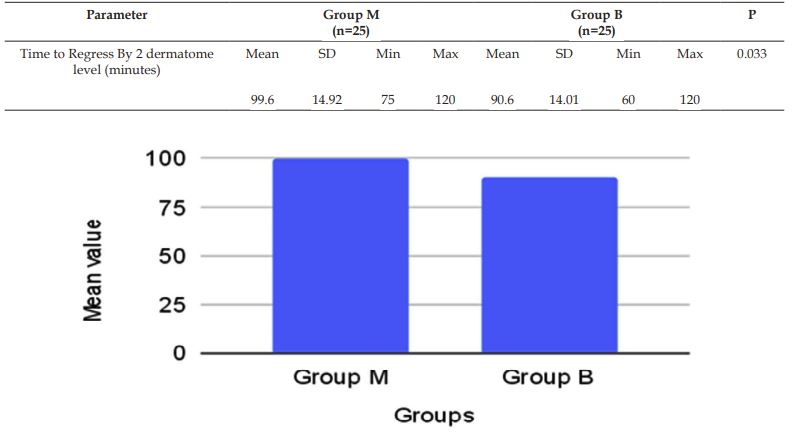
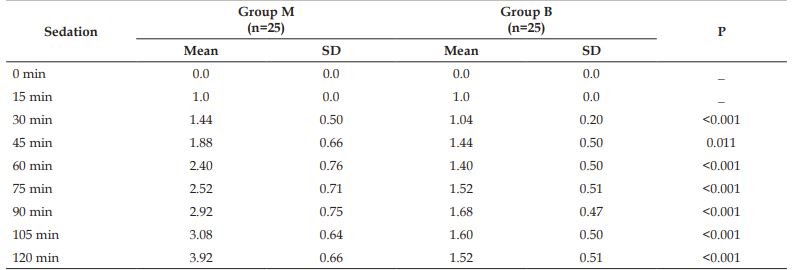
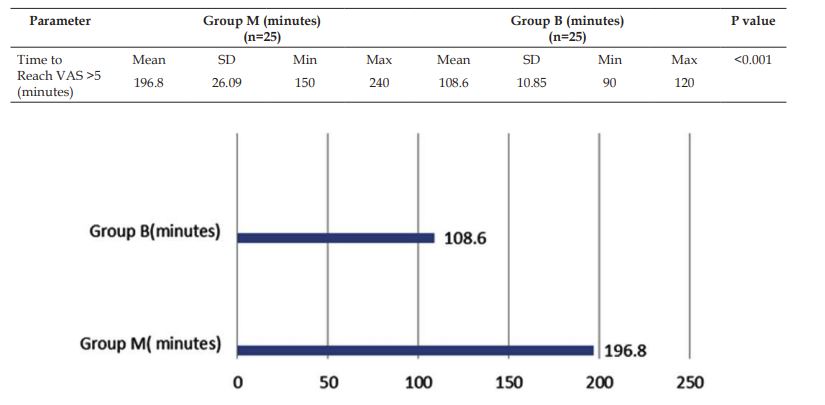
Results: Analgesic duration of patients in Midazolam Group was signiÞcantly longer compared to Bupivacaine Group for sensory block. More patients in the midazolam group were sedated and easily arousable.
Conclusions: This study concludes that the addition of intrathecal preservative-free midazolam to hyperbaric bupivacaine improved intra - operative anaesthesia and prolonged duration of analgesia. Also, it was observed that there was a significant reduction in the
consumption of analgesics during the postoperative period in patients undergoing infra-umbilical surgeries without causing any significant haemodynamic changes.
References
- 1. Prakash S. Analgesic efficacy of two doses of intrathecal midazolam with bupivacaine in patients undergoing cesarean delivery. Reg Anesth Pain Med. 2006 Jun;31(3):221–6.
- 2. Capdevila X, Dadure C. Perioperative management for one day hospital admission: regional anesthesia is better than general anesthesia. Acta Anaesthesiol Belg. 2004;55 Suppl:33–6.
- 3. Schulz-Stübner S. The critically ill patient and regional anesthesia. Curr Opin Anaesthesiol. 2006 Oct;19(5):538–44.
- 4. Bajwa SJS, Kulshrestha A. Anaesthesia for laparoscopic surgery: General vs regional anaesthesia. J Minimal Access Surg. 2016;12(1):4–9.
- 5. Vaghadia H, Viskari D, Mitchell GWE, Berrill A. Selective spinal anesthesia for outpatient laparoscopy. I: Characteristics of three hypobaric solutions. Can J Anesth. 2001;48(3):256–60.
- 6. Chaney MA. Side effects of intrathecal and epidural opioids. Can J Anaesth. 1995;42:891–903.
- 7. Goodchild CS, Guo Z, Musgreave A, Gent JP. Antinociception by intrathecal midazolam involves endogenous neurotransmitters acting at spinal cord delta opioid receptors. Br J Anaesth. 1996;77(6):758–63.
- 8. Wang J, Sun P, Liang P. Neuropsychopharmacological effects of midazolam on the human brain. Brain Inform. 2020;7(1):15.
- 9. Bharti N, Madan R, Mohanty PR, Kaul HL. Intrathecal midazolam added to bupivacaine improves the duration and quality of spinal anaesthesia. Acta Anaesthesiol Scand. 2003;47(9):1101–5.
- 10. Shadangi BK, Garg R, Pandey R, Das T. Effects of intrathecal midazolam in spinal anaesthesia: a prospective randomised case control study. Singapore Med J. 2011;52(6):432–5.
- 11. Yegin A, Sanli S, Dosemeci L, Kayacan N, Akbas M, Karsli B. The analgesic and sedative effects of intrathecal midazolam in perianal surgery. Eur J Anaesthesiol. 2004;21(8):658–62.
- 12. Karbasfrushan A, Farhadi K, Amini-Saman J, Bazargan-Hejazi S, Ahmadi A. Effect of Intrathecal Midazolam in the Severity of Pain in Cesarean Section: A Randomized Controlled Trail. Iran Red Crescent Med J. 2012;14(5):276–82.
- 13. Batra YK, Jain K, Chari P, Dhillon MS, Shaheen B, Reddy GM. Addition of intrathecal midazolam to bupivacaine produces better post-operative analgesia without prolonging recovery. Int J Clin Pharmacol Ther. 1999;37(10):519–23.
- 14. Kim MH, Lee YM. Intrathecal midazolam increases the analgesic effects of spinal blockade with bupivacaine in patients undergoing haemorrhoidectomy. Br J Anaesth. 2001;86(1):77–9.
- 15. Agrawal N, Usmani A, Sehgal R, Kumar R, Bhadoria P. Effect of intrathecal midazolam bupivacaine on post-operative analgesia. Indian J Anaesth. 2005;49(1):37–9.
- 16. Ho KM, Ismail H. Use of intrathecal midazolam to improve perioperative analgesia: a meta-analysis. Anaesth Intensive Care. 2008;36(3):365–73.
- 17. Lee JM, Ju YH, Lee SK, Cho HW, Park JH, Moon HS. The Effects of Intrathecal Midazolam Added to Bupivacaine Spinal Anesthesia. Korean J Anesthesiol. 2006;50(1):66–71.
Data Sharing Statement
All raw data and code are available upon request.
Funding
This research received no funding.
Author Contributions
All authors contributed significantly to the work and approve its publication.
Ethics Declaration
This article does not involve any human or animal subjects, and therefore does not require ethics approval.
Acknowledgements
Information not provided.
Conflicts of Interest
The authors report no conflicts of interest in this work.
About this article

Cite this article
Varghese MJ, Fernandez JJ, Buena R, et al. Comparison of 0.5% Hyperbaric Bupivacaine with Midazolam Versus 0.5% Hyperbaric Bupivacaine Alone Intrathecally: Prospective Observational Study. Indian J Anesth Analg. 2023;10(4):173–80.
Licence:
Attribution-Non-commercial 4.0 International (CC BY-NC 4.0)This license enables reusers to distribute, remix, adapt, and build upon the material in any medium or format for noncommercial purposes only, and only so long as attribution is given to the creator.
| Received | Accepted | Published |
|---|---|---|
| September 01, 2023 | October 10, 2023 | October 30, 2023 |
DOI: https://doi.org/10.21088/ijaa.2349.8471.10423.4
Keywords
nfra-umbilical surgeryhyperbaric bupivacainemidazolamspinal anaesthesiaSearch for Similar Articles
Similar Articles
- Awake Fibreoptic Intubation for Airway Management in Massive Thyroid Enlargement...
- A Case of Thoracotomy with One Lung Ventilation for Carcinoma Oesophagus
- A Case of Empyema for Thoracotomy and Decortication-Anaesthesia Management
- Full Mouth Rehabilitation in a 3-Year-Old Female Child with Repaired Tetralogy o...
- Do Gel Manicures Affect SpO2 Readings ? A Clinical Investigation
Article Level Metrics
Last UpdatedTuesday 14 July 2026, 07:45:13 (IST)
5689
Accesses
11
679
00
Citations
NA
NA
NA
Download citation
Article Keywords
Keyword Highlighting
Highlight selected keywords in the article text.
Timeline
| Received | September 01, 2023 |
| Accepted | October 10, 2023 |
| Published | October 30, 2023 |
licence
Attribution-Non-commercial 4.0 International (CC BY-NC 4.0)
This license enables reusers to distribute, remix, adapt, and build upon the material in any medium or format for noncommercial purposes only, and only so long as attribution is given to the creator.