Full Text (PDF)
Indian Journal of Anesthesia and Analgesia 9(6):p 267-274, November-December 2022. | DOI: https://doi.org/10.21088/ijaa.2349.8471.9622.1
Original Article
Comparision of Hemodynamic Effect of Sevoflorane 1.5% and Desflurane 3% in Laproscopic Appendicectomy
Dushyant Chavda, Senior Resident, Department of Anesthesia, Dhiraj Hospital, Sumandip Vidyapith, Baroda 391760, India. null, Dushyant Chavda 1 null, Shaikh Abdul Nasir 2 null, Anjali Kankhara 3 null
Author Information
Licence:
Attribution-Non-commercial 4.0 International (CC BY-NC 4.0)This license enables reusers to
distribute, remix, adapt, and build upon the material in any medium or format
for noncommercial purposes only, and only so long as attribution is given to
the creator.
Indian Journal of Anesthesia and Analgesia 9(6):p 267-274, November-December 2022. | DOI: https://doi.org/10.21088/ijaa.2349.8471.9622.1
How Cite This Article:
Dushyant Chavda, Shaikh Abdul Nasir, Anjali Kanhhara/Comparision of Hemodynamic Effect of Sevoflurane 1.5% and
Desflurane 3% in Laparoscopic Appendicectomy/Indian J Anesth Analg. 2022;9(6)267-274.
Timeline
Received : September 12, 2022
Accepted : October 14, 2022
Published : December 10, 2022
Abstract
Aims and objective: To compare heamodynamic parameters, complication, recovery time and time of early extubation with sevoflurane and desflurane.
Materials and methods: This was prospective study conducted from January to December 2020 using sampling technique total 60 adult patient of American society of Anesthesiologist (ASA) Grade I, II, III. Age between 18–60 years of either male or female who were posted for Laproscopic appendicectomy under general anesthesia were selected for study after informed consent. All the patient were randomly allocated into one of two group using computer generated random number table. Group ‘S’ received induction with sevofluraneamd Group ‘D’ received induction with desflurane.
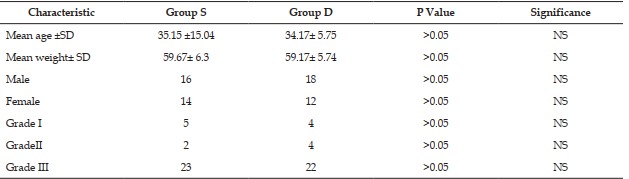
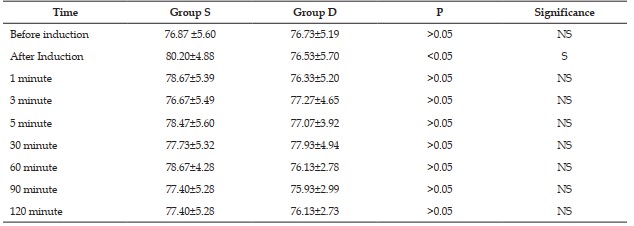
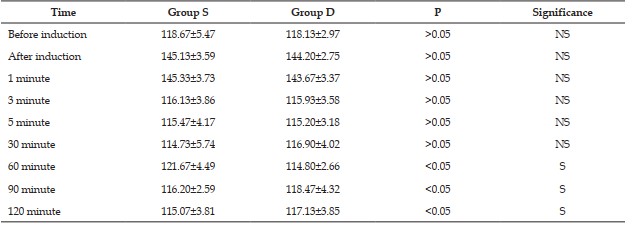
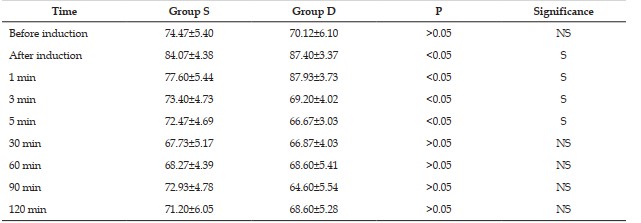
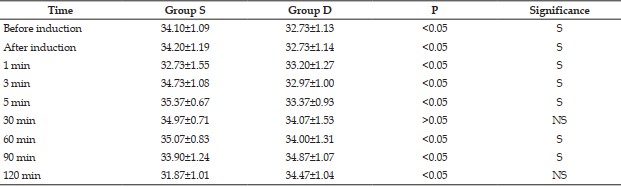
Result: Both group did not differ significantly in age, weight, sex, ASA grade. Heart rate was significantly higher in the sevoflurane group than in the desflurane group after intubation. Systolic blood pressure was significantly higher in the sevoflurane group. The Sevoflurane group showed higher time in spontaneous respiration, verbal commands following, ET removal time.
Conclusion: Desflurane provides faster recovery from anesthesia and better hemodynamic
stability introperative and post operative.
References
- 1. Eberts TJ, Schmid PG. Inhaled anesthetics. In: Barash PG, Cullen BF, Stoelting RK, Cahalan MK, Stock MC, editors. Clinical Anesthesia. 6th ed. Philadelphia, PA: Lippincott Williams and Wilkins; 2009. p. 413-43.
- 2. Morgan GE Jr., Mikhail MS, Murray MJ. Inhalational anesthetics. In: Clinical Anesthesiology. 4th ed. New York: cGraw-Hill; 2006. p. 155-78.
- 3. Ebert TJ, Muzi M, Lopatka CW. Neurocirculatory responses to sevoflurane in humans. A comparison to desflurane. Anesthesiology 1995;83:88-95.
- 4. Jeffrey L. Apfelbaum, MD, J. Lance Lichtor, MD, Bradford S. Lane, BA, Dennis W. Coalson, MD, and Kari T. Korttila, MD, PhD. Awakening, Clinical Recovery, and Psychomotor Effects AfterDesflurane and PropofolAnesthesia. AnesthAnalg 1996; 83:721-725.
- 5. Anil Gupta, MD, FRCA, PhD, Tracey Stierer, MD, Rhonda Zuckerman, MD, Neal Sakima, MD,Stephen D. Parker, MD, and Lee A. Fleisher, MD. Comparison of Recovery Profile After Ambulatory Anesthesia with Propofol, Isoflurane,
- 6. S. Gergin, B. Cevik, G. Yildirim, E. Ciplakligil & S. Colakoglu: Sevoflurane Vs Desflurane: Hemodynamic Parameters And Recovery Characteristics. The Internet Journal of Anesthesiology. 2005 Volume 9 Number 1.
- 7. Fletcher JE, Sebel PS, Murphy MR, Smith CA, Mick SA, Flister MP. Psychomotor performance after desfluraneanesthesia: A comparison with isoflurane. AnesthAnalg 1991;73:260-5.
- 8. Shan J, Sun L, Wang D, Li X. Comparison of the neuroprotective effects and recovery profiles of isoflurane, sevoflurane and desflurane as neurosurgical pre-conditioning on ischemia/ reperfusion cerebral injury. Int J ClinExpPathol 2015;8:2001-9.
- 9. Magni G, Rosa IL, Melillo G, Savio A, Rosa G. A comparison between sevoflurane and desfluraneanesthesia in patients undergoing craniotomy for supratentorial intracranial surgery. AnesthAnalg 1995; 81:118-90.
- 10. Nathanson MH, Fredman B, Smith I, White PF. Sevoflurane versus desflurane for outpatient anesthesia: A comparison of maintenance and similar with the study done by Kaur et al.,[18] Larsen et al.[28] and Loop and Priebe.[29] This finding is not comparable with recovery profiles. AnesthAnalg 1995;81:1186-90.
- 11. White PF, Tang J, Wender RH, Yumul R, Stokes OJ, Sloninsky A, et al. Desflurane versus sevoflurane for maintenance of outpatient anesthesia: The effect on early versus late recovery and perioperative coughing. AnesthAnalg 2009;109:387-93.
- 12. Patel M, Parmar N. Comparison of hemodynamic parameters and recovery characteristics between sevoflrane and desflrane in patients undergoing day care gynecological laparoscopic surgery. Int J Med Sci Public Health 2016;5:1412-6.
- 13. Gupta P, Rath GP, Prabhakar H, Bithal PK. Comparison between sevoflurane and desflurane on emergence and recovery characteristics of children undergoing surgery for spinal dysraphism. Indian J Anesth 2015;59:482-7.
- 14. Weiskopf RB, Moore MA, Eger EI 2nd, Noorani M, McKay L, Chortkoff B, et al. Rapid increase in desflurane concentration is associated with greater transient cardiovascular stimulation than with rapid increase in isoflurane concentration in humans. Anesthesiology 1994;80:1035-45.
- 15. Kang H, Cha SM, Park SG, Jung YH, Woo YC, Kim JY, et al. The effects of changing from isoflurane to desflurane on the recovery profile during the latter part of anesthesia. Acta Med Okayama 2010;64:307- 16.
- 16. Kaur A, Jain AK, Sehgal R, Sood J. Hemodynamics and early recovery characteristics of desflurane versus sevoflurane in bariatric surgery. J AnesthesiolClinPharmacol 2013;29:36-40.
- 17. Strum EM, Szenohradszki J, Kaufman WA, Anthone GJ, Manz IL, Lumb PD. Emergence and recovery characteristics of desflurane versus sevoflurane in morbidly obese adult surgical patients: A prospective, randomized study. AnesthAnalg 2004;99:1848-53.
Data Sharing Statement
There are no additional data available. All raw data and code are available upon request.
Funding
This research received no funding.
Author Contributions
All authors contributed significantly to the work and approve its publication.
Ethics Declaration
This article does not involve any human or animal subjects, and therefore does not require ethics approval.
Acknowledgements
We would like to express our gratitude to the patients, their families, and all those who have contributed to this study.
Conflicts of Interest
No conflicts of interest in this work.
About this article

Cite this article
Dushyant Chavda, Shaikh Abdul Nasir, Anjali Kanhhara/Comparision of Hemodynamic Effect of Sevoflurane 1.5% and
Desflurane 3% in Laparoscopic Appendicectomy/Indian J Anesth Analg. 2022;9(6)267-274.
Licence:
Attribution-Non-commercial 4.0 International (CC BY-NC 4.0)This license enables reusers to
distribute, remix, adapt, and build upon the material in any medium or format
for noncommercial purposes only, and only so long as attribution is given to
the creator.
| Received | Accepted | Published |
|---|---|---|
| September 12, 2022 | October 14, 2022 | December 10, 2022 |
DOI: https://doi.org/10.21088/ijaa.2349.8471.9622.1
Keywords
DesfluraneSevofluraneHemodynamic.SevofluraneHemodynamic.Search for Similar Articles
Similar Articles
- Awake Fibreoptic Intubation for Airway Management in Massive Thyroid Enlargement...
- A Case of Thoracotomy with One Lung Ventilation for Carcinoma Oesophagus
- A Case of Empyema for Thoracotomy and Decortication-Anaesthesia Management
- Full Mouth Rehabilitation in a 3-Year-Old Female Child with Repaired Tetralogy o...
- Do Gel Manicures Affect SpO2 Readings ? A Clinical Investigation
Article Level Metrics
Last UpdatedMonday 13 July 2026, 05:08:10 (IST)
5647
Accesses
11
678
00
Citations
NA
NA
NA
Download citation
Article Keywords
Keyword Highlighting
Highlight selected keywords in the article text.
Timeline
| Received | September 12, 2022 |
| Accepted | October 14, 2022 |
| Published | December 10, 2022 |
licence
Attribution-Non-commercial 4.0 International (CC BY-NC 4.0)
This license enables reusers to
distribute, remix, adapt, and build upon the material in any medium or format
for noncommercial purposes only, and only so long as attribution is given to
the creator.