Full Text (PDF)
Indian Journal of Library and Information Sciences 18(1):p 7-19, January - April 2024. | DOI: 10.21088/ijlis.0973.9548.18124.1
Original Article
Comparing Library Science Education in India and Australia: Issues, Challenges and Growth Strategies for India
Mehtab Alam Ansari, Shamim Aktar Munshi
Author Information
Licence:
Attribution-Non-commercial 4.0 International (CC BY-NC 4.0)Indian Journal of Library and Information Sciences 18(1):p 7-19, January - April 2024. | DOI: 10.21088/ijlis.0973.9548.18124.1
How Cite This Article:
Ansari MA, Munshi SA. Comparing library science education in India and Australia: issues, challenges and growth strategies for India. Indian J Lib Inf Sci. 2024;18(1):7-19.Timeline
Received : January 18, 2024
Accepted : February 20, 2024
Published : April 06, 2024
Abstract
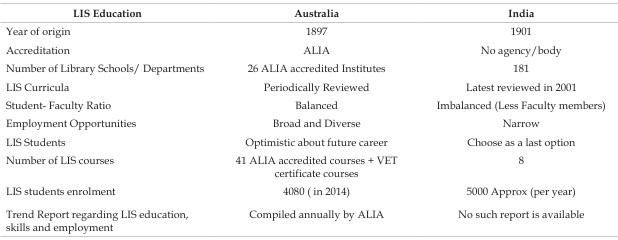
Library education in India and Australia has developed independently with distinct features. This paper provides brief profile of the history of India and Australia followed by discussion of the evolution of LIS education in both the countries. The paper is a comparative study. It discusses the different issues and challenges encountered in LIS education in India and Australia. This comparison is an attempt to critique improvements that must be made to LIS education in India to ensure on going sustainability and relevance. In India, the growth of library schools; dated LIS curricula; increasing student faculty ratios; accreditation; and the employability of graduates are some key issues. In Australia challenges include the broad employment landscape; mismatch between pay and qualifications; decreasing numbers of educators; existence of a multi-tiered system; LIS students and institutional affiliations. A number of strategies have been used in both India and Australia to enhance LIS education. Using LIS education in Australia as a benchmark the authors show how LIS education in India can be enhanced and improved.
References
- 1. Abels, E. G., Howarth, L. C. & Smith, L. C. (2016). Envisioning our information future and how to educate for it. Journal of education for library and information science, 57(2).
- 2. Abell, A., (2006). Roles in the e-landscape. Business Information Review, 23(4), 241-251.doi: 10.1177/0266382106072249.
- 3. AC Nelson Research Services (2000). Employer satisfaction with graduate skills: research report. Retrieved from http://www.dest.gov.au/archive/ highered/eippubs/eip99-7/eip99 _7 pdf.pdf.
- 4. Agarwal, U. K. (2005). Visible State of library Education in Rajasthan. In Shubha Tiwari (Ed.), Education in India (pp. 1-2). New Delhi: Atlantic.
- 5. Australian Library and Information Association (2010). Enrolments in Library and information management courses. Retrieved from http://www. alia.org.au /employment/ enrolment.courses/.
- 6. Australian Library and Information Association (2016). LIS Education, Skills and Employment, Trend Report. Retrieved from https://www. alia.org.au/sites/default/files/ALIA%20LIS%20 Education%20Skills%20and%20Employment%20 Trend%20Report%202016_0.pdf.
- 7. Australian Library and Information Science Association (2005a). ALIA’s role in education of library and information professionals. Retrieved from http://www.alia.org.au /policies/ education. role.html.
- 8. Australian Library and Information Science Association (2005b). Courses in library and information management. Retrieved from http:// www.alia.org.au/policies/courses.html.
- 9. Australian Library and Information Science Association (2005c). Library and information sector: coreknowledge, skills and attributes. Retrieved from http://www.alia.org.au/policies/ core. knowledge.html.
- 10. Australian Library and Information Science Association (2006c). ALIA recognition of courses: Criteria for recognition of first award courses in library and information technician level. Retrieved from http://www.alia.org.au/education/courses /criteria .html.
- 11. Australian Library and Information Science Association (2006d). Employer roles and responsibilities in education and professional development. Retrieved from http://www.alia. org.au/policies / information.centres.html.
- 12. Berry, J. N. (2004) Blatant Berry: Don’t Dis the LIS “Crisis”. Library Journal. Retrieved from http:// www. Library journal.com/article/CA456234.html.
- 13. Biddiscombe, R. (2001). The development of information professionals’ needs for internet and IT skills: experiences at the University of Birmingham. Program, 35(2), 66-157.
- 14. Blainey, G.(1968). A shrinking world keeps its own distance. Retrieved from http//old.smh.com.au/ news/020/18/opinion/opinion 1.html.
- 15. Bennett, N., Dunne, E., & Carre, C. (2000). Skills development in higher education and employment. A London: The society for Research into Higher Education & Open University Press. Philadelphia: Society for Research into Higher Education & Open University Press.
- 16. Carroll, M. (2002). The well-worn path. Australian Library Journal, 51(2), 117-125.
- 17. Carroll, M. & Murray, J. (2010). Swirling Students: A study of Professionals and Vocational Training Avenues for the Library and Information Industry. Library Trends, 59(1), 188-207.
- 18. Central Intelligence Agency (2016). The World Fact book-Australia. Retrieved from https://www.cia. gov/library/publications/resources/the-worldfactbook/geos/as.html.
- 19. Central Intelligence Agency (2016). The World Fact book-India. Retrieved from https://www.cia. gov/library/publications/resources/the-worldfactbook/geos/in.html.
- 20. Chakraborty, S. & Sarkhel, J.K. (2009). LIS education in India: an appraisal of the parity between the syllabus and the market demands. Proceedings of the World Library and Information Congress: 75th IFLA General Conference and council, Milan, Italy. Retrieved from https://www.ifla.org/pastwlic/2009/86-chakraborty-en.pdf.
- 21. Chawner, Brenda (2015). Library and Information Studies Education in New Zealand and Australia: Background, Issues, and Challenges. Journal of Education for Library and Information Science, 56 (1), S17-S26.
- 22. Chopra, Ritik (2016, November 15). IITs estimate cost of improving its global rankings. The Hindustan Times,p.5.
- 23. Combes, B., Hanisch, Jo, Carroll, M. & Hughes, H. (2011). Student voices: Re-conceptualising and repositioning Australian library and information science education for the twenty-first century.International Information & Library Review, 43(3), 137-143.
- 24. Cronin, B. (2002). Holding the center while prospecting at the periphery: domain identity and coherence in North American information studies education. Education for Information, 20, 3-10.
- 25. Dearing, Ron (1997). Higher education in the Learning Society. Leeds, England: National Committee of Inquiry into Higher Education.
- 26. Dillon, A., & Norris, A. (2005). Crying Wolf: An Examination and Reconsideration of the Perception of Crisis in LIS Education. Journal of Education for Library and Information Science, 46(4), 280-298.
- 27. Genoni, P. (2005). The changing face of LIS higher education in Australia, part 2. in Cite, 26(8), 18.
- 28. Gerolimos, M. (2009). Skills developed through library and information science education. Library Review, 58 (7), 527 – 540.
- 29. Gorman, M. (2004). Whither library education. New Library World, 105(9/10), 376-380. doi:10.1108/03074800410557330.
- 30. Gorman, M. (2011). Confronting the Crisis in Library Education: Satellite Broadcast and Webcast. Proceedings of the National Teleconference. Retrieved from http://www.Dupage press.com/no_cache/library learning-network/previous-teleconferences/ala.
- 31. Hallam, Gillian (2006). Trends in LIS education in Australia. In Khoo, C. & Singh, D. and Chaudhry, A.S., (Eds). Proceedings of the Asia-Pacific Conference on Library and Information Education and Practice 2006, Preparing information professionals for leadership in the new age(pp. 41-51). Retrieved from http://arizona.openrepository.com/arizona/ bitstream/10150/105355/2/07.
- 32. Hallam, Gillian (2007). Education for library and information service. In Ferguson, S. (Ed.), Libraries in the twenty first century: Mapping future directions in information services (pp. 310-336). Waga wagga NSW:Centre for Information Studies.
- 33. Harvey, R. (2001). Losing the quality battle in Australian education for librarianship. Australian Library Journal, 50(1), 15-22.
- 34. Harvey, R. (2004). Changes in the librarianship curriculum: Where are we heading? Australian Law Librarian, 12 (2), 33-36.
- 35. Harvey, R., & Higgins, S. (2003). Defining fundamentals and meeting expectations: Trends in LIS education in Australia. Education for Information, 21(2/3), 149-157.
- 36. Indian Association of Teachers of Library and Information Science (2016). About IATLIS. Retrieved from https://sites.google.com/site/ iatlishome/about-iat.
- 37. Indian Association of Special Libraries and Information Centres (2016). Activities SIG on Library & Information Science Education. Retrieved fromhttp://www.iaslic1955.org.in/Default. aspx?PageId=83.
- 38. Indian Library Association (2016). About ILA: Vision Mission. Retrieved from http:// www.ilaindia.net/index.php?option=com_ content&view=article&id=4:vision-mission&catid =8&Itemid=111.
- 39. Jagtar Singh & Malhan, I.V. (2010). Trends and Issues in LIS Education in India. Proceedings of the IFLA Satellite Meeting. Retrieved from http://conf. euclid-lis.eu/index.php/IFLA2010/IFLA2010/paper/ download/15/15.
- 40. Karsiddappa, C.R. (2004). LIS curriculum from the developing countries. Proceedings of the 70th IFLA General Conference and Council World Library and Information Congress. Retrieved from http://ec2- 54-194-84-58.eu-west-1. compute.amazonaws. com/ greenstone /collect/toolbox/index/assoc/HASH01e5. dir/Library%20And%20Information%20Science%20 Curriculum.pdf.
- 41. Kaur, Trishanjit (2015). Challenges and Concerns for Library and Information Science (LIS) Education in India and South Asia. Journal of Education for Library and Information Science, 56 (1), S17-S26.
- 42. Khan, M. A. (1996). Library Science Education in India. New Delhi: Sarup.
- 43. Khurshid, Anis (1976). Intellectual foundations of library education. International Library Review, 8, 3-21.
- 44. Krishan Kumar & Sharma, J. (1973). Research libraries in developing countries. New Delhi: Vikas.
- 45. Krishan Kumar (2016, October 11). Shortcut to scholarship. The Indian Express, p.9.
- 46. Ling Hwey Jeng (2005). The points of ALA Task Force on Library School Closing. PRISM, 13(2). Retrieved from:http://www.ala.org/ala/accreditation/prp/ prism/prismarchive/FA05 v13i2.pdf.
- 47. Macauley, P (2004). Challenging librarians: The relevance of the doctorate in professional practice. Challenging ideas. In Janine Schmidt (Ed.), Proeedings of the ALIA 2004 Biennial Conference. Retrieved from http://dro.deakin.edu.au/view/ DU:30005313.
- 48. Mangla, P.B. (1994). Library and Information Science Education in South Asia: India, Pakistan, Bangladesh and Sri Lanka. Education for Information, 12(4), 399-427.
- 49. Mangla, P. B. (1998). Library and Information Science Education: Trends and issues. In Jain, M. K., (Ed.), Fifty years of Library and Information Services in India (pp. 285-293). New Delhi: Shipra.
- 50. Miwa, M. (2006). Trends and Issues in LIS Education in Asia. Journal of Education for Library and Information Science, 47(3), 167-180.
- 51. Muilenburg, L.Y., & Berge, Z.L. (2005). Student barriers to online learning: a factor analytic study. Distance Education, 26(1), 29-48.
- 52. Mulvaney, J. P., & O’Connor, D. (2006). The crux of our crisis. American Libraries, 37(6), 38-40.
- 53. My burgh, S. (2003). Education directions for new information professionals. Australian Library Journal, 52(3), 213–228.
- 54. National Knowledge Commission (2007). Report to the nation 2006. New Delhi: National Knowledge Commission.
- 55. Nicholson, J. & Tattersall, N. (2001, Nov.). Issues, challenges and directions in education and training for the current and future library and information services sector: an association perspective. Proceedings of the ALIA LISEKA Ideas Forum.
- 56. Partridge, H. & Yates, C. (2012). A frame work for the Education of the Information Professionals in Australia. The Australian Library Journal, 61(2), 81-93.
- 57. Partridge, H., Menzies, V., Lee, J. & Munro, C. (2010). The contemporary librarian: skills, knowledge and attributes required in a world of emerging technologies. Library and Information Science Research, 32, 265-271.
- 58. Phuritasabam, B. & Devi, P. (2009). Trends in Library and Information Science Education in South Asia: Issues and Challenges. Proceedings of the AsiaPacific Conference on Library & Information Education and Practice. Retrieved from http://www.slis.tsukuba. ac.jp/a-liep2009/proceedings/Papers/a23.pdf.
- 59. Planning Commission (1984). Report of the Working Group of the Planning Commission on Modernisation of Library Services and Informatics for the Seventh Five Year Plan 1985-90. New Delhi: Planning Commission.
- 60. Poynton, C (2004). Received wisdom. Managing Partner, 10(9).
- 61. Pyati, Ajit. (2010). Understanding the role of Information Policy in LIS education. Feliciter, 56(3), 116-117.
- 62. Ranganathan, S.R. (1965). Review Committee Report on Library Science in Indian Universities. New Delhi: University Grants Commission.
- 63. Rochester, M.K. (1997). Education for Librarianship in Australia. New York: Mansell.
- 64. Sabharwal, Manish (2016, November 21). Jobs vs Wages. Indian Express, p. 10.
- 65. Satija, M.P. (1993). Research in Librarianship before and after Ranganathan. In Navalani, K and Satija, M.P. (Eds.), Pettits petals: A tribute to S R Ranganathan (pp. 27-45). New Delhi: ABC Publishing House.
- 66. Seavey, C. A. (2005). The Coming Crisis in Education for Librarianship. American Libraries, 36(9), 54-56.
- 67. Sharma, R. N. (2005). Development of Library and Information Science Education in South Asia with Emphasis on India: Strengths, Problems and Suggestions. Journal of Education for Library and Information Science, 46(1), 77-83.
- 68. Singh, K.P. & Chander, H. (2013). Professional Inclination of Library and Information Science (LIS) students of India: A Study of Socioeconomic Background and Career Choice Factors. International Journal of Knowledge Content Development & Technology, 3(2) 5-15.
- 69. Singh, S. P. (2003). Library and Information Science Education in India: Issues and Trends. Malaysian Journal of Library & Information Science, 8(2), 1-17.
- 70. Stoffle, C. J., & Leeder, K. (2005). Practitioners and library education: A crisis of understanding. Journal of Education for Library and Information science, 46(4), 312–319.
- 71. Trant, J. (2009). Emerging convergence? Thoughts on museums, archives, libraries, and professional training. Museum Management & Curatorship, 24(4), 369-387. doi:10.1080/09647770903314738.
- 72. University Grants Commission (1992). Report of the Curriculum Development Committee on Library and Information Science. New Delhi: University Grants Commission.
- 73. University Grants Commission (2001). Model Curriculum Library and Information Science, Report. Retrieved from http://www.ugc.ac.in/policy/ model-curr.html.
- 74. University Grants Commission (1986). National policy on library and information system–A presentation. Report of the Curriculum Development Committee. New Delhi: University Grants Commission.
- 75. Whitmell & Associates (2004). Preparing for demographic change: Workforce and succession planning of the Australian technology network. Ontario, Canada: Whitmell and Associates.
- 76. Williamson, K. (2002). Research methods for students, academics and professionals: Information management and systems (2nd ed.). Wagga Wagga, NSW: Centre for Information studies Charles Stuart University.
- 77. Wijetunge, P. (2009). Selection of students to LIS education programmes in Sri Lanka and some related issues. Proceedings of the 27th Conference of the Indian Association of Teachers of Library and Information Science (IATLIS), India. Patiala: Punjab University.
Data Sharing Statement
There are no additional data available.
Funding
This research received no funding.
Author Contributions
All authors contributed significantly to the work and approve its publication.
Ethics Declaration
This article does not involve any human or animal subjects, and therefore does not require ethics approval.
Acknowledgements
Information not provided.
Conflicts of Interest
No conflicts of interest in this work.
About this article

Cite this article
Ansari MA, Munshi SA. Comparing library science education in India and Australia: issues, challenges and growth strategies for India. Indian J Lib Inf Sci. 2024;18(1):7-19.
Licence:
Attribution-Non-commercial 4.0 International (CC BY-NC 4.0)| Received | Accepted | Published |
|---|---|---|
| January 18, 2024 | February 20, 2024 | April 06, 2024 |
DOI: 10.21088/ijlis.0973.9548.18124.1
Keywords
LIS EducationLIS ProfessionLibrarianshipIndiaAustraliaSearch for Similar Articles
Similar Articles
- Scientometric Portrait of Dr. Anil Kumar Dhiman, an Information Scientist-Part I...
- A Study on Humanities Students’ Literacy Skills at Alagappa University in Using...
- Awareness and Utilization of Artificial Intelligence Tools (ChatGPT) among Stude...
- Global Trends on Artificial Intelligence in Science Research: A Scientometric Ob...
- Information Needs of Persons with Visual Impairments: A Socioeconomic Analysis
Article Level Metrics
Last UpdatedThursday 10 September 2026, 02:50:43 (IST)
3922
Accesses
22
738
00
Citations
NA
NA
NA
Download citation
Article Keywords
Keyword Highlighting
Highlight selected keywords in the article text.
Timeline
| Received | January 18, 2024 |
| Accepted | February 20, 2024 |
| Published | April 06, 2024 |
licence
Attribution-Non-commercial 4.0 International (CC BY-NC 4.0)