Full Text (PDF)
New Indian Journal of Surgery 16(2):p 59-66, April - June 2025. | DOI: 10.21088/nijs.0976.4747.16225.3
Original Article
Comparative Study of the Efficacy of Conventional and Collagen Dressing in First and Second Degree Superficial Burns
Vishakha Iyer,, Sarojini Jadhav, Suyash Deshmukh
Author Information
Licence:
Attribution-Non-commercial 4.0 International (CC BY-NC 4.0)This license enables reusers to distribute, remix, adapt, and build upon the material in any medium or format for noncommercial purposes only, and only so long as attribution is given to the creator.
New Indian Journal of Surgery 16(2):p 59-66, April - June 2025. | DOI: 10.21088/nijs.0976.4747.16225.3
How Cite This Article:
Iyer V, Jadhav S, Deshmukh S. Comparative Study of The Efficacy of Conventional and Collagen Dressing in First and Second Degree Superficial Burns. New Indian J Surg. 2025;16(2):59-66.Timeline
Received : May 17, 2025
Accepted : June 20, 2025
Published : June 30, 2025
Abstract
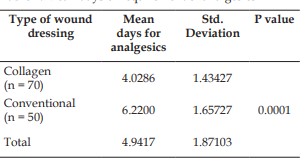
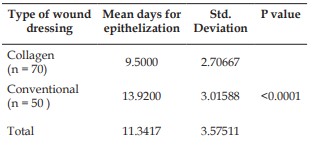
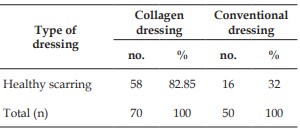
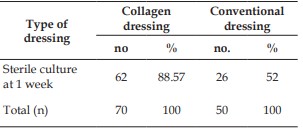
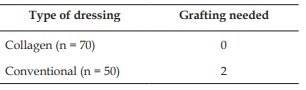
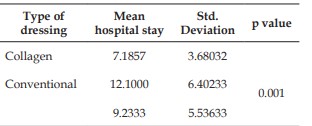
Introduction: Burns injury is one of the most common cause for hospitalization in the world. About 80% are first degree and second degree ones. Since paediatric skin has a faster rate of healing, superficial first and second degree burns have significant improvement. Recent advances show that collagen dressing in burns because of its biological properties have better outcomes reducing morbidity. A prospective, interventional observational study was conducted over 120 paediatric patients with less than 30% superficial burns dividing them in 2 groups (collagen and conventional dressing). The analgesic need, infection rate, rate of epithelialization, scarring, need for grafting and hospital stay were assessed. Chi square test was applied to obtain ‘p’ value to decide ignificance. 70 patients were offered collagen and 50 patients silver sulfadiazine(SSD) dressing. The mean rate of ithelialization with collagen and SSD dressing was 9.50 days and13.92 days respectively. The mean days for analgesic need was 4.02 days with collagen and 6.22 days with SSD dressing. Sterile culture at 1 week was seen in 88.57% patients with collagen and 52% patients with SSD. With collagen dressing healthy scarring was seen in 82.85% patients and with SSD dressing, 32%. Of 50 patients with SSD dressing 2 required skin grafting. Collagen rejection was seen in 4 of 70 patients. With collagen dressing the average hospital stay was 7.18 days and with SSD dressing, 12.10 days. Collagen dressing showed lesser analgesics, faster epithelialization, lesserantibiotic use, healthy scarring, lesser hospital stay.
References
- 1. Brigham PA, McLoughlin E. Burn incidence and medical care use in the United States: estimates, trends, and data sources. J Burn Care Rehabil. 1996;17:95–107.
- 2. Purna SK, Babu M. Collagen based dressings — a review. Burns 2000;26:54-62.
- 3. Collagen dressings in the management of partial thickness pediatric burns: Our experience: Mukta Waghmare, Hemanshi Shah, Charu Tiwari, Deepa Makhija, Jayesh Desale, Pankaj Dwivedi Indian J Burns 2016;24:53-7
- 4. Lesher AP, Curry RH, Evans J, et al. Effectiveness of Biobrane for treatment of Mukta Waghmare, Hemanshi Shah, Charu Tiwari, Deepa Makhija, Jayesh Desale, Pankaj Dwivedi Indian J Burns 2016;24:53-7
- 5. Khurram MF, Sheikh MT, Ahmad I, Maurya SK, Ambedkar V, Maurya RK. The efficacy of collagen based dressings for treatment of scald burns in under 5 years paediatric population: a non-comparative, prospective single centre experience. Int J Community Med Public Health 2018;5:4298-302.
- 6. Dr. S. Karthikeyan “A Comparative Study on Collagen Vs Silversulphadiazine Dressing in Burns Wounds.”IOSR Journal of Dental and Medical Sciences (IOSR-JDMS), vol. 17, no. 8, 2018, pp 12-20.
- 7. Hansbrough JF, Zapata-Sirvent R, Carroll WJ, Dominic WJ, Wang XW, Wakimoto A. Clinical experience with Biobrane biosynthetic dressing in the treatment of partial thickness burns. Burns Incl Therm Inj. 1984;10:415-9.
- 8. Singh O, Gupta SS, Soni M, Moses S, Shukla S, Mathur RK. Collagen Dressing Versus Conventional Dressings in Burn and Chronic Wounds: A Retrospective Study. Journal of Cutaneous and Aesthetic Surgery. 2011;4(1):12- 16. doi:10.4103/0974-2077.79180.
- 9. Mehta MA, Shah S, Ranjan V, Sarwade P, Philipose A. Comparative study of silversulfadiazine-impregnated collagen dressing versus conventional burn dressings in second degree burns. J Family Med Prim Care 2019;8:215-9.
- 10. Wasiak J, Cleland H, Campbell F, Spinks A. Dressings for superficial and partial thickness burns.Cochrane Database ofSystematic Reviews2013, Issue 3. Art. No.: CD002106. DOI: 10.1002/1465 1858.CD002106.pub4.
- 11. Pham C, Greenwood J, Cleland H, Woodruff P, Maddern G. Bioengineered skin substitutes for the management of burns: a systematic review. Burns 2007;33(8):946-957.
- 12. Vloemans AF, Hermans MH, van der Wal MB, Liebregts J, Middelkoop E. Optimal treatment of partial thickness burns in children: a systematic review. Burns 2014; 40:177-90.
- 13. A Comparative Study between Collagen Dressing and Conventional Dressing in Case of Superficial and Second Degree Superficial Burns *Dr. K. Srinivasa Rao1, Dr. K. Ravi2, Dr. K. Ravi Chandra 3, e-ISSN: 2279-0853, p-ISSN 2279-0861.Volume 16, Issue 12 Ver. VI (Dec. 2017), PP 11-15.
- 14. S, Barrow RE, Wolf SE, et al. Biobrane improves wound healing in burned children without increased risk of infection. Shock. 2000;14:314–9.
- 15. Biobrane dressing for paediatric burns in Singapore: a retrospective review Cong Fan, MBBS, Chong Han Pek, MRCS, MMed, [...], and Gale Jue Shuang Lim, MMed, FAMS
- 16. Heyneman A, Hoeksema H, Vandekerckhove D, Pirayesh A, Monstrey S. The role of silver sulphadiazine in the conservative treatment of partial thickness burn wounds: A systematic review. Burns 2016;42:1377-86.
- 17. Greenwood JE, Clausen J, Kavanagh S. Experience with Biobrane—uses and caveats for success. ePlasty. 2009;9:243-55
- 18. Delatte SJ, Evans J, Hebra A, et al. Effectiveness of beta-glucan collagen for treatment of partial-thickness burns in children. J Pediatr Surg. 2001;36:113–8
Data Sharing Statement
There are no additional data available. All raw data and code are available upon request.
Funding
This research received no funding.
Author Contributions
All authors contributed significantly to the work and approve its publication.
Ethics Declaration
This article does not involve any human or animal subjects, and therefore does not require ethics approval.
Acknowledgements
We would like to express our gratitude to the patients, their families, and all those who have contributed to this study.
Conflicts of Interest
No conflicts of interest.
About this article

Cite this article
Iyer V, Jadhav S, Deshmukh S. Comparative Study of The Efficacy of Conventional and Collagen Dressing in First and Second Degree Superficial Burns. New Indian J Surg. 2025;16(2):59-66.
Licence:
Attribution-Non-commercial 4.0 International (CC BY-NC 4.0)This license enables reusers to distribute, remix, adapt, and build upon the material in any medium or format for noncommercial purposes only, and only so long as attribution is given to the creator.
| Received | Accepted | Published |
|---|---|---|
| May 17, 2025 | June 20, 2025 | June 30, 2025 |
DOI: 10.21088/nijs.0976.4747.16225.3
Keywords
PaediatricBurnsCollagenConventionalSuperficialBiologicalSilver sulfadiazineEpithelializationScarringSearch for Similar Articles
Similar Articles
- Laparoscopy-Guided Bilateral Oblique Subcostal Transversus Abdominis Plane Bloc...
- Recognizing the Columnar Cell Subtype of Papillary Thyroid Carcinoma: A Case Rep...
- Randomized Controlled Study To Compare Intraperitoneal Plus Port-Site Instillat...
- Single Preoperative Dose Versus Conventional Multidose Antibiotic Prophylaxis In...
- To Compare the Dissection of Gallbladder by Ultrasonic Harmonic Scalpel Versus...
Article Level Metrics
Last UpdatedWednesday 30 September 2026, 13:49:13 (IST)
5308
Accesses
14
438
00
Citations
NA
NA
NA
Download citation
Article Keywords
Keyword Highlighting
Highlight selected keywords in the article text.
Timeline
| Received | May 17, 2025 |
| Accepted | June 20, 2025 |
| Published | June 30, 2025 |
licence
Attribution-Non-commercial 4.0 International (CC BY-NC 4.0)
This license enables reusers to distribute, remix, adapt, and build upon the material in any medium or format for noncommercial purposes only, and only so long as attribution is given to the creator.