Full Text (PDF)
New Indian Journal of Surgery 16(4):p 153-158, oct.Dec 2025. | DOI: 10.21088/nijs.0976.4747.16425.3
Original Article
Case Series Analysis of Medical Expulsive Therapy in Ureteric Calculi
Jigar Ratnottar, Frenali Gheewala, Gurmeet Singh Sarla
Author Information
Licence:
Attribution-Non-commercial 4.0 International (CC BY-NC 4.0)This license enables reusers to distribute, remix, adapt, and build upon the material in any medium or format for noncommercial purposes only, and only so long as attribution is given to the creator.
New Indian Journal of Surgery 16(4):p 153-158, oct.Dec 2025. | DOI: 10.21088/nijs.0976.4747.16425.3
How Cite This Article:
Frenali G, Gheewala J, Ratnottar J, Sarla GS. Case series analysis of medical expulsive therapy in ureteric calculi. New Indian J Surg. 2025;16(4):153–158.Timeline
Received : July 31, 2025
Accepted : September 27, 2025
Published : December 30, 2025
Abstract
Introduction: Urinary calculi are a common complaint, affecting the cases in a ratio of 3 men to 1 woman, with advanced incidence between 40 to 50 years of age. Size of the calculus influences the rate of spontaneous calculus passage. Medical expulsive therapy (MET) has been described as an effective conservative treatment option in the initial management of small distal ureteral/ Vesico-Ureteric Junction (VUJ). Ureteroscopy (URS) is indicated in unsuccessful cases of MET. Current European Association of Urology advocates the use of URS as first line treatment for distal ureteric calculus larger than 10 mm.
Methods: The study was conducted at a tertiary care hospital in Gujarat, India, nvolving both outpatient and inpatient cases. Patients underwent radiological, blood, and urine evaluations. They were instructed to take silodosin, deflazacort, diclofenac, and maintain supra-hydration. Follow-ups were scheduled every 7 days with X-ray KUB to monitor spontaneous calculus passage. If stone passage was unsuccessful after 28 days, patients underwent planned URS with or without lithotripsy and DJ stenting under anaesthesia.
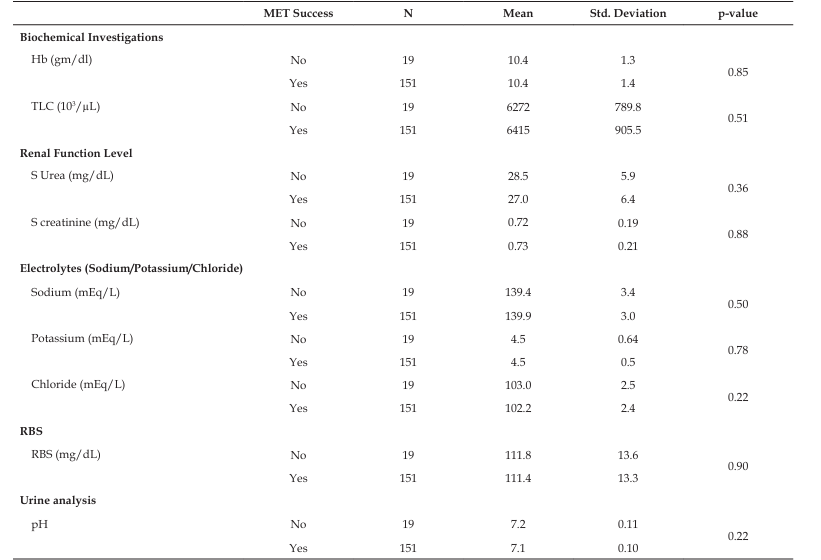
Results: In a cohort of 170 patients with small distal ureteral stones, 89% were successfully managed with medical expulsive therapy (MET), while 11% required ureteroscopy (URS) after unsuccessful MET. Comparative analyses considered factors such as patient demographics, stone characteristics, medical history, lab results, and URS findings, leading to the study’s conclusions.
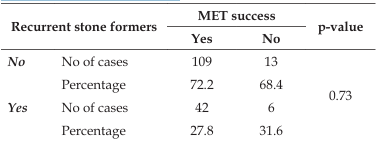
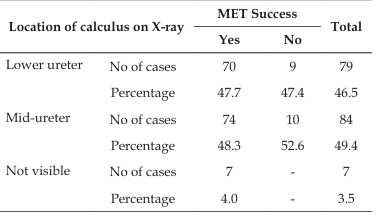
Conclusion: Our study has 170 patients with mid and distal ureteric calculi with size ranging from 4 to 10 mm with mild or no backpressure changes, which were subjected to MET with tablet silodosin, tablet deflazacort, tablet diclofenac and supra-hydration. We documented 88.8% MET success and 11.2% unsuccessful cases of MET. MET success is unaffected by age, gender of the patient, history of prior surgical procedure, diabetic status, hypertension or recurrent stone former status. For calculus size between 4 to 10 mm stone-free rate was achieved with medical therapy in 88.8% of patients with no overt complications. Size of the calculus is a significant predictor of expulsion rate. In our study all cases with unsuccessful MET underwent ureteroscopy for calculus clearance.
References
- 1. Johnston W, Low R, Das S. The evolution and progress of ureteroscopy. Urol Clin North Am. 2004 Feb;31(1):5-13. doi: 10.1016/S0094-0143(03)00100-9.
- 2. Miller NL, Lingeman JE. Management of kidney stones. BMJ. 2007 Mar 3;334(7591):468-72. doi: 10.1136/bmj.39113.480185.80.
- 3. Gettman MT, Segura JW. Management of ureteric stones: issues and controversies. BJU Int. 2005 Mar;95 Suppl 2:85-93. doi: 10.1111/j.1464-410X.2005.05206.x.
- 4. Knudsen BE, Beiko DT, Denstedt JD. Uric acid urolithiasis. In: Stoller ML, Meng MV, editors. Urinary stone disease: the practical guide to medical and surgical management. Totowa (NJ): Humana Press; 2007. p. 299-308.
- 5. Macaluso JN Jr. Management of calculus disease--bearing the burden. J Urol. 1996 Nov;156(5):1579-80. doi: 10.1016/s0022-5347(01)65452-1.
- 6. Rahman MJ, Faridi MS, Mibang N, Singh RS. Comparing tamsulosin, silodosin versus silodosin plus tadalafil as medical expulsive therapy for lower ureteric stones: A randomised trial. Arab J Urol. 2018 Jun;16(2):245-249. doi: 10.1016/j.aju.2017.11.012.
- 7. Kumar S, Jayant K, Agrawal MM, Singh SK, Agrawal S, Parmar KM. Role of tamsulosin, tadalafil, and silodosin as the medical expulsive therapy in lower ureteric calculus: a randomized trial (a pilot study). Urology. 2015 Jan;85(1):59-63. doi: 10.1016/j.urology.2014.09.022.
- 8. Wang CJ, Tsai PC, Chang CH. Efficacy of Silodosin in Expulsive Therapy for Distal Ureteral Stones: A Randomized Double-blinded Controlled Trial. Urol J. 2016 Jun 28;13(3):2666-71.
- 9. Huang W, Xue P, Zong H, Zhang Y. Efficacy and safety of silodosin in the medical expulsion therapy for distal ureteral calculi: a systematic review and meta-analysis. Br J Clin Pharmacol. 2016 Jan;81(1):13-22. doi: 10.1111/bcp.12737.
- 10. Sharma G, Pareek T, Kaundal P, Tyagi S, Singh S, Yashaswi T, et al. Comparison of efficacy of three commonly used alpha-blockers as medical expulsive therapy for distal ureter calculi: A systematic review and network meta-analysis. Int Braz J Urol. 2022 Sep-Oct;48(5):742-759. doi: 10.1590/S1677-5538.IBJU.2020.0548.
- 11. • Gürel K, Gürel S, Kalfaoğlu M, Yilmaz O, Metin A. Does an extra kidney-ureter-bladder radiograph taken in the upright position during routine intravenous urography provide diagnostic benefit? Diagn Interv Radiol. 2008 Dec;14(4):205-11.
- 12. • Wells IT, Raju VM, Rowberry BK, Johns S, Freeman SJ, Wells IP. Digital tomosynthesis—a new lease of life for the intravenous urogram? Br J Radiol. 2011 May;84(1001):464-8. doi: 10.1259/bjr/25656519.
- 13. • Ahmed F, Zafar AM, Khan N, Haider Z, Ather MH. A paradigm shift in imaging for renal colic — is it time to say goodbye to an old trusted friend? Int J Surg. 2010;8(3):252-6. doi: 10.1016/j.ijsu.2010.01.008.
- 14. • Coursey CA, Casalino DD, Remer EM, Arellano RS, Bishoff JT, Digre KB, et al. ACR Appropriateness Criteria® acute onset flank pain—suspicion of stone disease. Ultrasound Q. 2012 Dec;28(4):227-33. doi: 10.1097/RUQ.0b013e318271c53d.
- 15. • Jendeberg J, Geijer H, Alshamari M, Cierzniak B, Lidén M. Size matters: The width and location of a ureteral calculus accurately predict the chance of spontaneous passage. Eur Radiol. 2017 Nov;27(11):4775-4785. doi: 10.1007/s00330-017-4852-6.
- 16. • Bokka S, Jain A. Hounsfield unit and its correlation with spontaneous expulsion of lower ureteric calculus. Ther Adv Urol. 2019 Dec 3;11:1756287219887661. doi: 10.1177/1756287219887661.
- 17. • Gücük A, Uyetürk U. Usefulness of hounsfield unit and density in the assessment and treatment of urinary calculi. World J Nephrol. 2014 Nov 6;3(4):282-6. doi: 10.5527/wjn.v3.i4.282.
- 18. • Türk C, Knoll T, Petrik A, Sarica K, Skolarikos A, Straub M, et al. Guidelines on Urolithiasis. Arnhem, The Netherlands: European Association of Urology (EAU); 2015.
- 19. • Yilmaz E, Batislam E, Basar MM, Tuglu D, Ferhat M, Basar H. The comparison and efficacy of 3 different α1-adrenergic blockers for distal ureteral calculi. J Urol. 2005 Jun;173(6):2010-2. doi: 10.1097/01.ju.0000158453.60029.0a.
Data Sharing Statement
There are no additional data available. All raw data and code are available upon request.
Funding
This research received no funding.
Author Contributions
Whether all authors contributed significantly to the work and approve its publication.
Ethics Declaration
This article does not involve any human or animal subjects, and therefore does not require ethics approval.
Acknowledgements
We would like to express our gratitude to the patients, their families, and all those who have contributed to this study.
Conflicts of Interest
The authors report no conflicts of interest in this work.
About this article

Cite this article
Frenali G, Gheewala J, Ratnottar J, Sarla GS. Case series analysis of medical expulsive therapy in ureteric calculi. New Indian J Surg. 2025;16(4):153–158.
Licence:
Attribution-Non-commercial 4.0 International (CC BY-NC 4.0)This license enables reusers to distribute, remix, adapt, and build upon the material in any medium or format for noncommercial purposes only, and only so long as attribution is given to the creator.
| Received | Accepted | Published |
|---|---|---|
| July 31, 2025 | September 27, 2025 | December 30, 2025 |
DOI: 10.21088/nijs.0976.4747.16425.3
Keywords
Medical Expulsive TherapyUreteric StonesUreteroscopySearch for Similar Articles
Similar Articles
- Laparoscopy-Guided Bilateral Oblique Subcostal Transversus Abdominis Plane Bloc...
- Recognizing the Columnar Cell Subtype of Papillary Thyroid Carcinoma: A Case Rep...
- Randomized Controlled Study To Compare Intraperitoneal Plus Port-Site Instillat...
- Single Preoperative Dose Versus Conventional Multidose Antibiotic Prophylaxis In...
- To Compare the Dissection of Gallbladder by Ultrasonic Harmonic Scalpel Versus...
Article Level Metrics
Last UpdatedTuesday 29 September 2026, 08:42:38 (IST)
5220
Accesses
21
437
00
Citations
NA
NA
NA
Download citation
Article Keywords
Keyword Highlighting
Highlight selected keywords in the article text.
Timeline
| Received | July 31, 2025 |
| Accepted | September 27, 2025 |
| Published | December 30, 2025 |
licence
Attribution-Non-commercial 4.0 International (CC BY-NC 4.0)
This license enables reusers to distribute, remix, adapt, and build upon the material in any medium or format for noncommercial purposes only, and only so long as attribution is given to the creator.