Full Text (PDF)
New Indian Journal of Surgery 16(4):p 159-163, oct.Dec 2025. | DOI: 10.21088/nijs.0976.4747.16425.4
Original Article
Accuracy of TIRADS Classification in the Risk Stratification of Thyroid Swellings: A Cross-sectional Study from Northwest Rajasthan
Vinay Sharma, Ashok Kumar, Diwan Singh Jakhar, Dhanesh Singhal, Kedarnath null, Ravikant Maru
Author Information
Licence:
Attribution-Non-commercial 4.0 International (CC BY-NC 4.0)This license enables reusers to distribute, remix, adapt, and build upon the material in any medium or format for noncommercial purposes only, and only so long as attribution is given to the creator.
New Indian Journal of Surgery 16(4):p 159-163, oct.Dec 2025. | DOI: 10.21088/nijs.0976.4747.16425.4
How Cite This Article:
Sharma V, Kumar A, Jakhar DS, et al. Accuracy of TIRADS classification in the risk stratification of thyroid swellings: a cross-sectional study from Northwest Rajasthan. New Indian J Surg. 2025 Oct-Dec;16(4):159-163Timeline
Received : August 29, 2025
Accepted : November 08, 2025
Published : December 30, 2025
Abstract
Background: Thyroid nodules are a common clinical entity, with an increasing detection rate due to widespread use of ultrasonography (USG). Differentiating benign from malignant nodules is essential for optimal management. The Thyroid Imaging Reporting and Data System (TIRADS) standardizes sonographic evaluation to stratify malignancy risk, aiding clinical decision-making in a non invasive manner.
Objective: To evaluate the diagnostic accuracy of the TIRADS classification system in the risk stratification of thyroid swellings and to compare its performance with fine-needle aspiration cytology (FNAC) and histopathology.
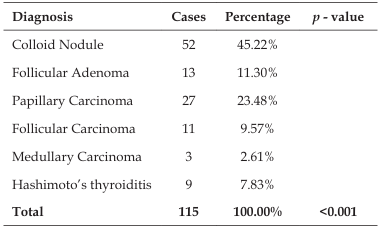
Methods: This was a hospital-based cross-sectional study conducted over one year in the Department of Surgery at Sardar Patel Medical College, Bikaner. A total of 115 patients with thyroid swellings scheduled for surgery were assessed. All underwent USG with TIRADS classification, FNAC based on the Bethesda system, and subsequent histopathological examination. Diagnostic accuracy parameters were calculated using histopathology as the gold standard.
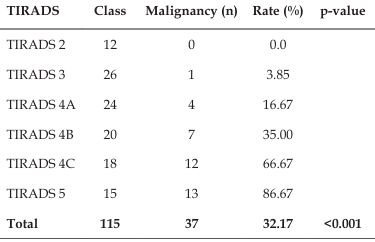
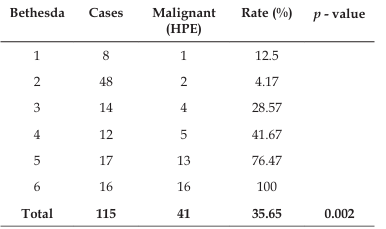
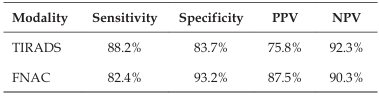
Results: Out of 115 patients, 36 (31.3%) were found to have malignant nodules on histopathology. TIRADS demonstrated a sensitivity of 88.2%, specificity of 83.7%, and an overall accuracy of 85.6%. FNAC showed a slightly higher specificity (93.2%) but lower sensitivity (82.4%). Malignancy risk increased proportionally with higher TIRADS categories.
Conclusion: TIRADS is an effective, non-invasive tool for thyroid nodule risk stratification. When combined with FNAC, it enhances diagnostic precision and guides surgical decisions.
Contribution: This study provides regional validation for TIRADS use in northwest Rajasthan, advocating its integration into routine thyroid nodule assessment protocols.
References
- 1. Cooper DS, Doherty GM, Haugen BR, Kloos RT, Lee SL, Mandel SJ, et al. Revised American Thyroid Association management guidelines for patients with thyroid nodules and differentiated thyroid cancer. Thyroid. 2009 Nov;19(11):1167-214.
- 2. Mazzaferri EL, Desforges J. Management of a solitary thyroid nodule. N Engl J Med. 1993 Feb 25;328(8):553-9.
- 3. Hegedüs L. Clinical practice. The thyroid nodule. N Engl J Med. 2004 Oct 21;351(17):1764-71..
- 4. Gharib H, Papini E. Thyroid nodules: clinical importance, assessment, and treatment. Endocrinol Metab Clin North Am. 2007 Sep;36(3):707-35.
- 5. Gharib H, Papini E, Valcavi R, Baskin HJ, Vitti P, Hostalek U, et al. American Association of Clinical Endocrinologists and Associazione Medici Endocrinologi medical guidelines for clinical practice for the diagnosis and management of thyroid nodules. Endocr Pract. 2006 Jan-Feb;12(1):63-102.
- 6. Yang R, Zou X, Zeng H, Zhao Y, Ma X. Comparison of diagnostic performance of five different ultrasound TI-RADS classification guidelines for thyroid nodules. Front Oncol. 2020 Oct 30;10:598225.
- 7. Papini E, Monpeyssen H, Frasoldati A, Hegedüs L. 2020 European Thyroid Association Clinical Practice Guideline for the use of image-guided ablation in benign thyroid nodules. Eur Thyroid J. 2020;9(4):172-185..
- 8. Guo C, Aniss A, Glover AR, Sywak MS, Sidhu SB. Risk of malignancy in radiologically and cytologically discordant thyroid nodules, based on TI-RADS and Bethesda classifications. BJS Open. 2024 Feb;8(1):zrad117.
- 9. Baek JH, Na DG, Lee JH, Jung SL, Kim JH, Sung JY, et al. 2017 thyroid radiofrequency ablation guideline: Korean Society of Thyroid Radiology. Korean J Radiol. 2018 Jul-Aug;19(4):632-55.
- 10. Tessler FN, Middleton WD, Grant EG, Hoang JK, Berland LL, Teefey SA, et al. ACR TI-RADS: white paper of the ACR TI-RADS Committee. J Am Coll Radiol. 2017 May;14(5):587-95.
- 11. Hoang JK, Middleton WD, Farjat AE, Langer JE, Reading CC, Teefey S, et al. Reduction in thyroid nodule biopsies and improved accuracy with ACR TI-RADS. Radiology. 2018 Apr;287(1):185-93..
- 12. Italian Minimally-Invasive Treatments of the Thyroid (MITT) Group. Minimally invasive treatments for benign thyroid nodules: a Delphi-based consensus statement. Ultrasonography. 2021 Jan;40(1):75-82.
- 13. Cantisani V, David E, Grazhdani H, de Vito C, Pecorella I, Di Segni M, et al. Prospective evaluation of semiquantitative strain ratio and quantitative 2D ultrasound shear-wave elastography in association with TI-RADS classification for thyroid nodule characterization. Ultraschall Med. 2019 Aug;40(4):495-503.
- 14. Yoon SJ, Na DG, Gwon HY, Paik W, Kim WJ, Song JS, et al. Similarities and differences between thyroid imaging reporting and data systems. AJR Am J Roentgenol. 2019 Aug;213(2):W76-84.
Data Sharing Statement
There are no additional data available. All raw data and code are available upon request.
Funding
This research received no funding.
Author Contributions
Whether all authors contributed significantly to the work and approve its publication.
Ethics Declaration
This article does not involve any human or animal subjects, and therefore does not require ethics approval.
Acknowledgements
We would like to express our gratitude to the patients, their families, and all those who have contributed to this study.
Conflicts of Interest
The authors report no conflicts of interest in this work.
About this article

Cite this article
Sharma V, Kumar A, Jakhar DS, et al. Accuracy of TIRADS classification in the risk stratification of thyroid swellings: a cross-sectional study from Northwest Rajasthan. New Indian J Surg. 2025 Oct-Dec;16(4):159-163
Licence:
Attribution-Non-commercial 4.0 International (CC BY-NC 4.0)This license enables reusers to distribute, remix, adapt, and build upon the material in any medium or format for noncommercial purposes only, and only so long as attribution is given to the creator.
| Received | Accepted | Published |
|---|---|---|
| August 29, 2025 | November 08, 2025 | December 30, 2025 |
DOI: 10.21088/nijs.0976.4747.16425.4
Keywords
TIRADSThyroid nodulesUltrasonographyFNACBethesda systemThyroid cancerRisk stratificationSearch for Similar Articles
Similar Articles
- Laparoscopy-Guided Bilateral Oblique Subcostal Transversus Abdominis Plane Bloc...
- Recognizing the Columnar Cell Subtype of Papillary Thyroid Carcinoma: A Case Rep...
- Randomized Controlled Study To Compare Intraperitoneal Plus Port-Site Instillat...
- Single Preoperative Dose Versus Conventional Multidose Antibiotic Prophylaxis In...
- To Compare the Dissection of Gallbladder by Ultrasonic Harmonic Scalpel Versus...
Article Level Metrics
Last UpdatedTuesday 29 September 2026, 08:43:32 (IST)
5220
Accesses
23
437
00
Citations
NA
NA
NA
Download citation
Article Keywords
Keyword Highlighting
Highlight selected keywords in the article text.
Timeline
| Received | August 29, 2025 |
| Accepted | November 08, 2025 |
| Published | December 30, 2025 |
licence
Attribution-Non-commercial 4.0 International (CC BY-NC 4.0)
This license enables reusers to distribute, remix, adapt, and build upon the material in any medium or format for noncommercial purposes only, and only so long as attribution is given to the creator.