Full Text (PDF)
Indian Journal of Cancer Education and Research 11(1):p 9-15, January-June 2023. | DOI: https://doi.org/10.21088/ijcer.2321.9815.11123.1
Original Article
Comparative Analysis of Hypofractionation versus Conventional Fractionation During Chest Wall Irradiation in Carcinoma Breast Patients: A Dosimetric and Clinical Study
Virendra Bhandar, Amresh Kumar, Ruchi Sharma, Saloni Singhal, Mahendran null, Ashar Iqbal Lodi null, Mahendran null, Ashar Iqbal Lodi, Virendra Bhandari
Author Information
Licence:
Attribution-Non-commercial 4.0 International (CC BY-NC 4.0)This license enables reusers to distribute, remix, adapt, and build upon the material in any medium or format for noncommercial purposes only, and only so long as attribution is given to the creator.
Indian Journal of Cancer Education and Research 11(1):p 9-15, January-June 2023. | DOI: https://doi.org/10.21088/ijcer.2321.9815.11123.1
How Cite This Article:
Kumar A, Sharma R, Singhal S, et al. Comparative analysis of hypofractionation versus conventional fractionation during chest wall irradiation in carcinoma breast patients: a dosimetric and clinical study. Indian J Canc Educ Res. 2023;11(1):9-15.Timeline
Received : January 06, 2023
Accepted : February 26, 2023
Published : February 28, 2023
Abstract
Introduction: Various dose fractionation schemes including conventional fractionation and hypofractionation, are in use for chest wall irradiation in carcinoma breast. Hypofractionation includes a higher dose per fraction with a smaller number of fractions with a biologically equivalent dose.
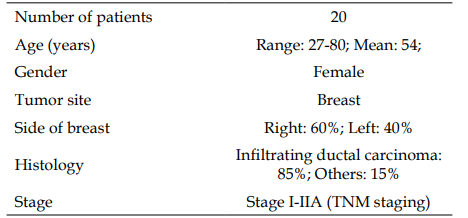
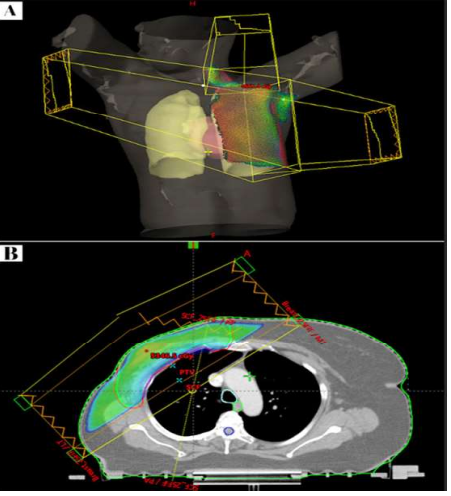
Aims: To study, analyse and compare the dosimetric and clinical outcomes using conventional fractionation versus hypofractionation. Methods and materials: This observational study includes 20 post-mastectomy patients and is randomized into two arms, with 10 patients in each arm. One arm received radiation as per conventional fractionation, and the other arm received it as per hypofractionation. 3 DCRT plans were generated, and doses to organs at risk were analysed and compared between the two groups. Patients were assessed for acute and late toxicities on follow-up, anda comparison was done between both groups.
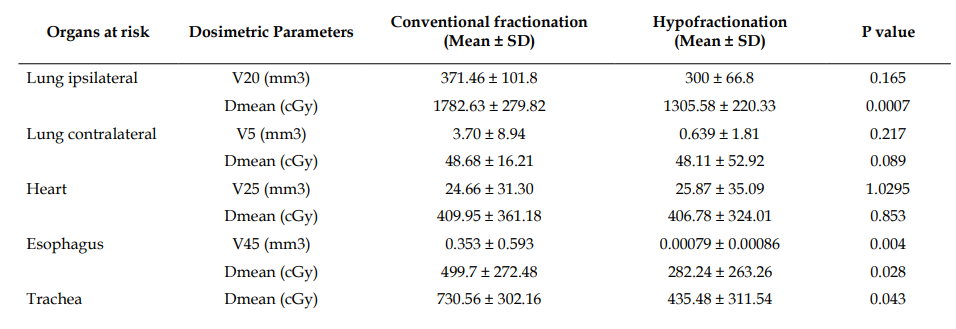
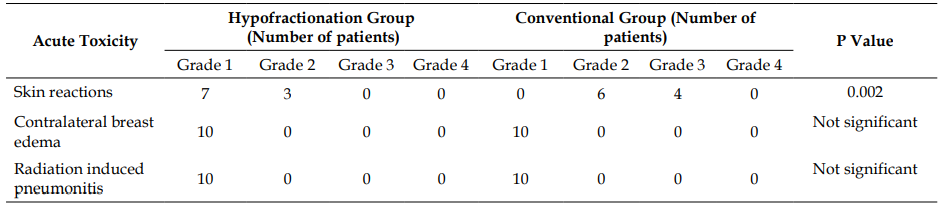
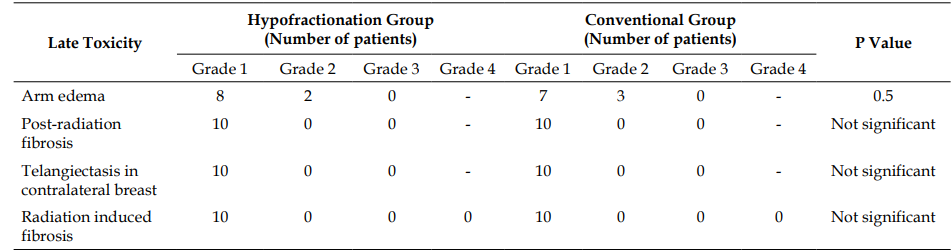
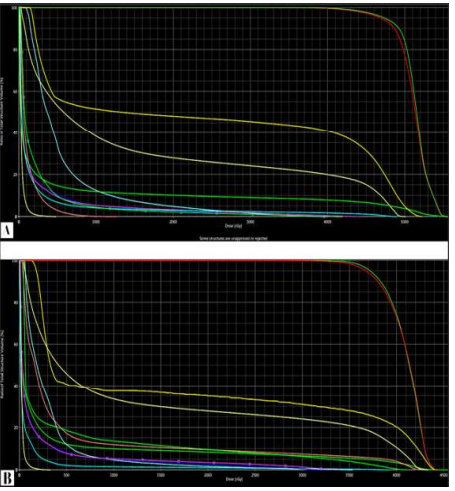
Results: Mean dose (D mean) in ipsilateral spine, lung, esophagus, trachea, and, thyroid showed statistically significant difference. The V25 and D mean in the heart, Liver showed no statistically significant difference. Acute toxicities were higher in conventional groups, with higher grades, while late toxicities were equivalent.
Conclusion: Hypofractionation significantly reduces mean doses to organs at risk and toxicities, with comparable locoregional control; hence it is comparable to and can be used in place of conventional fractionation in post-mastectomy breast cancer patients for chest wall irradiation.
References
- 1. Ferlay J, Ervik M, Lam F, Colombet M, Mery L, Piñeros M, et al. Global Cancer Observatory: Cancer Today [Internet]. Lyon: International Agency for Research on Cancer; 2020
- 2. START Trialists' Group; Bentzen SM, Agrawal RK, Aird EG, Barrett JM, Barrett-Lee PJ, et al. The UK Standardisation of Breast Radiotherapy (START) Trial A of radiotherapy hypofractionation for treatment of early breast cancer: a randomised trial. Lancet Oncol. 2008;9(4):331-341.
- 3. Li XA. Breast Cancer Atlas for Radiation Therapy Planning: Consensus Definitions [Internet]. [Place unknown]: [Publisher unknown]; [date unknown] [cited 2022 Sep 30]. p. 7-11.
- 4. National Cancer Institute. Common Terminology Criteria for Adverse Events (CTCAE) Version 5.0 [Internet]. Bethesda (MD): National Cancer Institute; 2017 Nov [cited 2022 Oct
- 5. Cox JD, Stetz J, Pajak TF. Toxicity criteria of the Radiation Therapy Oncology Group (RTOG) and the European Organization for Research and Treatment of Cancer (EORTC). Int J Radiat Oncol Biol Phys. 1995;31(5):1341-1346.
- 6. Clarke M, Collins R, Darby S; Early Breast Cancer Trialists' Collaborative Group (EBCTCG). Effects of radiotherapy and of differences in the extent of surgery for early breast cancer on local recurrence and 15-year survival: an overview of the randomised trials. Lancet. 2005;366(9503):2087–2106.
- 7. Overgaard M, Bentzen SM, Christensen JJ, Madsen EH. The value of the NSD formula in equation of acute and late radiation complications in normal tissue following 2 and 5 fractions per week in breast cancer patients treated with postmastectomy irradiation. Radiother Oncol. 1987;9(1):1–11.
- 8. Bentzen SM, Saunders MI, Dische S. Repair halftimes estimated from observations of treatment-related morbidity after CHART or conventional radiotherapy in head and neck cancer. Radiother Oncol. 1999;53(3):219–226.
- 9. Yarnold J, Ashton A, Bliss J; START Trialists' Group. Fractionation sensitivity and dose response of late adverse effects in the breast after radiotherapy for early breast cancer: long-term results of a randomised trial. Radiother Oncol. 2005;75(1):9–17.
- 10. Owen JR, Ashton A, Bliss JM; START Trialists' Group. Effect of radiotherapy fraction size on tumour control in patients with early-stage breast cancer after local tumour excision: long-term results of a randomised trial. Lancet Oncol. 2006;7(6):467–471.
- 11. START Trialists' Group; Bentzen SM, Agrawal RK, Aird EG, Barrett JM, Barrett-Lee PJ, et al. The UK Standardisation of Breast Radiotherapy (START) Trial B of radiotherapy hypofractionation for treatment of early breast cancer: a randomised trial. Lancet. 2008;371(9618):1098-1107.
- 12. Whelan T, MacKenzie R, Julian J, Levine M, Shelley W, Grimard L, et al. Randomized trial of breast irradiation schedules after lumpectomy for women with lymph node-negative breast cancer. J Natl Cancer Inst. 2002;94(15):1143-1150.
- 13. Haviland JS, Owen JR, Dewar JA, Agrawal RK, Barrett J, Barrett-Lee PJ, et al. The UK Standardisation of Breast Radiotherapy (START) trials of radiotherapy hypofractionation for treatment of early breast cancer: 10-year follow-up results of two randomised controlled trials. Lancet Oncol. 2013;14(11):1086–1094.
Data Sharing Statement
There are no additional data available. All raw data and code are available upon request.
Funding
This research received no funding.
Author Contributions
Whether all authors contributed significantly to the work and approve its publication.
Ethics Declaration
This article does not involve any human or animal subjects, and therefore does not require ethics approval.
Acknowledgements
We would like to express our gratitude to the patients, their families, and all those who have contributed to this study.
Conflicts of Interest
No conflicts of interest in this work.
About this article

Cite this article
Kumar A, Sharma R, Singhal S, et al. Comparative analysis of hypofractionation versus conventional fractionation during chest wall irradiation in carcinoma breast patients: a dosimetric and clinical study. Indian J Canc Educ Res. 2023;11(1):9-15.
Licence:
Attribution-Non-commercial 4.0 International (CC BY-NC 4.0)This license enables reusers to distribute, remix, adapt, and build upon the material in any medium or format for noncommercial purposes only, and only so long as attribution is given to the creator.
| Received | Accepted | Published |
|---|---|---|
| January 06, 2023 | February 26, 2023 | February 28, 2023 |
DOI: https://doi.org/10.21088/ijcer.2321.9815.11123.1
Keywords
RadiationBreast cancerHypofractionationConventionalSearch for Similar Articles
Similar Articles
- Unusual Presentation of Solitary Metastasis to the Right Metacarpal Bone in Rena...
- Technical Feasibility and Planning Challenges of Delivering Total Body Irradiat...
- Excellent Response Rates with Bortezomib - Cyclophosphamide – Dexamethasone (VCD...
- Optimizing Postoperative Radiation Therapy in Ewing’s Sarcoma with Lung Metasta...
- Current Therapeutic Strategies Targeting Tyrosine Kinase Receptor in Colon Canc...
Article Level Metrics
Last UpdatedWednesday 30 September 2026, 08:35:42 (IST)
1909
Accesses
25
289
00
Citations
NA
NA
NA
Download citation
Article Keywords
Keyword Highlighting
Highlight selected keywords in the article text.
Timeline
| Received | January 06, 2023 |
| Accepted | February 26, 2023 |
| Published | February 28, 2023 |
licence
Attribution-Non-commercial 4.0 International (CC BY-NC 4.0)
This license enables reusers to distribute, remix, adapt, and build upon the material in any medium or format for noncommercial purposes only, and only so long as attribution is given to the creator.