Full Text (PDF)
Journal of Nurse Midwifery and Maternal Health 12(2):p 105-110, May-August 2026. | DOI: https://doi.org/10.21088/jnmmh.2454.7506.12226.6
Review Article
Bridging the Policy and Practice Gap in Midwifery: Pathways to Professional Autonomy: A Systematic Review
Shilpi Sarkar, Jeeva George, Geetha R, Roshni B, Sabita Balakrishnan, Kumud Dogra, Sigymol KK
Author Information
Licence:
Attribution-Non-commercial 4.0 International (CC BY-NC 4.0)This license enables reusers to distribute, remix, adapt, and build upon the material in any medium or format for noncommercial purposes only, and only so long as attribution is given to the creator.
Journal of Nurse Midwifery and Maternal Health 12(2):p 105-110, May-August 2026. | DOI: https://doi.org/10.21088/jnmmh.2454.7506.12226.6
How Cite This Article:
Shilpi Sarkar, Jeeva George, Geetha R et. al, Bridging the Policy and Practice Gap in Midwifery: Pathways to Professional Autonomy: A Systematic Review. J Nurse Midwifery Matern Health. 2026; 12(2): 105-110.Timeline
Received : April 30, 2026
Accepted : June 01, 2026
Published : August 30, 2026
Abstract
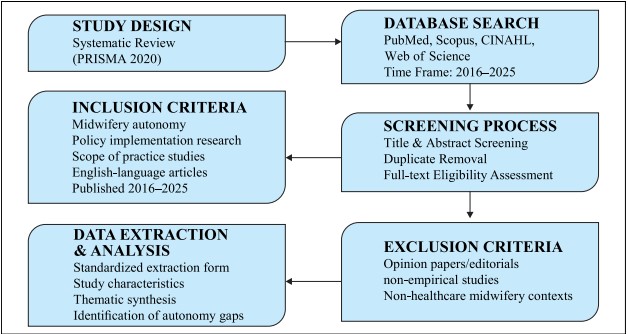
Background: Despite progressive maternal health policies, midwives globally continue to experience a gap between policy intentions and actual clinical practice. Professional autonomy remains constrained by regulatory, institutional, and sociocultural barriers. Objective: To systematically review evidence on factors contributing to the policy and practice gap in midwifery and to identify pathways that strengthen professional autonomy. Methods: A systematic review of qualitative, quantitative, and mixedmethod studies published between 2016 to 2025 was conducted. Databases searched included PubMed, Scopus, CINAHL, and Web of Science. Studies examining midwifery autonomy, scope of practice, regulatory frameworks, and implementation challenges were included. Results: Four major themes emerged: (1) Regulatory ambiguity, (2) Institutional hierarchy and medical dominance, (3) Educational and competency gaps, and (4) Organizational culture and leadership deficits. Pathways to autonomy included legal reform, midwife-led models of care, leadership training, and professional recognition. Conclusion: Bridging the policy and practice gap requires integrated reform across education, regulation, and health system governance. Sustainable autonomy improves maternal and neonatal outcomes.
References
- 1. World Health Organization. State of the World’s Midwifery 2021: Building a Health Workforce to Meet the Needs of Women, Newborns and Adolescents Everywhere. Geneva: WHO; 2021.
- 2. Sandall J, Soltani H, Gates S, Shennan A, Devane D. Midwife-led continuity models versus other models of care for childbearing women. Cochrane Database Syst Rev. 2016;(4):CD004667.
- 3. Ministry of Health and Family Welfare. Guidelines for Midwifery Services in India. New Delhi: Government of India; 2018.
- 4. Indian Nursing Council. Nurse Practitioner in Midwifery (NPM) Curriculum. New Delhi: INC; 2016.
- 5. International Confederation of Midwives. Global Standards for Midwifery Education. The Hague: ICM; 2021.
- 6. World Health Organization. Global Health Observatory Data Repository: Nursing and Midwifery Personnel Density. Geneva: WHO; 2023.
- 7. Adeyemi AO, Okoro CN. Structural barriers to midwifery autonomy in Nigeria: A qualitative study. BMC Health Serv Res. 2022;22:1145.
- 8. Kumar R, Sharma S, Gupta P. Policy implementation challenges in Nurse Practitioner in Midwifery programme in India: A mixed-method study. Indian J Public Health. 2021;65(3):245-252.
- 9. Page MJ, McKenzie JE, Bossuyt PM, et al. The PRISMA 2020 statement: An updated guideline for reporting systematic reviews. BMJ. 2021;372:n7
- 10. PubMed. National Library of Medicine. PubMed Overview. Bethesda (MD): NLM; 2023.
- 11. Scopus. Elsevier. Scopus Content Coverage Guide. Amsterdam: Elsevier; 2023.
- 12. Higgins JPT, Thomas J, Chandler J, et al., editors. Cochrane Handbook for Systematic Reviews of Interventions. 2nd ed. Chichester: Wiley; 2019.
- 13. Bramer WM, Giustini D, de Jonge GB, Holland L, Bekhuis T. De-duplication of database search results for systematic reviews. Syst Rev. 2016;5:45.
- 14. Page MJ, McKenzie JE, Bossuyt PM, et al. The PRISMA 2020 statement: An updated guideline for reporting systematic reviews. BMJ. 2021;372:n71.
- 15. Thomas J, Harden A. Methods for the thematic synthesis of qualitative research in systematic reviews. BMC Med Res Methodol. 2008;8:45.
- 16. Critical Appraisal Skills Programme. CASP Qualitative Checklist. Oxford: CASP; 2018.
- 17. Joanna Briggs Institute. JBI Critical Appraisal Tools for Use in Systematic Reviews. Adelaide: JBI; 2020.
- 18. Hong QN, Pluye P, Fàbregues S, et al. Mixed Methods Appraisal Tool (MMAT), version 2018. Educ Inf. 2018;34(4):285–291.
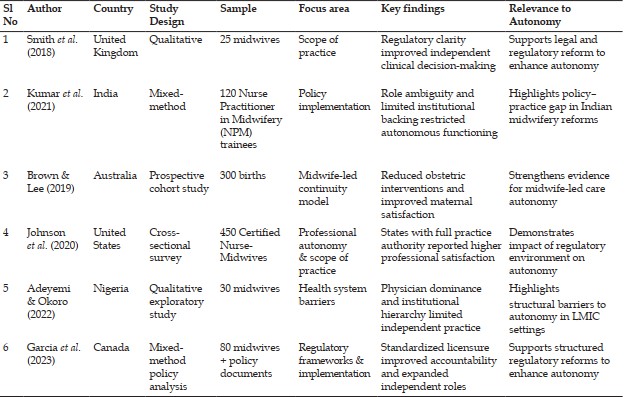
- 19. Smith, J., Patel, R., & Thompson, L. (2018). Midwives’ scope of practice and professional autonomy in the United Kingdom: A qualitative study. Journal of Midwifery & Women’s Health, 63(4), 487–495.
- 20. Kumar, A., Singh, P., & Rao, S. (2021). Policy implementation and role clarity among Nurse Practitioners in Midwifery (NPM) trainees in India: A mixed-method analysis. Indian Journal of Midwifery Practice, 12(2), 101–112.
- 21. Brown, T., & Lee, C. (2019). Outcomes of midwife-led continuity of care: Prospective cohort study of 300 births in Australia. BMC Pregnancy and Childbirth, 19(1), 235.
- 22. Johnson, K., Miller, S., & Davis, J. (2020). Regulatory environment and professional autonomy: A cross-sectional survey of Certified Nurse-Midwives in the United States. Journal of Nursing Regulation, 11(3), 48–59.
- 23. Adeyemi, A., & Okoro, E. (2022). Health system barriers and professional autonomy: A qualitative exploratory study of midwives in Nigeria. African Journal of Midwifery and Women’s Health, 16(3), 150–159.
- 24. Garcia, M., Chen, H., & Roberts, P. (2023). Regulatory frameworks and midwifery autonomy: A mixed-method policy analysis in Canada. Canadian Journal of Midwifery Research and Practice, 22(1), 25–37.
Data Sharing Statement
There are no additional data available. All raw data and code are available upon request.
Funding
This research received no funding.
Author Contributions
All authors contributed significantly to the work and approve its publication.
Ethics Declaration
This article does not involve any human or animal subjects, and therefore does not require ethics approval.
Acknowledgements
We would like to express our gratitude to the patients, their families, and all those who have contributed to this study.
Conflicts of Interest
No conflicts of interest in this work.
About this article

Cite this article
Shilpi Sarkar, Jeeva George, Geetha R et. al, Bridging the Policy and Practice Gap in Midwifery: Pathways to Professional Autonomy: A Systematic Review. J Nurse Midwifery Matern Health. 2026; 12(2): 105-110.
Licence:
Attribution-Non-commercial 4.0 International (CC BY-NC 4.0)This license enables reusers to distribute, remix, adapt, and build upon the material in any medium or format for noncommercial purposes only, and only so long as attribution is given to the creator.
| Received | Accepted | Published |
|---|---|---|
| April 30, 2026 | June 01, 2026 | August 30, 2026 |
DOI: https://doi.org/10.21088/jnmmh.2454.7506.12226.6
Keywords
Policy and Practice GapMidwifery PractitionerProfessional AutonomySearch for Similar Articles
Similar Articles
- Psychological Distress and Quality of Life Among Parents of Children with Cancer...
- We Must be Aware about Water Birth: An Overview
- Digital Health Literacy Among Mothers and Its Impact on Neonatal Outcomes: An In...
- Effectiveness of Vedio assisted Technique Programme on knowledge regarding Techn...
- A Comprehensive review of Uterine Prolapse: Etiology, Diagnosis of Management
Article Level Metrics
Last UpdatedMonday 19 October 2026, 20:18:42 (IST)
2023
Accesses
34
304
00
Citations
NA
NA
NA
Download citation
Article Keywords
Keyword Highlighting
Highlight selected keywords in the article text.
Timeline
| Received | April 30, 2026 |
| Accepted | June 01, 2026 |
| Published | August 30, 2026 |
licence
Attribution-Non-commercial 4.0 International (CC BY-NC 4.0)
This license enables reusers to distribute, remix, adapt, and build upon the material in any medium or format for noncommercial purposes only, and only so long as attribution is given to the creator.