Full Text (PDF)
Physiotherapy and Occupational Therapy Journal 17(4):p 200-206, October-December 2024. | DOI: http://dx.doi.org/10.21088/potj.0974.5777.17424.2
Original Article
Association between Foot Posture Asymmetry, Dynamic Stability, and Disability in Gujarati Adults with Primary Osteoarthritis of the Knee
Dibyendunarayan D. Bid, Gandhi Prachi Rajeshkumar, Thangamani Ramalingam Alagappan
Author Information
Licence:
Attribution-Non-commercial 4.0 International (CC BY-NC 4.0)This license enables reusers to distribute, remix, adapt, and build upon the material in any medium or format for noncommercial purposes only, and only so long as attribution is given to the creator.
Physiotherapy and Occupational Therapy Journal 17(4):p 200-206, October-December 2024. | DOI: http://dx.doi.org/10.21088/potj.0974.5777.17424.2
How Cite This Article:
Gandhi PR, Bid DD, et al. Association between foot posture asymmetry, dynamic stability, and disability in Gujarati adults with primary osteoarthritis of the knee. Physio and Occ Therapy Jr. 2024;17(4):200-206.Timeline
Received : September 09, 2024
Accepted : October 16, 2024
Published : December 24, 2024
Abstract
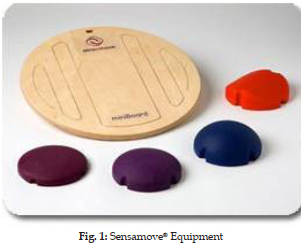
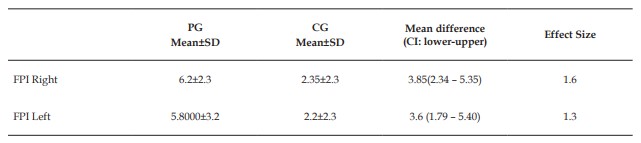
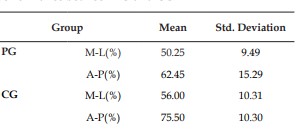
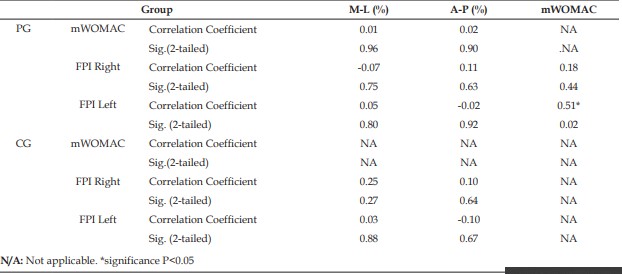
Background: Knee osteoarthritis (KOA) is a prevalent degenerative disease that significantly impairs daily functioning owing to joint instability, pain, and stiffness. Foot posture asymmetry and dynamic stability could play a role in functional disability in individuals with KOA, yet limited research has examined this relationship. Objectives: This study investigated the associations between foot posture asymmetry, dynamic stability, and disability in the Gujarati adult population with KOA compared with healthy controls. Methods and Materials: An observational study was conducted with 40 participants (20 patients with KOA and 20 healthy controls). Foot posture asymmetry was assessed using the Foot Posture Index (FPI), dynamic stability was measured with the Sense Balance MiniBoard (Sensamove, Netherlands), and functional disability was evaluated using the modified Western Ontario and McMaster Universities Osteoarthritis Index (mWOMAC). Non-parametric tests were used for group comparisons, and Spearman’s rho was used to determine correlations. Results: Patients with KOA demonstrated significantly higher FPI scores, indicating more pronated feet (mean FPI: right 6.2, left 5.8) than controls (right 2.35, left 2.2). Dynamic stability was also impaired in KOA patients, with lower mediolateral (50.25%) and anteroposterior (62.45%) stability than in controls. A positive correlation was found between foot posture asymmetry and disability (r = 0.51; p = 0.02). KOA severity correlated moderately with foot posture asymmetry (r = 0.656, p < 0.01) and strongly with disability (r = 0.80, p < 0.01). Conclusion: This study found a very weak to moderate association between foot posture asymmetry, dynamic stability, and disability in the Gujarati adult population with KOA.
References
- 1. Lawrence JS, Bremner JM, Bier F. Osteo-arthrosis. Prevalence in the population and relationship between symptoms and radiographic changes. Ann Rheum Dis. 1966; 25(1):1-24.
- 2. Kean WF, Kean R, Buchanan WW. Osteoarthritis: Symptoms, signs, and source of pain. Inflammopharmacology. 2004; 12(1):3-31.
- 3. Karimi MT, Sharifmoradi K. Static and local dynamic stability of subjects with knee joint osteoarthritis. Proceedings of the Institution of Mechanical Engineers Part H, Journal of Engineering in Medicine. 2022; 236(8):1100-5.
- 4. Ohi H, Iijima H, Aoyama T, Kaneda E, Ohi K, Abe K. Association of frontal plane knee alignment with foot posture in patients with medial knee osteoarthritis. BMC musculoskeletal disorders. 2017; 18(1):246.
- 5. Abourazzak F, Kadi N, Azzouzi H, Lazrak F, Najdi A, Nejjari C, et al. A positive association between foot posture index and medial compartment knee osteoarthritis in moroccan people. Open Rheumatol J. 2014; 8:96-9.
- 6. Al-Bayati Z, Coskun Benlidayi I, Gokcen N. Posture of the foot: Don’t keep it out of sight, out of mind in knee osteoarthritis. Gait & Posture. 2018; 66:130-4.
- 7. Resende RA, Kirkwood RN, Deluzio KJ, Hassan EA, Fonseca ST. Ipsilateral and contralateral foot pronation affect lower limb and trunk biomechanics of individuals with knee osteoarthritis during gait. Clinical Biomechanics. 2016; 34:30-7.
- 8. Buldt AK, Forghany S, Landorf KB, Levinger P, Murley GS, Menz HB. Foot posture is associated with plantar pressure during gait: A comparison of normal, planus and cavus feet. Gait & Posture. 2018; 62:235-40.
- 9. Koura GM, Elimy DA, Hamada HA, Fawaz HE, Elgendy MH, Saab IM. Impact of foot pronation on postural stability: An observational study. Journal of back and musculoskeletal rehabilitation. 2017; 30:1327-32.
- 10. Gosavi P, Kolke S, Chitre J, Shyam A, Sancheti P. Foot posture assessment in people with primary medial compartment knee osteoarthritis: An observational study. Physiotherapy - The Journal of Indian Association of Physiotherapists. 2021; 15(1):12-6.
- 11. Rokkedal-Lausch T, Lykke M, Hansen MS, Nielsen RO. Normative values for the foot posture index between right and left foot: A descriptive study. Gait & Posture. 2013; 38(4):843-6.
- 12. Nambi G, Rathod P. Translation and Validation of Gujarati Version of WOMAC and Lequesne Questionnaire in Subjects with Knee Osteoarthritis 2018. Khuman R, Chavda D, Surbala L, Bhatt U. Reliability and validity of modified western ontario and mcmaster universities osteoarthritis index gujarati version in participants with knee osteoarthritis. 2018; 12(1):8-15.
- 14. Laessoe U, Svendsen AW, Christensen MN, Rasmussen JR, Gaml AS. Evaluation of functional ankle instability assessed by an instrumented wobble board. Physical therapy in sport: official journal of the Association of Chartered Physiotherapists in Sports Medicine. 2019; 35:133-8.
- 15. Kim D, Park G, Kuo L-T, Park W. The effects of pain on quadriceps strength, joint proprioception and dynamic balance among women aged 65 to 75 years with knee osteoarthritis. BMC Geriatr. 2018; 18(1):245.
- 16. Mahmoudian A, Bruijn SM, Yakhdani HRF, Meijer OG, Verschueren SMP, van Dieen JH. Phase-dependent changes in local dynamic stability during walking in elderly with and without knee osteoarthritis. Journal of Biomechanics. 2016; 49(1):80-6.
- 17. Raizah A, Reddy RS, Alshahrani MS, Tedla JS, Dixit S, Gular K, et al. Investigating Knee Joint Proprioception and Its Impact on Limits of Stability Using Dynamic Posturography in Individuals with Bilateral Knee Osteoarthritis—A Cross-Sectional Study of Comparisons and Correlations. Journal of Clinical Medicine [Internet]. 2023; 12(8).
- 18. Reilly K, Barker K, Shamley D, Newman M, Oskrochi GR, Sandall S. The role of foot and ankle assessment of patients with lower limb osteoarthritis. Physiotherapy. 2009;95(3):164-9.
- 19. Chen Z, Shen Z, Ye X, Wu J, Wu H, Xu X. Association between Foot Posture Asymmetry and Static Stability in Patients with Knee Osteoarthritis: A Case-Control Study.
- 20. BioMed Research International. 2020; 2020:1890917. Iijima H, Ohi H, Isho T, Aoyama T, Fukutani N, Kaneda E, et al. Association of bilateral flat feet with knee pain and disability in patients with knee osteoarthritis: A cross-sectional study. Journal of Orthopedic Research. 2017; 35(11):2490-8.
- 21. Salwa F. Abd El-Mageed Pd, Aalaa M. Sweelam, M.sc., Ahmad H. Azzam Md, Ebtessam F. Gomaa, Ph.D. Effect of Pronated Foot Posture on the Arabic Version of WOMAC Index in Women with Medial Compartment Knee Osteoarthritis. The Medical Journal of Cairo University. 2018; 86(June):1111-7.
- 22. Zeng Z, Shan J, Zhang Y, Wang Y, Li C, Li J, et al. Asymmetries and relationships between muscle strength, proprioception, biomechanics, and postural stability in patients with unilateral knee osteoarthritis. Frontiers in Bioengineering and Biotechnology. 2022; 10.
Data Sharing Statement
There are no additional data available.
Funding
This research received no funding.
Author Contributions
All authors contributed significantly to the work and approve its publication.
Ethics Declaration
This article does not involve any human or animal subjects, and therefore does not require ethics approval
Acknowledgements
Information Not Provided
Conflicts of Interest
No conflicts of interest in this work.
About this article

Cite this article
Gandhi PR, Bid DD, et al. Association between foot posture asymmetry, dynamic stability, and disability in Gujarati adults with primary osteoarthritis of the knee. Physio and Occ Therapy Jr. 2024;17(4):200-206.
Licence:
Attribution-Non-commercial 4.0 International (CC BY-NC 4.0)This license enables reusers to distribute, remix, adapt, and build upon the material in any medium or format for noncommercial purposes only, and only so long as attribution is given to the creator.
| Received | Accepted | Published |
|---|---|---|
| September 09, 2024 | October 16, 2024 | December 24, 2024 |
DOI: http://dx.doi.org/10.21088/potj.0974.5777.17424.2
Keywords
Knee osteoarthritisFoot posture asymmetryDynamic stabilityDisabilityFPImWOMACThe Sense Balance MiniboardSearch for Similar Articles
Similar Articles
- Cross-Cultural Adaptation, Reliability, and Validity of the Gujarati Version of...
- Physiotherapy Management of Multiple Sclerosis: An Overview of Recent Technologi...
- Converging Technologies in Cardiopulmonary Physiotherapy: A Review of VR, AR, AI...
- Cross-Cultural Adaptation, Reliability, and Validity of the Gujarati Version of...
- Effects of Kinesiotaping in Lateral Epicondylitis: A Narrative Review
Article Level Metrics
Last UpdatedWednesday 29 July 2026, 21:46:22 (IST)
1979
Accesses
6
429
00
Citations
NA
NA
NA
Download citation
Article Keywords
Keyword Highlighting
Highlight selected keywords in the article text.
Timeline
| Received | September 09, 2024 |
| Accepted | October 16, 2024 |
| Published | December 24, 2024 |
licence
Attribution-Non-commercial 4.0 International (CC BY-NC 4.0)
This license enables reusers to distribute, remix, adapt, and build upon the material in any medium or format for noncommercial purposes only, and only so long as attribution is given to the creator.