Full Text (PDF)
Journal of Microbiology and Related Research 11(2):p 81-90, July-Dec 2025. | DOI: 10.21088/jmrr.2395.6623.11225.3
Original Article
Antibiogram of Bacterial Isolates from Critical Care Patients in Sharda Hospital: A Tertiary Care Hospital
Anshika Srivastava, Dalip K Kakru
Author Information
Licence:
Attribution-Non-commercial 4.0 International (CC BY-NC 4.0)This license enables reusers to distribute, remix, adapt, and build upon the material in any medium or format for noncommercial purposes only, and only so long as attribution is given to the creator.
Journal of Microbiology and Related Research 11(2):p 81-90, July-Dec 2025. | DOI: 10.21088/jmrr.2395.6623.11225.3
How Cite This Article:
Srivastava A, Kakru DK. Antibiogram of Bacterial Isolates from Critical Care Patients in Sharda Hospital: A Tertiary Care Hospital. J Microbiol Relat Res. 2025;11(2):81-90.Timeline
Received : May 09, 2025
Accepted : September 27, 2025
Published : December 30, 2025
Abstract
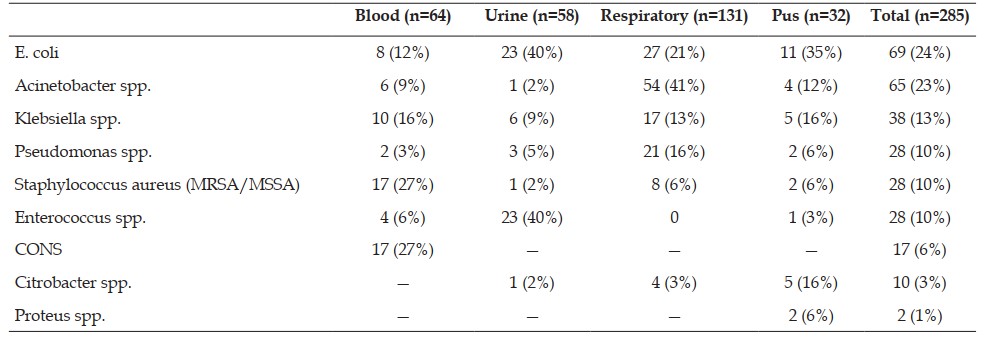
Background: Antimicrobial resistance (AMR) poses a major threat to global public health, particularly in developing nations with high infection burdens and widespread antibiotic misuse. Intensive Care Units (ICUs) are critical sites for the emergence and transmission of multidrug-resistant (MDR) organisms, with critically ill patients at increased risk due to invasive procedures and compromised immunity. ESKAPE pathogens and other Gram-negative bacteria are frequently implicated in ICU infections, complicating empirical treatment and contributing to adverse outcomes. Despite this, there is limited surveillance data on resistance trends in ICUs, especially in low and middle-income countries like India. Materials and Methods: A hospital based cross-sectional observational study was conducted over six months (October 2023-March 2024) in the Department of Microbiology, Sharda Hospital, Greater Noida. Clinical samples from ICU patients including blood, urine, respiratory secretions, and pus were processed using standard microbiological techniques. Bacterial identification involved Gram staining, colony morphology, and biochemical testing. Antimicrobial susceptibility testing (AST) was carried out using the Kirby-Bauer disc diffusion method, interpreted as per CLSI 2023 guidelines. Results: A total of 2,125 ICU samples were analyzed, including blood (46%), urine (30%), respiratory samples (20%), and pus (4%). From these, 285 clinical isolates were recovered: respiratory samples yielded the highest proportion (46%), followed by blood (23%), urine (20%), and pus (11%). The most common isolates included Klebsiella pneumoniae, Acinetobacter baumannii, Pseudomonas aeruginosa, Escherichia coli, Staphylococcus aureus, and Enterococcus spp., consistent with the global ESKAPE pathogen profile. Conclusion: The study highlights a predominance of Gram-negative organisms in ICU infections, with significant antimicrobial resistance, emphasizing the need for regular surveillance and updated antibiograms. Tailored empirical therapy based on local resistance patterns is crucial to improve patient outcomes and support antimicrobial stewardship efforts in resource-limited settings.
References
- 1. Kumar S, Adithan C, Harish BN, Sujatha S, Roy G, Malini A. Antimicrobial resistance in India: A review. [No journal details provided].
- 2. Moolchandani K, Sastry AS, Deepashree S, Mandal J. Antimicrobial Resistance Surveillance among Intensive Care Units of a Tertiary Care Hospital in Southern India. [No journal details provided].
- 3. Santajit S, Indrawattana N. Mechanisms of antimicrobial resistance in ESKAPE pathogens. Biomed Res Int. 2016;2016:2475067. doi:10.1155/2016/2475067.
- 4. Negm EM, Mowafy SMS, Mohammed AA, Amer MG, Tawfik AE, Ibrahim AES, et al. Antibiograms of intensive care units at an Egyptian tertiary care hospital. Egypt J Bronchol. 2021;15(1). doi:10.1186/s43168-021-00059-w.
- 5. Savanur SS, Gururaj H. Study of antibiotic sensitivity and resistance pattern of bacterial isolates in intensive care unit setup of a tertiary care hospital. Indian J Crit Care Med. 2019;23(12):547-555. doi:10.5005/jpjournals-10071-23295.
- 6. Jain S, Sharma V, Ahamad I, Farooq U, Singh S, Sharma SR. Study on bacteriological profile and antibiogram of bloodstream infections in patients admitted in intensive care unit. [No journal details provided].
- 7. Katyal A, Singh D, Sharma M, Chaudhary U. Bacteriological profile and antibiogram of aerobic blood culture isolates from intensive care units in a teaching tertiary care hospital. J Health Sci Res. 2018;9(1):6-10.
- 8. Deb J, Debnath S, Bhattacharya S, Majumdar T. Spectrum of bacterial isolates and their antibiogram in intensive care unit (ICU) of tertiary care hospital as a part of hospital acquired infection (HAI) surveillance. [No journal details provided].
- 9. Padmaja N. Bacteriological profile and antibiogram of bronchoalveolar lavage fluid from patients with respiratory tract infections at a tertiary care hospital. [No journal details provided].
- 10. Kursheed F, Tabassum A, Farwa U, Wazir S, Shafiq M, Sheikh AK. The antibiogram of pus cultures in federal tertiary care hospital, Islamabad and its utility in antimicrobial stewardship. Iran J Microbiol. 2024;16(1):56-61. doi:10.18502/ijm.v16i1.14871.
Data Sharing Statement
There are no additional data available.
Funding
This research received no funding.
Author Contributions
All authors contributed significantly to the work and approve its publication.
Ethics Declaration
This article does not involve any human or animal subjects, and therefore does not require ethics approval.
Acknowledgements
Information not provide.
Conflicts of Interest
The authors report no conflicts of interest in this work.
About this article

Cite this article
Srivastava A, Kakru DK. Antibiogram of Bacterial Isolates from Critical Care Patients in Sharda Hospital: A Tertiary Care Hospital. J Microbiol Relat Res. 2025;11(2):81-90.
Licence:
Attribution-Non-commercial 4.0 International (CC BY-NC 4.0)This license enables reusers to distribute, remix, adapt, and build upon the material in any medium or format for noncommercial purposes only, and only so long as attribution is given to the creator.
| Received | Accepted | Published |
|---|---|---|
| May 09, 2025 | September 27, 2025 | December 30, 2025 |
DOI: 10.21088/jmrr.2395.6623.11225.3
Keywords
AntimicrobialMultidrug ResistantEnterococcusSearch for Similar Articles
Similar Articles
- Ochrobactrum anthropi Bacteremia in Immunocompromised Patients: A Unique Threat...
- A Survey of Current Research on the Green Synthesis of Silver Nanoparticles (AgN...
- Navigating the Global Obesity a Global Catastrophe: The Role of Pancreatic Lipas...
- Phenotypic Detection of MRSA from Conventional Methods and CHROM Agar Medium in...
- Isolation of Exopolysaccharides Producing Microorganisms from Garden Soils
Article Level Metrics
Last UpdatedMonday 21 September 2026, 14:30:34 (IST)
1469
Accesses
20
188
00
Citations
NA
NA
NA
Download citation
Article Keywords
Keyword Highlighting
Highlight selected keywords in the article text.
Timeline
| Received | May 09, 2025 |
| Accepted | September 27, 2025 |
| Published | December 30, 2025 |
licence
Attribution-Non-commercial 4.0 International (CC BY-NC 4.0)
This license enables reusers to distribute, remix, adapt, and build upon the material in any medium or format for noncommercial purposes only, and only so long as attribution is given to the creator.