Full Text (PDF)
Indian Journal of Library and Information Sciences 16(2):p 91-96, May-August 2022. | DOI: https://doi.org/10.21088/ijlis.0973.9548.16222.2
Original Article
Analysis of Nuclear Medicine Research using Web of Science Database: A Global Perspective
Author Information
Licence:
Attribution-Non-commercial 4.0 International (CC BY-NC 4.0)This license enables reusers to distribute, remix, adapt, and build upon the material in any medium or format for noncommercial purposes only, and only so long as attribution is given to the creator.
Indian Journal of Library and Information Sciences 16(2):p 91-96, May-August 2022. | DOI: https://doi.org/10.21088/ijlis.0973.9548.16222.2
How Cite This Article:
N Rathika, S Thanuskodi/Analysis of Nuclear Medicine Research using Web of Science Database: A Global Perspective/Indian J Lib Inf Sci 2022;16(2):91–96.Timeline
Received : November 29, 2021
Accepted : December 30, 2021
Published : August 25, 2022
Abstract
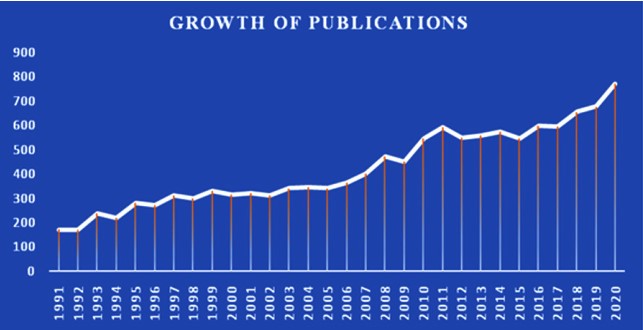
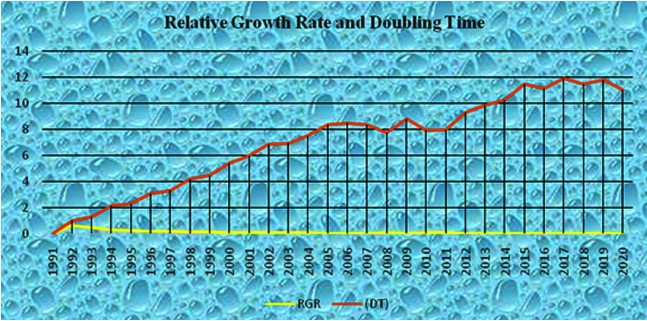
The study aimed to assess the Nuclear Medicine research output from 1991 to 2020. Totally 12632 data were mainly collected from the web of science database. These data were downloaded and analyzed by using MS Excel as per the objective of the study. The researcher has been done to discover the development and properties of large data output is the global level. The year-wise distribution of Nuclear Medicine research. The study revealed the year 2020 occupied the first position with 771 (6.10) records, followed by the year 2019 with 677(5.36) records compared to 1991 to 2020.Author-wise distribution of publication showed that Rubello, D occupied the first position with 81(0.64%) and Signore, A is the second position with 72 (0.57%) and others. In this study single author contributed 1776 (14.06) papers in this study. The relative growth rate and doubling time the growth of publications decreased trend, the corresponding doubling time was increased.
References
- 1. Ajiferuke, I., Burrel, Q. &Taque, J. (1988). Collaborative coefficient: a single measure ofcollaborationin research. Scientometrics, 14(5-6), 421.
- 2. Alagu, A., & Thanuskodi, S. (2019). Bibliometric analysis of digital Literacy research output: A global perspective. Library Philosophy and Practice, Retrieved from Scopus. Provide the url
- 3. Alonso, S., Cabrerizo, F. J., Herrera-Viedma, E. & Herrera, F. (2010).hg-index: A new indexto characterize the scientific output of researchers based on the h- and g-indices.Scientometrics,82(2), 391-400.
- 4. Badawi, R. D. (2001). Nuclear medicine. Physics education, 36(6), and 452.
- 5. Bradford, S. C. (1934). Sources of Information of Specific Subjects. Engineering, 137, 85-86. Egghe,L. (2006). Theory andpractise of the g-index. Scientometrics,69(1), 131–152.
- 6. Devi, M. (2015). Scientometric analysis of growth of literature in nuclear medicine. History, 21(74), 511-20.
- 7. Frame, J. D. (1977).Mainstream research in Latin America and the Caribbean. Interciencia,2(3),143-148.
- 8. Gupta, B. M. (2012). Hereditary Blood Disorders (HBD): A Scientometric Analysis of Publications Output from India during 2002-2011. J Blood Disorder and Transfusion, 3(4), 1-7.
- 9. https://journals.sbmu.ac.ir/aab/article/ view/13591/14318 https://www.ijlis.org/articles/a-scientometric-study-on-research-output-andliterature-growth-of-information-literacy.pdf
- 10. Kademani, B. S., Surwase, G., Sagar, A., Mohan, L., & Bhanumurthy, K. (2013).Research trends in radioactive waste management: a global perspective. International Journal of Low Radiation, 9(1), 59-94.
- 11. Rathika, N., Thanuskodi, S. and Sudhakar, K. (2020). Lotka’s Law and the Pattern of Scientific Productivity in the Marine Pollution Research. International Journal on Emerging Technologies, 11(2): 332– 341.
- 12. Rathika, N. and Thanuskodi, S. (2021) “Studies on Relative Growth Rate and Doubling Time of Publications Productivity of Nuclear Medicine Research”, Journal of Pharmaceutical Research International, 33(32A), pp. 198-211. doi: 10.9734/jpri/2021/v33i32A31732.
- 13. Santhakumar,R.,&Kaliyaperumal,K.(2014). Mapping of mobiletechnology publications: Ascien to metric approach. DESIDOC Journal of Library & Information Technology, 34 (4),298-303.
- 14. Selvi, M., & Dhanavanan, D. (2014). A scientometric study on research output and literature growth of information literacy. International Journal of Library and Information Studies, 4(4).
- 15. Suresh, N., & Thanuskodi, S. (2019). Seed technology research output: A scientometric analysis on SCOPUS database. Library Philosophy and Practice, 2019. Retrieved from Scopus.
- 16. Thanuskodi, S., & Venkatalakshmi, V. (2010). The growth and development of research on ecology in India: A bibliometric study. Library Philosophy and Practice, 2010 (MAY), 1–10. Retrieved from Scopus.
- 17. Thanuskodi, S. (2011). Bibliometric analysis of DESIDOC journal of library & information technology. In Library and Information Science in Developing Countries: Contemporary Issues (pp. 303–312). https://doi.org/10.4018/978-1-61350-335-5.ch022
- 18. Thanuskodi, S. (2011). Bibliometric analysis of the Indian Journal of Chemistry. Library Philosophy and Practice, 2011(JULY). Retrieved from Scopus.
- 19. Venkatesan, M. N., & Thanuskodi, S. (2014). Nuclear Power Generation research hasbeen seen through Scopus: A Scientometric Analysis. International journal of Digital Library Services, 4(4),146-161.
- 20. Vijayakumar, P., Sivasubramaniyan, G., & Rao, M. S. (2019). Bibliometrics Analysis of Indian Journal of Nuclear Medicine. Indian Journal of Information Sources and Services, 9(1), 122-127.
- 21. Van Raan, AFJ (1997). Scientometrics: State-of-the art. Scientometrics, 38(1), p.205-218.Web of Science.(n.d.) Retrieved December
- 22. Zang,C.T.(2009).Thee-index,complementingthehindexforexcesscitations.PLoSONE,4(5),e5429. https: //doi.org/10.1371/journal.pone.0005429
Data Sharing Statement
There are no additional data available. All raw data and code are available upon request.
Funding
This research received no funding.
Author Contributions
All authors contributed significantly to the work and approve its publication.
Ethics Declaration
This article does not involve any human or animal subjects, and therefore does not require ethics approval.
Acknowledgements
We would like to express our gratitude to the patients, their families, and all those who have contributed to this study.
Conflicts of Interest
No conflicts of interest in this work.
About this article

Cite this article
N Rathika, S Thanuskodi/Analysis of Nuclear Medicine Research using Web of Science Database: A Global Perspective/Indian J Lib Inf Sci 2022;16(2):91–96.
Licence:
Attribution-Non-commercial 4.0 International (CC BY-NC 4.0)This license enables reusers to distribute, remix, adapt, and build upon the material in any medium or format for noncommercial purposes only, and only so long as attribution is given to the creator.
| Received | Accepted | Published |
|---|---|---|
| November 29, 2021 | December 30, 2021 | August 25, 2022 |
DOI: https://doi.org/10.21088/ijlis.0973.9548.16222.2
Keywords
ScientometricsNuclear MedicineWeb of ScienceAuthorship patternRelative Growth Rate and Doubling TimeSearch for Similar Articles
Similar Articles
- Scientometric Portrait of Dr. Anil Kumar Dhiman, an Information Scientist-Part I...
- A Study on Humanities Students’ Literacy Skills at Alagappa University in Using...
- Awareness and Utilization of Artificial Intelligence Tools (ChatGPT) among Stude...
- Global Trends on Artificial Intelligence in Science Research: A Scientometric Ob...
- Information Needs of Persons with Visual Impairments: A Socioeconomic Analysis
Article Level Metrics
Last UpdatedThursday 10 September 2026, 03:57:02 (IST)
3922
Accesses
14
738
00
Citations
NA
NA
NA
Download citation
Article Keywords
Keyword Highlighting
Highlight selected keywords in the article text.
Timeline
| Received | November 29, 2021 |
| Accepted | December 30, 2021 |
| Published | August 25, 2022 |
licence
Attribution-Non-commercial 4.0 International (CC BY-NC 4.0)
This license enables reusers to distribute, remix, adapt, and build upon the material in any medium or format for noncommercial purposes only, and only so long as attribution is given to the creator.