Full Text (PDF)
Indian Journal of Genetics and Molecular Research 14(2):p 67-69, July-Dec 2025. | DOI: https://doi.org/10.21088/ijgmr.2319.4782.14225.3
Case Report
A Rare Case of Chromosomal Disorder Wolf–Hirschhorn Syndrome at Teritary Care Centre
Author Information
Licence:
Attribution-Non-commercial 4.0 International (CC BY-NC 4.0)This license enables reusers to distribute, remix, adapt, and build upon the material in any medium or format for noncommercial purposes only, and only so long as attribution is given to the creator.
Indian Journal of Genetics and Molecular Research 14(2):p 67-69, July-Dec 2025. | DOI: https://doi.org/10.21088/ijgmr.2319.4782.14225.3
How Cite This Article:
Sinha MB. A rare case of chromosomal disorder Wolf–Hirschhorn syndrome at tertiary care centre. Ind J Genet Mol Res. 2025;14(2):67-69.Timeline
Received : July 21, 2025
Accepted : September 05, 2025
Published : December 28, 2025
Abstract
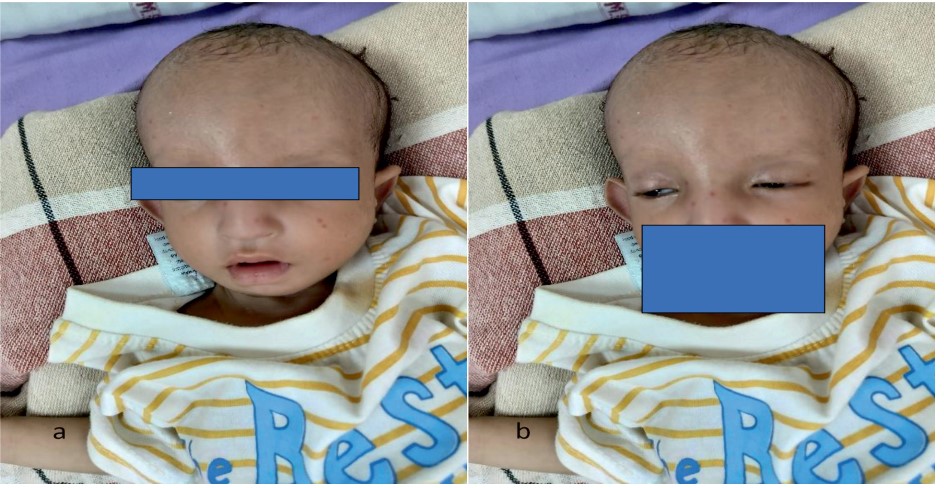
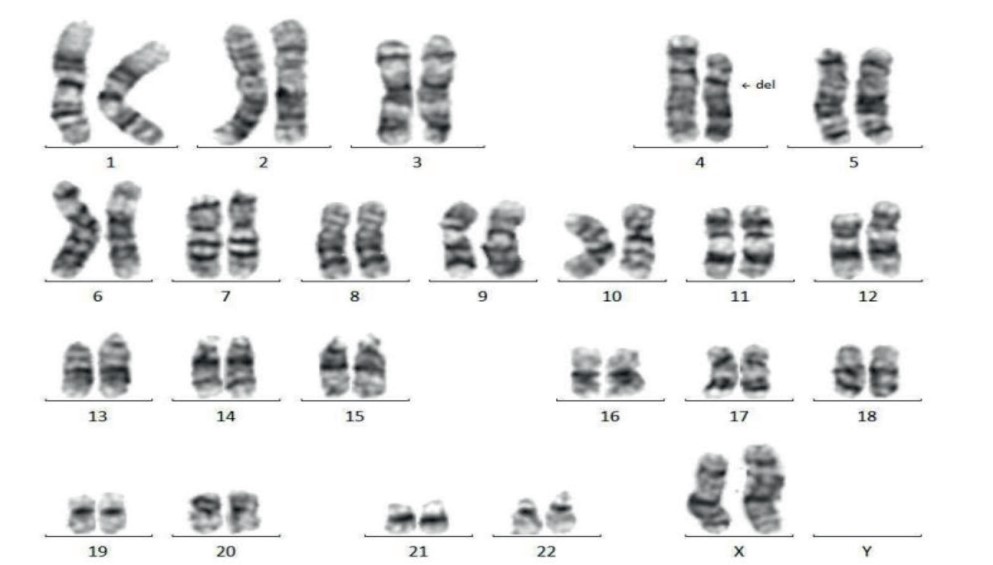
Background: A rare chromosomal anomaly, Wolf–Hirschhorn syndrome (WHS), which results from the deletion of 4p (4p). Case: The case was identified at AIIMS Raipur, Chhattisgarh. The diagnostic findings included a “Greek warrior helmet” appearance of the head, ptosis, and a flat nasal bridge. Discussion: We reported patients with submicroscopic deletions at 4p16.3. In the current case, the diagnosis was on the basis of karyotype and clinical features. Our results showed the importance of testing with the conventional karyotype.
References
- 1. Battaglia, A., A. Lortz, and J.C. Carey, Natural history study of adults with Wolf–Hirschhorn syndrome 1: Case series of personally observed 35 individuals. American Journal of Medical Genetics Part A, 2021. 185(6): p. 1794-1802.
- 2. Lurie, I.W., et al., The Wolf-Hirschhorn syndrome. I. Genetics. Clin Genet, 1980. 17(6): p. 375-84.
- 3. Maas NM, Van Buggenhout G, Hannes F, Thienpont B, Sanlaville D, Kok K, Midro A, Andrieux J, Anderlid BM, Schoumans J, Hordijk R, Devriendt K, Fryns JP, Vermeesch JR. Genotype-phenotype correlation in 21 patients with Wolf-Hirschhorn syndrome using high resolution array comparative genome hybridisation (CGH). J Med Genet, 2008. 45(2): p. 71-80.
- 4. Rjiba K, Ayech H, Kraiem O, Slimani W, Jelloul A, Ben Hadj Hmida I, et al. Disorders of sexdevelopment in Wolf-Hirschhorn syndrome: a genotype-phenotype correlation and MSX1 ascandidate gene. Mol Cytogenet. 2021;14(1):12.
- 5. Nieminen P, Kotilainen J, Aalto Y, Knuutila S, Pirinen S, Thesleff I. MSX1 gene is deleted in Wolf-Hirschhorn syndrome patients with oligodontia. J Dent Res. 2003;82(12):1013–7.
- 6. Battaglia, A., et al., Spectrum of epilepsy and electroencephalogram patterns in WolfHirschhorn syndrome: experience with 87 patients. Dev Med Child Neurol, 2009. 51(5): p. 373-80.
- 7. Filli I, Yatim H, Abdelilah R, Abilkacem R, Agard A.Wolf-Hirschhorn syndrome revealed by status epilepticus: A case report.
- 8. Venegas-Vega CA, Fernández-Ramírez F, Zepeda LM, Nieto-Martínez K, GómezLaguna L, Garduño-Zarazúa LM, Berumen J, Kofman S, Cervantes A. Diagnosis of familial Wolf-Hirschhorn syndrome due to a paternal cryptic chromosomal rearrangement by conventional and molecular cytogenetic techniques. Biomed Res Int. 2013;2013:209204. doi: 10.1155/2013/209204. Epub 2013 Feb 3. PMID: 23484094; PMCID: PMC3581116.
Data Sharing Statement
There are no additional data available. All raw data and code are available upon request.
Funding
This research received no funding.
Author Contributions
All authors contributed significantly to the work and approve its publication.
Ethics Declaration
Yes
Acknowledgements
We would like to express our gratitude to the patients, their families, and all those who have contributed to this study
Conflicts of Interest
No conflicts of interest in this work.
About this article

Cite this article
Sinha MB. A rare case of chromosomal disorder Wolf–Hirschhorn syndrome at tertiary care centre. Ind J Genet Mol Res. 2025;14(2):67-69.
Licence:
Attribution-Non-commercial 4.0 International (CC BY-NC 4.0)This license enables reusers to distribute, remix, adapt, and build upon the material in any medium or format for noncommercial purposes only, and only so long as attribution is given to the creator.
| Received | Accepted | Published |
|---|---|---|
| July 21, 2025 | September 05, 2025 | December 28, 2025 |
DOI: https://doi.org/10.21088/ijgmr.2319.4782.14225.3
Keywords
KaryotypeWolf–Wolf-Hirschhorn SyndromePtosisMicrognathiaSearch for Similar Articles
Similar Articles
- Success After Unexplained Multiple Miscarriages using PGT-A and PGT-M for RELN G...
- A Translational Strategy to Overcome Platinum Resistance in Ovarian Cancer via...
- Bridging Classic Cytogenetics with Modern Chromosomics: A Historical and Scienti...
- Mitochondrial D-Loop and HBB Gene Profiling in Antenatal Hemoglobinopathy Carrie...
- Histopathologic Features of High Grade Serous Ovarian Carcinomas Associated with...
Article Level Metrics
Last UpdatedMonday 24 August 2026, 13:19:42 (IST)
1453
Accesses
22
316
00
Citations
NA
NA
NA
Download citation
Article Keywords
Keyword Highlighting
Highlight selected keywords in the article text.
Timeline
| Received | July 21, 2025 |
| Accepted | September 05, 2025 |
| Published | December 28, 2025 |
licence
Attribution-Non-commercial 4.0 International (CC BY-NC 4.0)
This license enables reusers to distribute, remix, adapt, and build upon the material in any medium or format for noncommercial purposes only, and only so long as attribution is given to the creator.